
Category: AI Strategy

Strategic guidance for enterprise AI adoption and measurement

  • The AI Visibility Audit: What You Can’t See Is Costing You

    The AI Visibility Audit: What You Can’t See Is Costing You

    The CIO of a mid-market financial services firm thought she had a handle on AI adoption. Her team had sanctioned three tools, trained 200 employees, and built a governance policy around them. Then she ran an AI visibility audit. The audit found 23 AI tools running across the organization — seven times what she expected. Customer service had adopted a chatbot through a free trial. Marketing was using three different content generators. Two engineering teams were running code assistants that had never been security-reviewed. And an entire business unit had been piping client data through an AI summarization tool that stored data on external servers.

    She’s not unusual. According to the Torii 2026 Benchmark Report, 84% of organizations consistently discover more AI tools than expected during audits. And 31% find new unsanctioned tools every single month.

    This is the SEE problem — the first and most foundational step in the SEE, MEASURE, DECIDE, ACT framework for proving AI ROI. (This is the first of four companion deep-dives — see also MEASURE, DECIDE, and ACT.). You cannot measure what you cannot see. And in most enterprises today, the AI landscape is far larger, more fragmented, and more exposed than anyone in the C-suite realizes.

    The Visibility Crisis by the Numbers

    The scale of unsanctioned AI usage has grown faster than most security and IT teams anticipated. A 2025 UpGuard study found that more than 80% of workers — including nearly 90% of security professionals — use unapproved AI tools on the job. That last part bears repeating: the people responsible for protecting the organization are themselves using tools that haven’t been vetted.

    Deloitte’s 2026 State of AI survey tells the supply side of this story. Workforce access to AI tools expanded by 50% in a single year, from fewer than 40% of employees to roughly 60%. But that figure only counts sanctioned tools. The actual adoption rate — including shadow AI — is far higher. Research from Portal26 found that 73.8% of ChatGPT accounts used in the workplace are non-corporate accounts that lack enterprise security and privacy controls. For Gemini, that figure is 94.4%.

    The result is an AI ecosystem that leadership cannot see, security cannot govern, and finance cannot account for. Only 38% of organizations report knowing which AI applications their employees actually use.

    What Invisibility Actually Costs

    The cost of this visibility gap isn’t hypothetical. IBM’s 2025 Cost of a Data Breach report found that breaches involving shadow AI add $670,000 to the average breach cost compared to organizations with low or no shadow AI exposure. The average organization now experiences 223 AI-related data security incidents per month — incidents that range from sensitive data shared with external AI services to policy violations that create compliance exposure.

    But security costs are only one dimension. Hitachi Vantara research estimates that data infrastructure issues — many driven by ungoverned AI tooling — contribute to $108 billion in wasted annual AI spend across enterprises. When teams adopt AI tools independently, they duplicate capabilities, fragment data flows, and create redundant infrastructure costs that nobody tracks because nobody can see the full picture.

    Then there’s the opportunity cost. If you don’t know what AI your organization is running, you cannot measure whether it’s working. You cannot identify which tools deliver value and which ones burn budget. You cannot rationalize spending, consolidate licenses, or negotiate enterprise agreements. And you cannot answer the one question the board increasingly cares about — what’s the return on our AI investment — because you don’t even know what the investment includes.

    Why Traditional Discovery Fails

    Most IT organizations approach AI discovery the same way they approach software asset management: check the procurement records, run a network scan, send out a survey. None of these methods work for AI.

    Procurement records miss AI tools that employees adopt through free tiers, browser extensions, or personal accounts. Network scans miss browser-based AI tools that look like regular web traffic. Surveys depend on employees self-reporting usage they may not think of as “AI” — or usage they know isn’t sanctioned and don’t want to disclose.

    The deeper problem is velocity. Employees adopt new AI tools faster than security teams can evaluate them. Eighty-three percent of organizations report that employees install AI tools faster than security can track, according to industry surveys. A quarterly discovery audit is fundamentally mismatched against a weekly adoption cycle.

    And the challenge is getting more complex, not simpler. Embedded AI features — AI capabilities built into tools employees already use, like email clients, CRM platforms, and productivity suites — fly under the radar entirely. An employee isn’t “adopting a new AI tool” when their email client adds AI-powered reply suggestions. But the data exposure risk is real, and the cost shows up in per-seat licensing increases that finance sees but can’t attribute.

    What a Real AI Visibility Audit Looks Like

    A proper AI visibility audit goes beyond inventory. It answers four questions that are prerequisites to everything else in the AI ROI playbook:

    What AI is running? A complete catalog of AI tools, models, and capabilities across the organization — including assistive AI (copilots, chatbots, content generators), agentic AI (autonomous agents executing workflows), and embedded AI (features within existing software). This isn’t a one-time list. It’s a continuously updated inventory that captures new tools as they appear.

    Who is using it? Usage patterns by team, department, role, and individual. Not to police employees, but to understand where AI adoption is concentrated, where training gaps exist, and where usage patterns suggest risk or opportunity. If 60% of your customer success team uses an AI tool daily but 5% of your sales team does, that’s a signal worth understanding.

    What data is it touching? The critical question from both a security and compliance perspective. Which AI tools have access to customer data, financial records, intellectual property, or regulated information? Are employees sharing sensitive data with external AI services? The shadow AI risk isn’t just that unauthorized tools exist — it’s that unauthorized tools often handle the most sensitive data, because employees turn to AI precisely when they’re working with complex, high-value information.

    What is it costing? The total cost of AI across the organization, including sanctioned licenses, API consumption, infrastructure, and the hidden costs of shadow AI — duplicate tools, wasted capacity, and the remediation costs when things go wrong. Until you can see the full cost picture, you cannot calculate ROI.

    From Visibility to Value

    The SEE step isn’t an end in itself. It’s the foundation that makes everything else possible. Once you have visibility into your AI ecosystem, you can move to MEASURE — connecting AI activity to business outcomes. You can identify which tools are delivering value and which are creating risk. You can rationalize spending, consolidate tooling, and negotiate from a position of knowledge rather than ignorance.

    The enterprises that close the AI revenue gap — the 20% who prove AI drives results, according to Deloitte’s 2026 survey — start here. Not with measurement. Not with governance. With visibility. Because every dollar of AI ROI you can prove is built on a foundation of knowing what AI you have, who’s using it, what data it touches, and what it costs.

    The visibility audit typically reveals three immediate value opportunities: tool consolidation (reducing redundant AI spending by 20-30%), risk reduction (identifying unvetted tools handling sensitive data), and measurement readiness (instrumenting high-value AI workflows for ROI tracking). Most enterprises find that the audit pays for itself through spend rationalization alone.

    Ready to see what AI is actually running across your organization? Talk to an expert and we’ll show you how Olakai provides unified visibility across your entire AI ecosystem — sanctioned and shadow, assistive and agentic.

  • The Enterprise AI ROI Playbook: See, Measure, Decide, Act

    The Enterprise AI ROI Playbook: See, Measure, Decide, Act

    Half of CEOs believe their jobs are on the line if AI doesn’t pay off. Yet according to BCG’s AI Radar 2026 survey, 90% of chief executives believe agentic AI will deliver measurable ROI this year. That’s a remarkable level of conviction given what the data actually shows: IBM found that only 29% of executives can confidently measure their AI returns, and just 16% have scaled AI initiatives enterprise-wide.

    The confidence is there. The measurement capability is not. And that gap — between what leaders believe AI can do and what they can prove it has done — is where budgets get cut, pilots stall, and competitors pull ahead.

    This is why we built the SEE, MEASURE, DECIDE, ACT playbook — a four-step framework that takes enterprises from “we think AI is working” to “here’s exactly what it’s worth.” It’s the same methodology we use with every enterprise we work with, and the same framework that separates the 20% of organizations seeing real revenue impact from AI from the 74% who want it but can’t prove it.

    The Playbook Gap

    Deloitte’s 2026 State of AI survey captured the problem in a single data point: 74% of enterprises say they want AI to drive revenue growth. Only 20% have achieved it. That’s 3,235 business leaders across 24 countries essentially saying the same thing — we’re investing heavily, but we can’t connect the investment to results.

    The issue isn’t the technology. AI models are more capable than ever. The issue is that most enterprises lack a systematic approach to proving value. They launch pilots without defining what success looks like. They measure activity (tokens processed, queries handled) instead of outcomes (revenue influenced, costs avoided). And when the CFO asks “what’s our return?”, the answer is a shrug wrapped in a slide deck full of usage charts.

    BCG found that companies plan to double their AI spending in 2026, pushing AI investment to roughly 1.7% of total revenues. CEOs are committing more than 30% of their AI budgets specifically to agentic AI. The money is flowing. But without a measurement playbook, most of it flows into a black box.

    Step 1: SEE — Map Your AI Ecosystem

    You can’t measure what you can’t see. And in most enterprises, the AI landscape is far more sprawling than leadership realizes.

    Workforce access to AI tools expanded by 50% in just one year, according to Deloitte — from fewer than 40% of workers to roughly 60% now equipped with sanctioned AI tools. That’s just the sanctioned ones. Factor in the tools employees adopt on their own — the shadow AI that bypasses procurement and IT review — and the real number is significantly higher.

    The SEE step is an AI visibility audit. It answers three questions: What AI tools and models are running across the organization? Who is using them? And what data are they touching? This isn’t a one-time inventory. It’s an ongoing discovery process, because AI adoption in enterprises is a moving target — new tools appear weekly, usage patterns shift monthly, and the risk surface evolves with every new integration.

    Most enterprises discover during this step that they have three to five times more AI touchpoints than they thought. Customer service teams running chatbots that marketing doesn’t know about. Engineering teams experimenting with code assistants that security hasn’t reviewed. Sales teams piping prospect data through AI tools that legal hasn’t vetted. Until you see the full picture, every other step in this playbook is built on incomplete information.

    Step 2: MEASURE — Connect Activity to Business Outcomes

    Once you can see what’s running, the next step is measuring what matters. And “what matters” is almost never what teams measure first.

    The natural instinct is to track operational metrics: response time, tokens consumed, uptime, error rates. These are useful for engineering but meaningless to the CFO. The measurement step connects AI activity to the business KPIs that drive budget decisions — revenue influenced, costs reduced, risk mitigated, time recovered.

    This is where most enterprises stall. IBM’s research found that while 79% of organizations see productivity gains from AI, only 29% can measure ROI confidently. The productivity is real but unquantified. A customer success agent saves each rep 45 minutes per day — but nobody has connected that time savings to the additional accounts each rep can now manage, or the churn reduction that comes from faster response times.

    Effective AI measurement requires three elements. First, a baseline: what was the metric before AI? Without a counterfactual, you’re reporting output, not impact. Second, attribution: which portion of the improvement is actually due to AI versus other factors? Third, a time horizon that matches the business cycle. An AI agent that qualifies leads doesn’t show revenue impact in week one. It shows impact when those leads close, which in enterprise B2B might be 90 days later.

    The 20% of enterprises that prove AI revenue impact aren’t using more sophisticated models. They’re using more sophisticated measurement. They define the success KPI before deployment, not after. They instrument their AI systems to capture business outcomes, not just technical telemetry. And they present results in the language the CFO speaks — dollars, not tokens.

    Step 3: DECIDE — Turn Data Into Scaling Decisions

    Measurement without decision-making is just reporting. The DECIDE step uses the data from MEASURE to answer the questions that actually move AI forward in an organization: Which pilots get promoted to production? Which get sunset? Where should the next investment go?

    This is where the 30-to-45-day structured pilot becomes critical. Rather than running open-ended experiments that drift for months, a time-boxed pilot with predefined KPIs produces a clear decision point. At the end of 30 days, you have data. Not opinions, not anecdotes — data that shows whether the AI investment is generating the business outcome you defined in the MEASURE step.

    The enterprises stuck in pilot purgatory almost always lack this decision framework. They have pilots running for six, nine, twelve months with no clear criteria for what constitutes success or failure. The result is the worst possible outcome: continued investment without conviction, where the AI initiative is too expensive to ignore and too poorly measured to champion.

    A proper DECIDE framework answers four questions with data: Is the AI system delivering the outcome KPI we defined? Is the cost-to-value ratio favorable? Can the governance and risk profile support scaling? And does the organization have the operational readiness to absorb the change?

    Google Cloud’s research found that top-performing enterprises generate $10.30 in value for every dollar invested in AI, while the average is $3.70. The difference isn’t luck. It’s disciplined decision-making about which investments to scale and which to cut — and that discipline is only possible with measurement data.

    Step 4: ACT — Scale With Confidence

    The final step is where measurement pays off: scaling the AI investments that prove their value while governing the entire portfolio continuously.

    Deloitte found that 25% of organizations now report AI having a “transformative” effect — up from just 12% a year ago. These are the enterprises that have moved through SEE, MEASURE, and DECIDE, and are now deploying AI at scale with the data to back every decision. They’re not guessing which use cases deserve investment. They know, because they measured.

    But scaling introduces new challenges that require continuous measurement. An AI agent that performs well with 100 users may behave differently with 10,000. Cost structures change at scale. Risk profiles shift as AI touches more sensitive data and higher-stakes decisions. The ACT step isn’t a one-time event — it’s an ongoing cycle of deploying, measuring, governing, and optimizing.

    This is where governance and measurement converge. The enterprises with the strongest ROI data are also the ones with the most rigorous governance frameworks. Not because governance is a checkbox exercise, but because governance forces the discipline that measurement requires: defining what AI is allowed to do, instrumenting how it performs, and maintaining the accountability structures that ensure continuous improvement.

    BCG reports that 72% of CEOs are now the primary decision-makers on AI, double the share from a year ago. These executives don’t want dashboards full of technical metrics. They want a portfolio view: which AI investments are generating returns, which ones need intervention, and where the next opportunity lies. The SEE, MEASURE, DECIDE, ACT framework gives them exactly that.

    Building Your Playbook

    The 74-to-20 gap Deloitte identified isn’t permanent. But it won’t close on its own. It closes when enterprises stop treating AI measurement as an afterthought and start treating it as the foundation of every AI initiative.

    Start with SEE: audit your AI ecosystem. You’ll likely find more than you expected. Move to MEASURE: define the business outcomes that matter and instrument your AI systems to capture them. Progress to DECIDE: use 30-day structured pilots to generate decision-quality data. And then ACT: scale what works, govern what runs, and keep measuring.

    The enterprises in the 20% didn’t get there with better AI. They got there with better measurement. The playbook isn’t complicated. The hard part is committing to it before the CFO asks the question you can’t answer. Our AI ROI measurement framework breaks down the methodology step by step, and Future of Agentic’s KPI library offers specific metrics by use case to get you started.

    Ready to build your AI ROI playbook? Talk to an expert and we’ll show you how enterprises are turning AI activity into measurable business outcomes.

  • AI Pilot to Production: Why Measurement Is the Decisive Factor

    AI Pilot to Production: Why Measurement Is the Decisive Factor

    When JPMorgan Chase launched its LLM Suite platform in summer 2024, something unusual happened: within eight months, 200,000 employees were using it daily. No mandate. No compliance requirement. Just organic adoption at a scale that most enterprises can only dream about.

    Meanwhile, at most other organizations, a very different story was playing out. MIT’s 2025 “GenAI Divide” report, based on 150 executive interviews and 300 public AI deployments, found that 95% of generative AI pilots fail to deliver rapid revenue acceleration. Not 50%. Not even 80%. Ninety-five percent.

    The gap between JPMorgan and everyone else isn’t about technology, talent, or even budget. It’s about something far more fundamental: whether you can prove your AI is working.

    The Measurement Gap Is the Real Pilot Killer

    Enterprise AI has an accountability problem. Organizations are spending aggressively — global generative AI investment tripled to roughly $37 billion in 2025 — but most cannot answer a simple question: What’s the ROI on our AI?

    The numbers tell a stark story. McKinsey’s State of AI 2025 report found that 88% of organizations now use AI regularly in at least one business function. Yet only 6% qualify as “AI high performers” who can attribute more than 5% of total EBIT to AI. The other 82% are running AI, but they cannot connect it to business results.

    Deloitte’s State of AI in the Enterprise 2026 survey — covering 3,000 director-to-C-suite leaders across 24 countries — revealed what might be the most telling statistic of all: 74% of organizations want AI to grow revenue, but only 20% have actually seen it happen. That’s not a technology gap. That’s a measurement gap.

    Why “Pilot Purgatory” Is Getting Worse, Not Better

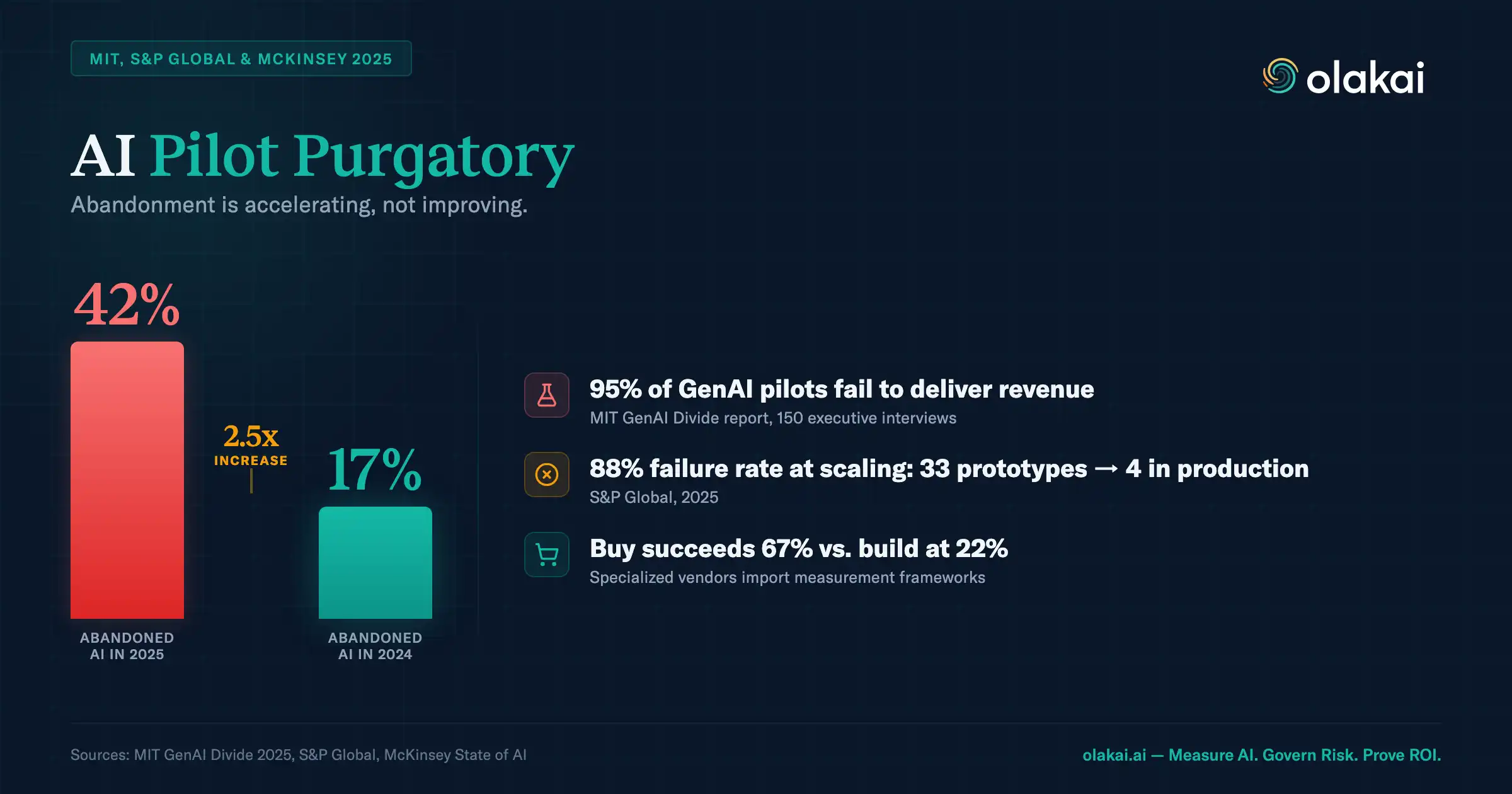
    You might expect the pilot-to-production problem to improve as AI matures. It’s not. S&P Global data shows that 42% of companies abandoned most of their AI initiatives in 2025, more than double the 17% abandonment rate just one year earlier. The average enterprise scrapped 46% of AI pilots before they ever reached production — a pattern we first explored in From AI Experimentation to Business Impact. For every 33 prototypes built, only 4 made it into production — an 88% failure rate at the scaling stage.

    The pattern is consistent: organizations launch pilots with enthusiasm, run them for three to six months, then struggle to justify continued investment. Without baseline metrics established before deployment, there’s no way to quantify what AI actually changed. Our AI ROI measurement framework provides the methodology for establishing those baselines and tracking outcomes. Without ongoing measurement, there’s no way to distinguish a successful pilot from an expensive experiment. And without clear ROI data, there’s no executive willing to sign off on scaling.

    Gartner reinforced this trajectory in June 2025, predicting that over 40% of agentic AI projects will be canceled by the end of 2027, citing three drivers: escalating costs, unclear business value, and inadequate risk controls. The emphasis on “unclear business value” is telling — it’s not that the AI doesn’t work, it’s that nobody built the infrastructure to prove that it does.

    AI Pilot Purgatory — 42% of companies abandoned AI in 2025 vs. 17% in 2024, with findings from MIT, S&P Global, and McKinsey

    What the 5% Do Differently

    The companies that successfully move AI from pilot to production share a pattern that has nothing to do with having better models or bigger datasets. They build measurement into the process from day one.

    JPMorgan didn’t just deploy AI — they tracked adoption rates, time savings, and productivity gains from the first week. Their AI benefits are growing 30-40% annually, and they know this because they measure it. Walmart didn’t just experiment with AI in their supply chain — they documented that route optimization eliminated 30 million unnecessary delivery miles and avoided 94 million pounds of CO2 emissions. Their customer service AI cut problem resolution times by 40%, a number they can report because they established baselines before deployment.

    This is the pattern MIT’s research confirmed across hundreds of deployments: the companies that scale AI successfully are the ones that treat measurement as infrastructure, not an afterthought. They know which processes AI is accelerating, by how much, and at what cost. They can calculate the total cost of ownership — including the API costs, engineering time, and maintenance burden that most organizations bury in IT budgets. And they can present executives with a clear picture: here’s what AI costs, here’s what it delivers, and here’s why scaling it makes financial sense.

    The Four Phases of Scaling (and Where Most Organizations Get Stuck)

    Successfully moving AI from pilot to production typically follows four phases, each gated by measurement milestones rather than arbitrary timelines.

    Phase 1: Validate value (weeks 1-4). Deploy the AI solution with a small group and establish clear baselines. What does the process look like without AI? How long does it take? What does it cost? What’s the error rate? Without these pre-AI measurements, you’ll never be able to quantify impact. Most organizations skip this step entirely and then wonder why they can’t prove ROI six months later.

    Phase 2: Harden for production (weeks 5-10). Once you have evidence that the AI delivers measurable value, build the governance and monitoring infrastructure needed for scale. This means policy enforcement, access controls, audit trails, and cost tracking. It also means ensuring someone owns ongoing operations — not as a side project, but as a defined responsibility.

    Phase 3: Controlled expansion (weeks 11-16). Roll out to a broader group while continuing to measure. Are the gains from Phase 1 holding at scale? Are costs scaling linearly or exponentially? Are new user segments finding different use cases? This phase is where many organizations discover that their pilot’s curated dataset doesn’t translate to messy real-world data — Gartner found that data quality issues derail 85% of AI projects at this stage.

    Phase 4: Full deployment and continuous optimization. With validated ROI data from the first three phases, you have the evidence to justify enterprise-wide investment. But the measurement doesn’t stop — it shifts from proving value to optimizing it. Which teams are getting the most benefit? Where are costs disproportionate to returns? What new use cases are emerging?

    The organizations that stall are almost always stuck between Phase 1 and Phase 2. They ran a pilot, it “seemed to work,” but they never established the baselines or tracking needed to prove it. So the pilot sits in limbo — too promising to kill, too unproven to scale.

    Buy vs. Build: A Measurement Shortcut

    MIT’s research uncovered a surprising finding about the build-versus-buy decision. Purchasing AI tools from specialized vendors and building partnerships succeeds roughly 67% of the time, while internal builds succeed only about 22% of the time. Our analysis of 100+ AI agent deployments confirms this pattern. The gap is striking, and measurement is a significant part of the explanation.

    Specialized vendors have already solved the measurement problem for their specific domain. They’ve established the benchmarks, built the tracking, and validated the ROI across hundreds of customers. When an enterprise buys rather than builds, they’re importing not just the technology but the measurement framework that proves it works.

    Internal builds, by contrast, require organizations to solve two problems simultaneously: making the AI work and building the infrastructure to prove it works. Most teams focus entirely on the first problem and neglect the second.

    From Science Experiment to Business Case

    Harvard Business Review captured the core challenge in November 2025: “Most AI initiatives fail not because the models are weak, but because organizations aren’t built to sustain them.” Their five-part framework for scaling AI emphasizes that the bottleneck is organizational, not technical — and at the center of every organizational bottleneck is the inability to prove value.

    The path from pilot to production isn’t about better technology. It’s about building the measurement infrastructure that turns an AI experiment into a business case. That means establishing baselines before deployment, tracking outcomes continuously, calculating total cost of ownership honestly, and presenting results in terms executives care about: revenue impact, cost reduction, risk mitigation, and time to value.

    Without that measurement layer, every AI pilot is a science experiment. And enterprises don’t scale science experiments — they scale proven investments.

    Ready to move your AI from pilot to production? Talk to an expert to see how Olakai helps enterprises measure AI ROI, govern risk, and scale what works across every AI tool and team.

  • Voice AI in the Enterprise: From Call Centers to Revenue Impact

    Voice AI in the Enterprise: From Call Centers to Revenue Impact

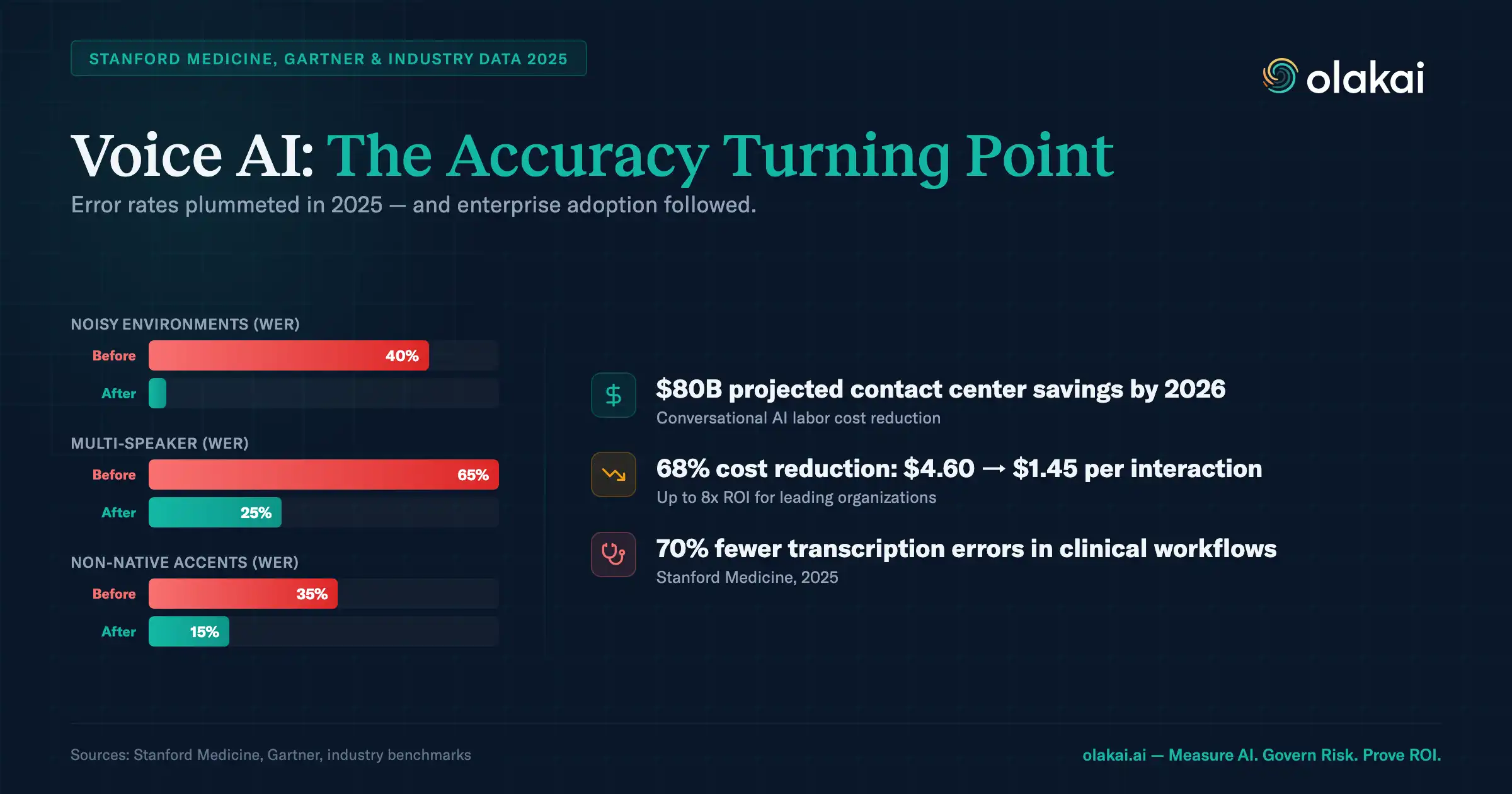
    Conversational AI is projected to save $80 billion in contact center labor costs by 2026. That number is staggering — but it also tells a narrow story. Most enterprises still think of voice AI as a call deflection tool: something that answers the phone so a human doesn’t have to. That framing misses what’s actually happening.

    Voice AI has quietly become one of the most versatile technologies in the enterprise stack. It’s writing medical notes in real time. It’s scoring sales calls for sentiment and coaching reps mid-conversation. It’s authenticating banking customers by analyzing 100 vocal traits in under a second. And the economics are compelling: companies implementing voice AI in customer support are seeing 68% reductions in cost per interaction, from $4.60 to $1.45 on average, with leading organizations reporting ROI as high as 8x their initial investment.

    The question for enterprise leaders isn’t whether voice AI works — it’s whether they can measure, govern, and scale it responsibly across every department that’s already experimenting with it.

    The Accuracy Turning Point

    For years, accuracy held voice AI back. Anyone who has shouted “REPRESENTATIVE” into a phone tree understands the frustration. But 2025 marked a genuine inflection point. Word error rates in noisy environments — the kind you’d encounter in a hospital, a factory floor, or a busy sales bullpen — dropped from over 40% to near zero. Recognition of non-native accents improved from 35% WER to 15%. Multi-speaker scenarios went from “largely unusable” at 65% WER to “practically viable” at 25%.

    These aren’t incremental improvements. They’re the difference between a technology that frustrates users and one that earns their trust. Healthcare saw it first: specialized speech models now produce 70% fewer transcription errors in clinical workflows, according to Stanford Medicine research. Meanwhile, latency has dropped to the natural conversational rhythm of 500 milliseconds — fast enough that talking to an AI agent no longer feels like talking to a machine.

    This accuracy revolution explains why 80% of businesses plan to integrate AI-driven voice technology into customer service by 2026, and why the voice AI agent market is on track to grow from $2.4 billion to $47.5 billion over the next decade.

    Voice AI Accuracy Turning Point — word error rates plummeted in 2025 with $80B projected savings and 68% cost reduction per interaction

    Beyond the Call Center

    The real story of enterprise voice AI isn’t about replacing call center agents. It’s about what happens when voice becomes a data layer across your organization.

    In healthcare, ambient listening technology is quietly transforming clinical documentation. AI scribe systems listen to patient-provider conversations and automatically generate structured SOAP notes that sync directly with electronic health records. A 2025 study published in JAMA Network Open found that clinicians using ambient AI documentation reported self-reported burnout dropping from 42% to 35%, spent less time writing notes both during and after appointments, and — crucially — felt they could actually listen to their patients. Microsoft’s Dragon Copilot, launched in March 2025, now combines real-time dictation with ambient listening in a single clinical workflow.

    In financial services, voice AI handles two mission-critical functions simultaneously: authentication and compliance. Biometric voice analysis can verify a customer’s identity by analyzing over 100 vocal characteristics, cutting identity checks from minutes to seconds while satisfying KYC and AML requirements. At the same time, real-time compliance monitoring flags potential regulatory violations during live calls — an agent recommending an unauthorized product, a missing disclosure, a sanctions-list match — alerting supervisors instantly rather than catching issues in a post-call review weeks later. Over 60% of financial firms plan to increase voice AI investment to boost both automation and fraud detection.

    In sales, conversation intelligence platforms are turning every call into structured data. Real-time sentiment scoring helps reps adapt their pitch based on a prospect’s emotional state. Post-call analytics identify which talk tracks convert and which don’t. AI-assisted outbound campaigns enable round-the-clock prospect engagement, with some enterprises reporting 35% higher first-visit conversion rates. This isn’t replacing salespeople — it’s giving them the kind of coaching and analytics that used to require a dedicated enablement team.

    The Consolidation Signal

    The investment landscape tells its own story. Meta acquired Play AI for $23.5 million to embed voice capabilities into Meta AI products and smart glasses. SoundHound acquired Interactions for $60 million, bringing Fortune 100 clients into its voice portfolio. NICE acquired Cognigy in September 2025. ElevenLabs raised $180 million at a $3.3 billion valuation. Uniphore secured $260 million from Nvidia and AMD.

    In total, more than 200 voice AI startups raised over $1.5 billion in 2025 alone. This kind of capital concentration signals that voice AI is moving from experimental to infrastructural — and that enterprises need to start treating it accordingly.

    The Governance Gap Nobody’s Talking About

    Here’s the problem: as voice AI proliferates across departments, the governance complexity multiplies in ways that text-based AI never required.

    Voice data is inherently biometric. Every conversation captures patterns unique to the speaker — making governance essential — patterns that fall under GDPR, CCPA, BIPA, HIPAA, and an evolving patchwork of state and international regulations. The FCC has already ruled AI-generated robocalls illegal without prior written consent. Financial services firms deploying voice AI must satisfy PCI-DSS, SOC 2, and local regulator requirements — and in many jurisdictions, public cloud-only deployments may not even be compliant.

    Then there’s the bias question. Speech recognition models trained on limited datasets still struggle with certain accents and dialects. In a customer-facing context, that’s not just a technical limitation — it’s a discrimination risk. And as voice AI handles increasingly sensitive workflows (clinical documentation, financial advice, legal consultations), the stakes of getting it wrong compound.

    Deepfake spoofing adds another layer. Voice biometrics that seemed secure a year ago now require multi-factor verification — OTP codes, device fingerprints, behavioral analytics — to guard against synthetic voice attacks. The technology that makes voice AI powerful also makes it vulnerable.

    Most enterprises deploying voice AI today have no unified way to monitor these risks across vendors and departments. The call center team uses one platform. Sales uses another. Healthcare uses a third. Each has its own compliance posture, its own accuracy metrics, its own cost structure — and nobody has the full picture.

    Measuring What Actually Matters

    The standard voice AI metric — call deflection rate — is necessary but insufficient. It tells you how many conversations the AI handled, not whether those conversations produced good outcomes. Enterprises that are serious about measuring AI ROI need a broader framework.

    That means tracking revenue impact (conversion rates, upsell opportunities, time-to-resolution), quality metrics (CSAT, accuracy, escalation rates), risk metrics (compliance violations, hallucinations, customer churn from bad AI experiences), and true cost beyond infrastructure — vendor switching costs, integration complexity, the human effort required for QA at scale. As we found in studying 100+ AI agent deployments, the organizations that prove ROI are the ones that instrument these metrics from day one, not the ones that try to retrofit measurement after the fact.

    Voice AI makes this measurement challenge particularly acute because conversations are ephemeral by nature. Unlike a chatbot transcript you can grep through, voice interactions require real-time analysis or expensive post-processing. The enterprises getting this right are the ones building measurement into their voice AI stack from the start — tracking accuracy, sentiment, compliance, and cost per interaction across every vendor and department in a single view.

    Getting Started

    If your organization is deploying voice AI — or if teams are already experimenting without central oversight — the first step isn’t choosing a vendor. It’s establishing visibility. Map where voice AI is being used today, what data it’s processing, which regulations apply, and what success looks like for each use case. That foundation makes everything else possible: vendor evaluation, governance policies, ROI measurement, and the confidence to scale what’s working.

    We explored the accuracy breakthroughs driving this shift in depth on our podcast episode Breaking Through Voice AI Accuracy Barriers — worth a listen if you’re evaluating voice AI for your enterprise.

    Ready to measure and govern your voice AI deployments? Talk to an expert to see how Olakai gives you unified visibility across every AI tool in your organization — voice included.

  • What 100+ AI Agent Deployments Taught Us About Proving ROI

    What 100+ AI Agent Deployments Taught Us About Proving ROI

    A voice AI agent in a retail call center was handling thousands of calls per month. Costs were down. Resolution rates were up. The operations team was thrilled.

    Then the CFO asked a question no one could answer: “How much revenue did this thing actually generate?”

    The basic metrics — calls handled, cost per call, resolution rate — told an efficiency story. But efficiency doesn’t get budget renewed. Revenue does. When the team finally tracked qualified leads that converted within 30 days, the agent proved thousands of dollars in quarterly value. Not cost savings. Revenue.

    That’s the gap hiding in plain sight across enterprise AI today. And after measuring more than 100 AI agent deployments across retail, financial services, healthcare, and professional services, we’ve seen the same pattern repeat with remarkable consistency.

    The $2.5 Trillion Question Nobody Can Answer

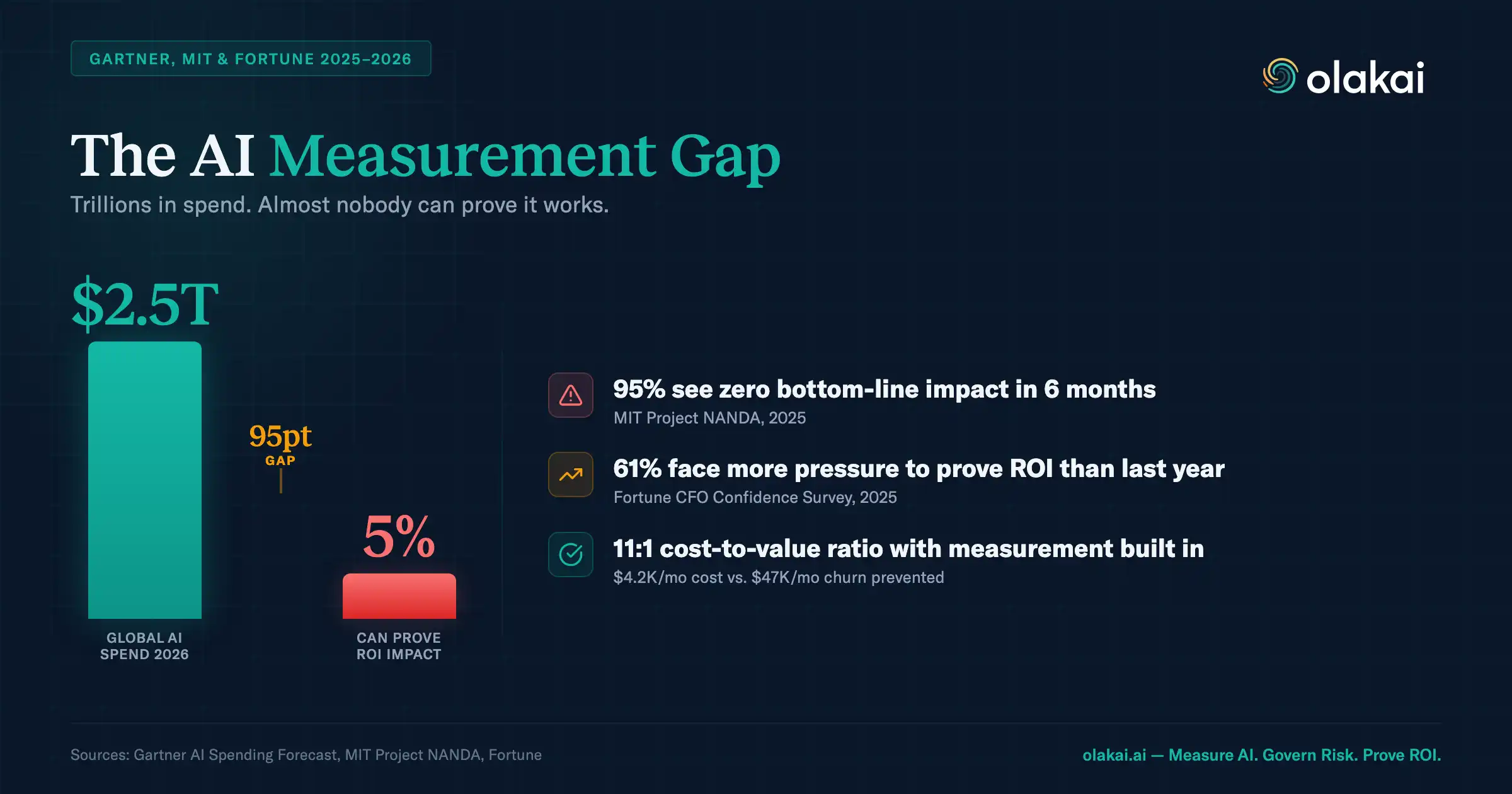
    Global AI spending is projected to reach $2.5 trillion in 2026, according to Gartner. AI now represents more than 40% of total IT spending. Yet MIT’s Project NANDA found that 95% of companies see zero measurable bottom-line impact from their AI investments within six months.

    Read that again. Trillions in spend. Ninety-five percent with nothing to show the CFO.

    The problem isn’t that AI doesn’t work. The agents we’ve measured do work — they resolve tickets, qualify leads, process documents, flag anomalies. The problem is that most enterprises never connect that activity to business outcomes. They measure what’s easy (calls handled, tokens processed, tasks completed) instead of what matters (revenue influenced, costs avoided, risk reduced, time recovered).

    This is why 61% of senior business leaders now report more pressure to prove AI ROI than they felt a year ago, according to Fortune’s 2025 CFO confidence survey. The era of “trust us, AI is helping” is over.

    The AI Measurement Gap — $2.5T global AI spend vs. only 5% can prove ROI impact, with findings from MIT, Fortune, and Olakai data

    What 100+ Deployments Actually Taught Us

    Across more than 100 measured agent deployments, we’ve identified four patterns that separate the 5% who prove ROI from the 95% who can’t.

    1. They Define the Success KPI Before Deployment

    The retail voice AI example above illustrates this perfectly. The operations team measured what they controlled: call volume, handle time, resolution rate. All green. But the finance team needed to see qualified leads that converted — a metric that crossed departmental boundaries and required connecting the agent’s activity to CRM data 30 days downstream.

    The enterprises that prove ROI identify this “success KPI” before the agent goes live. Not after. Not when the CFO asks. Before. It’s the single metric that answers the question: If this agent works perfectly, what business outcome changes?

    2. They Measure the Counterfactual, Not Just the Output

    One financial services firm deployed an AI agent to flag compliance anomalies. The agent flagged 340 issues in its first quarter. Impressive? The team thought so — until someone asked how many of those would have been caught by the existing manual process. The answer was 312. The agent’s real value wasn’t 340 flags. It was 28 catches that would have been missed, each representing potential regulatory exposure worth six figures.

    Measuring output without a baseline is vanity metrics dressed up as ROI. The question isn’t “what did the agent do?” It’s “what would have happened without it?”

    3. They Track Cost-to-Value, Not Just Cost-to-Run

    Enterprise AI cost conversations almost always focus on infrastructure: compute costs, API calls, token usage. These matter, but they’re only half the equation. A customer success agent we measured cost $4,200 per month to run — and prevented an average of $47,000 in monthly churn by identifying at-risk accounts three weeks earlier than the human team. The cost-to-run looked expensive in isolation. The cost-to-value ratio was 11:1.

    The enterprises that scale AI investment successfully present both numbers to finance. They don’t defend the cost. They contextualize it against the value.

    4. They Build Governance Into Measurement, Not Around It

    Here’s the pattern that surprised us most. The deployments with the strongest ROI data weren’t the ones with the most sophisticated AI models. They were the ones with the most rigorous governance frameworks. Why? Because governance forces you to define what the agent is allowed to do, which forces you to define what success looks like, which forces you to instrument the metrics that prove value.

    Governance and measurement aren’t separate workstreams. They’re the same workstream. Organizations that treat them as separate end up with compliant agents they can’t prove are valuable, or valuable agents they can’t prove are compliant.

    The SEE → MEASURE → DECIDE → ACT Framework

    These four patterns map to a framework we’ve refined across every deployment:

    SEE: Get unified visibility into what AI agents are actually doing across your organization. Not just which agents exist, but what they’re touching — which data, which workflows, which customer interactions. You can’t measure what you can’t see, and most enterprises have agents running in places they don’t even know about.

    MEASURE: Connect agent activity to the success KPIs that matter to the business. This means going beyond operational metrics (tokens, latency, uptime) to outcome metrics (revenue influenced, costs avoided, risk mitigated). It also means establishing baselines so you can measure the counterfactual.

    DECIDE: Use measurement data to make scaling decisions. Which agents get more budget? Which get sunset? Which workflows should be automated next? Without measurement, these decisions are political. With measurement, they’re strategic.

    ACT: Scale what’s working, fix what’s not, and govern the entire portfolio continuously. This is where most enterprises stall — not because they lack the will, but because they lack the data to act with confidence.

    The framework isn’t complicated. But it requires designing measurement and governance from day one, not bolting them on after deployment. Enterprises that bolt on measurement retroactively spend 3-4x more time and money instrumenting metrics than those who build it in from the start.

    Why This Matters Now

    Gartner predicts that 40% of enterprise applications will feature task-specific AI agents by the end of 2026 — up from less than 5% in 2025. That’s an 8x increase in one year. Meanwhile, 58% of organizations still cite unclear ownership as their primary barrier to measuring AI performance, and 62% lack a comprehensive inventory of the AI applications they’re running.

    The math is straightforward. Agent proliferation is accelerating. Measurement capability is not keeping pace. The gap between AI activity and AI accountability is widening every quarter. And the organizations that close that gap first will be the ones who scale AI investment while their competitors are still stuck in pilot purgatory, unable to answer the CFO’s question.

    In 2026, AI is being judged less on promise and more on proof. The playbook for providing that proof exists. It starts with seeing what you have, measuring what matters, deciding with data, and acting with confidence.

    If your enterprise is deploying AI agents and struggling to prove their value, you’re not alone — but the organizations pulling ahead aren’t waiting for better AI. They’re building better measurement. Our AI ROI framework breaks down the methodology, and Future of Agentic’s success KPI library offers specific metrics by use case.

    Ready to see what your AI agents are actually worth? Talk to an expert and we’ll show you how enterprises are turning AI activity into measurable business outcomes.

  • Your Most Important 2026 Resolution: Measure Your AI

    Your Most Important 2026 Resolution: Measure Your AI

    Forget the gym membership. Here’s the 2026 resolution that will actually transform your organization.

    Every January, leadership teams gather to set priorities for the year ahead. They review budgets, realign strategies, and make bold promises about what they’ll accomplish. But if your organization launched AI initiatives in 2024 or 2025, there’s one resolution that matters more than all the others: this year, you’re going to measure what your AI is actually doing.

    It sounds simple. It isn’t. According to Gartner, at least 30% of generative AI projects were abandoned after proof of concept by the end of 2025—not because they failed, but because teams couldn’t demonstrate clear business value. The AI worked. The measurement didn’t.

    The Pilot Purgatory Problem

    If you’ve been in enterprise technology for any length of time, you’ve seen this movie before. A promising technology emerges. Teams rush to experiment. Pilots launch across departments. And then… nothing. The pilots keep running, but they never scale. They become permanent experiments, consuming budget and attention without ever delivering the transformation they promised.

    AI has accelerated this pattern dramatically. The barrier to launching an AI pilot is lower than ever—a team can spin up a chatbot or copilot integration in days. But the barrier to proving that pilot’s value remains stubbornly high. When the CFO asks “What’s the ROI on our AI investment?”, most teams can only offer anecdotes and assumptions.

    This is pilot purgatory, and it’s where AI initiatives go to languish. A recent industry analysis found that on average, only 48% of AI projects make it into production, and it takes 8 months to go from prototype to production. The problem isn’t the technology. It’s the inability to answer the fundamental question: is this working?

    Why 2026 Is Different

    The pressure to prove AI value has never been higher. After two years of experimentation, boards and executive teams are demanding results. They’ve seen the hype. They’ve approved the budgets. Now they want to know what they got for their investment.

    Meanwhile, AI capabilities are advancing rapidly. Agentic AI—systems that can autonomously plan and execute complex tasks—is moving from research labs to production environments. Organizations that can’t measure the value of their current AI deployments will struggle to make informed decisions about these more sophisticated (and more expensive) capabilities.

    The teams that figure out measurement in 2026 will scale their AI programs. The teams that don’t will watch their pilots slowly fade away, replaced by the next wave of experiments that also never prove their worth.

    Five Measurement Commitments for 2026

    Making “measure AI” a meaningful resolution requires specific commitments. Here’s what the teams that escape pilot purgatory actually do differently.

    First, they track outcomes, not just usage. Knowing that 500 employees used your AI assistant last month tells you almost nothing. Knowing that those employees resolved customer issues 23% faster, or processed invoices with 15% fewer errors—that’s actionable intelligence. The shift from counting interactions to measuring business impact is the single most important change most organizations need to make.

    Second, they tie AI to existing business KPIs. Your organization already measures what matters: revenue, costs, customer satisfaction, employee productivity, error rates, cycle times. Effective AI measurement connects AI usage to these existing metrics rather than creating a parallel universe of AI-specific vanity metrics. When you can show that teams using AI tools have 18% higher customer satisfaction scores, you’ve made the business case.

    Third, they monitor costs proactively. AI costs can spiral quickly—API calls, compute resources, vendor subscriptions, integration maintenance. Teams that measure well know their cost per outcome, not just their total spend. They can answer questions like “How much does it cost us to resolve a customer issue with AI assistance versus without?” This kind of granular cost visibility is essential for making scaling decisions.

    Fourth, they document what’s working and what isn’t. The value of AI measurement isn’t just in proving ROI—it’s in learning. Which use cases deliver the highest value? Which teams have figured out how to get the most from AI tools? Which integrations consistently underperform? Organizations that systematically capture these insights can make smarter decisions about where to invest next.

    Fifth, they build the case for scaling incrementally. The path from pilot to production isn’t a single leap—it’s a series of gates, each requiring evidence that the AI is delivering value. Teams that measure well can show steady improvement over time, building confidence with stakeholders and earning the resources needed to expand.

    How to Actually Keep This Resolution

    Unlike most New Year’s resolutions, measuring AI doesn’t require willpower—it requires infrastructure. You need systems that capture AI usage data, connect it to business outcomes, and present it in ways that executives and finance teams can act on.

    This is where many organizations stumble. They try to build measurement capabilities from scratch, cobbling together logging tools, custom dashboards, and manual reporting processes. The result is fragile, incomplete, and almost never maintained once the initial enthusiasm fades.

    The more sustainable approach is to implement purpose-built AI intelligence platforms that handle measurement automatically. These platforms integrate with your existing AI tools—chatbots, copilots, agent frameworks, AI-enabled SaaS—and provide unified visibility into usage, outcomes, and costs across all of them. Olakai, for example, was built specifically to solve this problem: giving enterprises the data they need to prove AI value and make confident scaling decisions.

    The Payoff

    Teams that measure scale. Teams that don’t stay stuck in pilot purgatory indefinitely. It’s that simple.

    When you can show the CFO exactly how much value your AI initiatives are delivering—in terms they understand, tied to metrics they already care about—you transform the conversation. You move from defending your AI budget to advocating for expansion. You shift from “we think this is working” to “here’s the data proving it works.”

    More importantly, you give your organization the information it needs to make smart decisions about AI. Not every pilot should scale. Not every use case delivers value. Measurement lets you distinguish the winners from the losers and concentrate resources where they’ll have the greatest impact.

    2026 will be the year that separates the organizations that figured out AI from the ones still experimenting. The difference won’t be which AI tools they chose or how sophisticated their implementations were. It will be whether they could prove their AI was working—and use that proof to build something lasting.

    That’s a resolution worth keeping.

    Ready to start 2026 with visibility into your AI investments? Talk to an expert to see how Olakai measures AI ROI across your entire organization.

  • AI in Finance: 5 Use Cases Every CFO Should Know

    AI in Finance: 5 Use Cases Every CFO Should Know

    When a Fortune 500 technology company’s finance team finally tallied the numbers, they were staggered. Their accounts payable department was processing 47,000 invoices monthly—at an average cost of $19 per invoice and a 17-day processing time. That’s nearly $900,000 annually in AP processing costs alone, not counting late payment penalties, missed early payment discounts, and the strategic opportunity cost of having skilled finance professionals manually keying data into ERP systems.

    Finance teams everywhere face this same paradox. CFOs are under relentless pressure to close faster, forecast more accurately, and provide real-time visibility into financial health. Yet their teams spend the majority of their time on manual work that machines could handle: invoice processing, expense reviews, reconciliations, and forecasting updates.

    According to the Deloitte Q4 2025 CFO Signals Survey, 87% of CFOs believe AI will be extremely or very important to their finance department’s operations in 2026—only 2% say it won’t be important. More than half of CFOs say integrating AI agents in their finance departments will be a transformation priority this year. The shift from experimentation to enterprise-wide deployment is happening now.

    Overview: Finance AI Use Cases

    Use Case Typical ROI Complexity Time to Value
    Invoice Processing 8-12x Medium 6-10 weeks
    Expense Review 6-10x Low 4-6 weeks
    Cash Flow Forecasting 10-15x Medium 8-12 weeks
    Accounts Receivable 8-12x Medium 6-10 weeks
    Financial Close 6-10x Medium-High 10-14 weeks

    1. Invoice Processing: From Manual to Touchless

    Manual invoice processing is one of the most expensive routine operations in finance. According to HighRadius research, the average cost to process an invoice manually ranges from $12.88 to $19.83 per invoice, with processing times stretching to 17.4 days for organizations without automation. Best-in-class AP departments using AI-powered automation spend just $2-3 per invoice—an 80% reduction—with processing times of 3.1 days.

    The numbers get more compelling at scale. A single AP employee can handle more than 23,000 invoices annually with automation, compared to just 6,000 with manual processing. That’s nearly a 4x productivity improvement per person. The global accounts payable automation market is projected to reach $1.75 billion by 2026, reflecting how rapidly finance organizations are moving to eliminate manual invoice handling.

    An AI agent transforms invoice processing by extracting data from invoices regardless of format—vendor, amount, date, line items—then validating against purchase order data and contracts. It routes for appropriate approvals based on amount and category, flags anomalies and potential fraud, and processes straight-through when validation passes. At maturity, organizations achieve 60-75% touchless processing rates, where invoices flow from receipt to payment without human intervention.

    Key metrics to track include data extraction accuracy (target: 95-98% for structured invoices), touchless processing rate, exception rate, cost per invoice, and fraud detection rate. Most organizations see payback within 6-12 months.

    2. Expense Review: Policy Enforcement at Scale

    Manual expense review is tedious, inconsistent, and often delayed. Finance teams spend hours on low-value approval work while policy violations slip through. The inconsistency is particularly problematic: one manager approves expenses that another would reject, creating frustration and compliance gaps.

    An AI expense agent reviews submissions against company policies in real-time, flags violations (missing receipts, over-limit spending, wrong categories), and auto-approves compliant expenses within predefined thresholds. It routes exceptions for human review with full context and identifies patterns that suggest policy abuse—like employees consistently submitting expenses just below approval thresholds or splitting single expenses across multiple submissions.

    The impact extends beyond efficiency. Organizations report 80% reduction in manual review time, consistent policy enforcement across the organization, faster reimbursement for employees, and 6-10x ROI through efficiency and compliance improvements. The consistency alone can reduce employee complaints and improve satisfaction with the expense process.

    3. Cash Flow Forecasting: See What’s Coming

    Cash flow forecasting is where AI moves from cost reduction to strategic value creation. Traditional forecasting is manual, time-consuming, and often wildly inaccurate—relying on historical averages and gut instinct when what finance leaders need is predictive insight.

    An AI forecasting agent analyzes historical payment patterns, incorporates seasonality and trends, and predicts customer payment timing based on actual behavior—not optimistic assumptions. It models different scenarios (best case, worst case, expected) and updates forecasts continuously as new data arrives. For a deeper framework on measuring AI-driven improvements, see our guide on how to measure AI ROI in the enterprise.

    The business impact is substantial: 25-35% improvement in forecast accuracy, earlier visibility into cash crunches, better working capital management, and 10-15x ROI through avoided borrowing costs and optimized investment timing. When you can predict cash positions weeks in advance rather than days, treasury operations transform from reactive crisis management to proactive optimization.

    4. Accounts Receivable: Collect Faster, Chase Smarter

    Collections are often reactive—chasing payments after they’re overdue. This hurts cash flow and strains customer relationships. Nobody enjoys making or receiving collection calls, and the awkwardness often leads finance teams to delay or avoid necessary follow-ups.

    An AI collections agent predicts payment likelihood based on customer behavior and history. It sends proactive reminders before due dates—when customers can still pay easily—rather than after-the-fact demands. It personalizes collection approaches based on customer segment and relationship, prioritizes collection efforts by likelihood and amount, and tracks payment commitments and follows up automatically when they’re missed.

    Organizations report 10-20 day reduction in DSO (Days Sales Outstanding), 15-25% reduction in bad debt write-offs, fewer uncomfortable collection conversations, and 8-12x ROI through improved cash flow. The relationship preservation matters as much as the cash: customers appreciate respectful reminders more than aggressive collection efforts.

    5. Financial Close: Faster, More Accurate

    Month-end close is a fire drill at most organizations. Reconciliations, adjustments, and reviews pile up. Teams work overtime, errors slip through, and the process takes 5-10 days that could be spent on analysis and planning. CFOs know that every day spent on close is a day not spent on forward-looking work.

    An AI close agent automates bank reconciliation—the tedious matching of transactions that consumes hours of staff time. It identifies and investigates discrepancies, prepares standard journal entries, flags unusual items for review, and tracks close tasks and deadlines. The system learns which discrepancies resolve themselves versus which require investigation, reducing noise over time.

    The impact includes 30-50% reduction in close time, fewer errors and restatements, more time for analysis and strategic work, and 6-10x ROI through efficiency and accuracy. Some organizations have compressed their close from 10 days to 4, freeing their teams to focus on variance analysis and forward planning rather than data reconciliation.

    Governance Considerations for Finance AI

    Finance AI requires careful governance given the sensitivity of financial data and the regulatory requirements surrounding financial reporting. This isn’t optional—it’s table stakes for any AI deployment in finance.

    SOX compliance demands audit trails for all AI-touched transactions. Every automated decision needs to be traceable, explainable, and reviewable. Segregation of duties must be maintained: AI shouldn’t both approve and execute payments, just as no single human should. Data retention requirements for financial records apply equally to AI-generated data.

    Build your control framework with immutable logging where every AI decision is recorded and cannot be altered. Establish clear exception handling with escalation paths for anomalies. Set threshold controls on what AI can process without human review—start conservative and expand as trust is established. Conduct regular audits to verify AI is performing as expected and catching what it should catch.

    Fraud detection deserves particular attention. Monitor for duplicate payments, flag unusual vendor patterns (new vendors with large invoices, vendors with addresses matching employee addresses), detect invoice anomalies, and track user behavior changes. AI can catch patterns that humans miss when processing thousands of transactions.

    Getting Started

    If you’re ready to bring AI to your finance organization, start with invoice processing. It’s high-volume, well-defined, and delivers clear ROI. Most organizations see payback within 6-12 months, and the use case is mature enough that vendors have proven solutions.

    Build governance from day one. Finance data is sensitive and regulated. Establish audit trails, controls, and compliance documentation before production—not after an auditor asks for them. The Future of Agentic use case library includes detailed finance automation scenarios with governance frameworks.

    Define success metrics upfront. Track cost per transaction, accuracy rates, processing time, and exception rates. Without measurement, you can’t prove value—and according to Deloitte, only 21% of active AI users say the technology has delivered clear, measurable value. Be in that 21%.

    Plan for exceptions. AI won’t handle 100% of cases. Design clear escalation paths for edge cases and train staff on when to intervene. The goal is appropriate automation, not total automation.

    The Finance Transformation

    The CFO role is evolving from scorekeeper to strategic partner. AI-powered automation handles the routine work, freeing finance teams to focus on analysis, planning, and decision support. According to Fortune’s CFO survey, finance chiefs broadly expect AI to shift from experimentation to proven, enterprise-wide impact in 2026—transforming the finance function rather than just trimming costs.

    The numbers bear this out: 50% of North American CFOs say digital transformation of finance is their top priority for 2026, and nearly two-thirds plan to add more technical skills—AI, automation, data analysis—to their teams. Automating processes to free employees for higher-value work is the leading finance talent priority, cited by 49% of CFOs.

    The finance organizations that embrace AI will operate faster, more accurately, and with better visibility. Those that don’t will struggle to keep up with the pace of business—and increasingly, with their competitors who’ve made the leap.

    Ready to transform your finance operations? Talk to an expert to see how Olakai helps you measure the impact of finance AI and govern it responsibly.

  • The Evolution of Enterprise AI: From Prediction to Action

    The Evolution of Enterprise AI: From Prediction to Action

    Three years ago, ChatGPT launched and changed everything. Or did it?

    The reality is more nuanced. According to McKinsey’s 2025 State of AI report, 88% of enterprises now report regular AI use in their organizations. That’s remarkable progress. But here’s the sobering counterpoint: over 80% of those same respondents reported no meaningful impact on enterprise-wide EBIT. AI has gone from experimental to operational, but for most organizations, it hasn’t yet become transformational.

    Understanding why requires understanding how enterprise AI has evolved—and where it’s heading next. What started as specialized machine learning models for prediction has evolved into autonomous agents capable of taking action on behalf of the organization. Each era has built on the last, and each has demanded different capabilities from the organizations deploying it.

    The Four Eras of Enterprise AI

    Era 1: Traditional AI (2020-2022)

    This was AI as most enterprises first knew it—sophisticated machine learning models trained on historical data to make predictions. A fraud detection model could flag suspicious transactions. A demand forecasting system could predict inventory needs. But the key limitation was fundamental: these systems provided scores and classifications. They couldn’t take action.

    These traditional AI systems excelled at passive prediction—providing scores or classifications that required human interpretation. Each model was single-purpose, built for a specific task, and demanded substantial data requirements for training. They had limited adaptability to new situations and couldn’t learn from conversational feedback. Think fraud detection scoring, demand forecasting, customer churn prediction, image classification, and recommendation engines.

    These systems were powerful but required significant data science expertise and infrastructure investment. Value came from better predictions, but humans still made all decisions and took all actions. The barrier to entry was high—you needed specialized talent and years of data to train effective models.

    Era 2: Chat AI (2023)

    ChatGPT’s November 2022 launch marked a turning point. Suddenly, any employee could interact with AI using natural language—no data science degree required. Within months, generative AI went from curiosity to corporate priority. According to the Stanford HAI 2025 AI Index Report, U.S. private AI investment grew to $109.1 billion in 2024—nearly 12 times China’s investment and 24 times the U.K.’s.

    Chat AI delivered an interactive Q&A interface with natural language understanding and generation, broad general knowledge, and remarkable accessibility. But it had no ability to take action and maintained only stateless conversations. ChatGPT for research and drafting, customer service chatbots, content creation tools, and code explanation and debugging became commonplace.

    ChatGPT made AI accessible to everyone. But these systems could only provide information—they couldn’t take action in business systems. The knowledge was impressive; the capability to act on it was absent.

    Era 3: Copilots (2024)

    Copilots represented the first real integration of generative AI into daily work. Code became AI’s first true “killer use case”—50% of developers now use AI coding tools daily, according to Menlo Ventures research, rising to 65% in top-quartile organizations. Menlo Ventures reports that departmental AI spending on coding alone reached $4 billion in 2025—55% of all departmental AI spend.

    Copilots brought context-aware suggestions while keeping humans in control of every decision. They provided real-time assistance during work and integrated into existing tools like IDEs, productivity apps, and CRMs. But they required constant human oversight—the AI suggested, the human decided. GitHub Copilot for code completion, Microsoft 365 Copilot for productivity, Salesforce Einstein GPT for sales, and Google Duet AI for workspace defined this era.

    Copilots showed AI could accelerate individual productivity. A developer with Copilot could write code faster; a sales rep could draft emails more quickly. But humans still made every decision and approved every action. The AI suggested; the human decided.

    Era 4: Agentic AI (2025-2026)

    This is where we are now—and where the transformation gets real. For a deeper understanding of what distinguishes agents from earlier AI systems, see our guide on what agentic AI actually means. According to Gartner, 40% of enterprise applications will be integrated with task-specific AI agents by the end of 2026, up from less than 5% in 2025. That’s an 8x increase in a single year.

    McKinsey’s research shows 62% of organizations are already experimenting with AI agents, with 23% actively scaling agentic AI systems. The projected ROI is striking: organizations expect an average return of 171% from agentic AI deployments, with U.S. enterprises forecasting 192% returns.

    Agentic AI introduces goal-oriented autonomy—systems that can plan multi-step processes and execute them independently. They use tools and APIs, adapt through learning from feedback, and maintain contextual memory across sessions. Automated incident response, end-to-end invoice processing, supply chain optimization, multi-step sales workflows, and customer onboarding automation are emerging applications.

    Agents can complete entire workflows autonomously. They don’t just suggest the next email—they draft it, send it, track responses, and follow up. The human role shifts from execution to oversight. This is where AI finally starts delivering on the promise of true business transformation.

    What Changes with Each Era

    Dimension Traditional AI Chat AI Copilots Agents
    Human role Interpret & act Ask & evaluate Approve & edit Supervise & escalate
    Autonomy None None Limited High
    Integration Backend systems Chat interface Within apps Across systems
    Expertise needed Data scientists Anyone Anyone Anyone (with governance)
    Risk profile Low (no action) Low (no action) Medium (human approval) Higher (autonomous action)

    The Governance Imperative

    As AI gains more autonomy, governance becomes more critical. But here’s a warning from Gartner that every enterprise leader should heed: over 40% of agentic AI projects will be canceled by the end of 2027, due to escalating costs, unclear business value, or inadequate risk controls.

    The enterprises that succeed will be the ones that treat governance as an enabler, not an afterthought.

    Traditional AI and Chat AI carried a low governance burden—they provided information but took no action. Main concerns centered on accuracy and appropriate use. Copilots require moderate governance—AI suggests actions but humans approve. Concerns include data handling, appropriate suggestions, and over-reliance on AI-generated outputs.

    Agentic AI demands high governance. AI takes action autonomously, which means you need visibility into what agents do, controls to prevent inappropriate actions, and audit trails for compliance. Without these, agents become liabilities rather than assets. Knowing how to measure AI ROI becomes essential when autonomous systems are making decisions on your behalf.

    What This Means for Enterprise Leaders

    The Opportunity

    Each era has delivered more value than the last. The numbers tell the story: companies spent $37 billion on generative AI in 2025, up from $11.5 billion in 2024—a 3.2x year-over-year increase. That investment is flowing toward real productivity gains, not just experimentation.

    The Challenge

    More autonomy means more risk. An agent that can take action can take wrong action. And the failure modes are real: 42% of companies abandoned most AI initiatives in 2025, up sharply from 17% in 2024, according to research from MIT and RAND Corporation. The gap between AI adoption and AI value remains stubbornly wide — a phenomenon we explore in depth in our guide on moving from AI experimentation to business impact.

    The Path Forward

    The enterprises that will win are those who embrace agentic AI for the right use cases—starting with low-risk, high-volume workflows where automation delivers clear value and mistakes are recoverable. They’ll build governance from day one, treating visibility, controls, and measurement as core requirements rather than afterthoughts. They’ll measure outcomes relentlessly, proving ROI and identifying problems before they become crises. And they’ll prepare their organization, helping employees understand how their roles will evolve from execution to oversight as agents take on more autonomous work.

    What’s Next

    The evolution isn’t over. By 2028, Gartner predicts at least 15% of day-to-day work decisions will be made autonomously through agentic AI—up from 0% in 2024. Additionally, 33% of enterprise software applications will include agentic AI by 2028, up from less than 1% in 2024.

    Several emerging trends deserve attention. Multi-agent systems—agents that coordinate with each other to complete complex tasks—are moving from research to production. Continuous learning enables agents that improve from feedback without manual retraining. Deeper integration gives agents access to more enterprise systems and data. And industry-specific agents provide pre-built solutions for common workflows in specific industries.

    For a deeper exploration of the economics driving agent adoption, the Future of Agentic guide to agent economics covers TCO analysis and ROI calculations.

    The enterprises that understand this evolution—and prepare for what’s coming—will be best positioned to capture value from AI. The ones that don’t will find themselves in that uncomfortable 80%: using AI everywhere, but struggling to show the ROI.

    Ready to navigate the evolution of enterprise AI? Talk to an expert to see how Olakai helps organizations measure and govern AI across all four eras.

  • 7 AI Use Cases for Customer Success Teams

    7 AI Use Cases for Customer Success Teams

    When a mid-market SaaS company’s customer success team realized they were losing customers, they discovered a painful pattern: by the time usage declined enough to trigger alerts in their CRM, customers had already mentally checked out. The decline started months earlier, but the signals were scattered across product analytics, support tickets, and billing data that no one was connecting. They were always too late.

    This reactive approach to customer success is common—and increasingly uncompetitive. According to the 2025 Customer Revenue Leadership Study, teams using customer success platforms average 100% net revenue retention versus 94% without. That six-point difference compounds dramatically over time: retained customers expand, while churned customers require expensive replacement.

    Customer success teams are the guardians of recurring revenue. They retain customers, drive expansion, and prevent churn. But they’re often stretched thin—managing hundreds of accounts with limited bandwidth for proactive engagement. AI agents can change this equation fundamentally. By automating routine tasks and surfacing insights that would otherwise remain hidden in siloed data, they enable CS teams to focus their energy on high-impact customer relationships.

    Overview: Customer Success AI Use Cases

    Use Case Typical ROI Complexity Time to Value
    Churn Risk Detection 20-30x Medium 8-12 weeks
    Customer Health Scoring 10-15x Medium 4-6 weeks
    Onboarding Automation 8-12x Medium 4-6 weeks
    QBR Automation 5-8x Low 2-4 weeks
    Expansion Opportunity Detection 15-20x Medium 6-10 weeks
    Renewal Management 10-15x Medium 4-6 weeks
    Sentiment Analysis 5-8x Low 2-4 weeks

    1. Churn Risk Detection: Save Customers Before They Leave

    Churn often becomes visible only when it’s too late—the customer has already decided to leave. Yet usage data contains early warning signals weeks or months in advance. In 2025’s AI-driven landscape, churn rate has evolved from a lagging indicator to a predictive metric. According to industry research, machine learning models can now forecast customer attrition 3-6 months in advance, giving CS teams time to intervene rather than simply react.

    An AI churn agent continuously monitors product usage and engagement metrics, identifying declining patterns that predict departure before customers stop responding to outreach. It scores each customer’s risk level based on behavioral signals—login frequency drops, feature abandonment, support ticket tone shifts—and alerts CSMs with prioritized lists of at-risk accounts. More importantly, it suggests specific intervention tactics based on what’s worked for similar accounts in similar situations.

    Organizations report 15-25% reduction in customer attrition through AI-powered early warning systems. For a subscription business with significant revenue per customer, that translates to 20-30x ROI through preserved revenue that would otherwise have walked out the door.

    2. Customer Health Scoring: Know Who Needs Attention

    Generic health scores miss segment nuances. A one-size-fits-all metric doesn’t capture the different patterns of healthy enterprise versus SMB customers, or new versus mature accounts. What looks like declining health in one segment might be perfectly normal in another.

    An intelligent health scoring agent builds segmented models that understand what “healthy” looks like for different customer types. It monitors usage and engagement in real-time, predicts future churn based on current trend trajectories, and alerts CSMs when health declines in ways that matter for each specific segment. The models improve over time as they learn which patterns actually precede churn versus which are false alarms.

    Organizations with sophisticated health scoring report 30% more accurate churn prediction and 25% reduction in actual churn through early intervention. The 2025 Customer Revenue Leadership Study found that survey participants ranked NRR (51%), churn rate (48%), and GRR (40%) as their top three metrics for customer success teams—health scoring directly impacts all three.

    3. Onboarding Automation: Accelerate Time-to-Value

    Generic onboarding yields 40-60% activation rates. Customers get stuck at friction points—confusing configurations, unclear next steps, features they don’t know exist—without anyone noticing until it’s too late. By then, the customer has formed their impression of the product, and it’s not a good one.

    An onboarding agent monitors new customer behavior in real-time, identifying stumbling blocks as they happen rather than in post-mortem analysis. It sends targeted in-app guidance when customers hesitate at known friction points. It personalizes onboarding based on role and use case—a finance user needs different guidance than an operations user. CSMs receive alerts when customers struggle, allowing human intervention before frustration sets in.

    The impact compounds: 30-40% improvement in activation rates means more customers reach the “aha moment” where they understand the product’s value. Time-to-value improvements of 50% mean customers see returns faster, strengthening the relationship before the first renewal conversation. That translates to 8-12x ROI through retention gains that start on day one.

    4. QBR Automation: Prepare Reviews in Minutes

    Quarterly Business Reviews are essential for strategic relationships, but CSMs spend hours preparing slides and gathering metrics for each customer. It’s high-value time spent on low-value work—pulling data from five different systems, formatting charts, writing narratives that say the same things slightly differently for each account.

    A QBR automation agent handles the mechanical work. It automatically pulls usage metrics, identifies wins worth celebrating and concerns worth discussing, and generates presentation drafts that highlight discussion topics based on customer goals. It tracks action items from previous reviews and surfaces their status. The CSM’s job shifts from data gathering to insight refinement—editing and personalizing rather than creating from scratch.

    Organizations report 80% reduction in QBR prep time. More importantly, the reviews become more consistent and data-driven. When every QBR includes the same depth of analysis, customers notice the professionalism—and CSMs can actually focus on the strategic conversation rather than defending their data sources.

    5. Expansion Opportunity Detection: Grow What You Have

    Expansion revenue is the most efficient revenue — and closely tied to what sales teams are doing with AI on the acquisition side — but CSMs often miss signals that customers are ready for more. Increased usage, new team members, questions about advanced features, approaching plan limits—these signals exist in the data but rarely surface in time for action.

    An expansion agent monitors usage patterns for signals that indicate readiness. It identifies customers approaching plan limits before they hit them (the perfect moment for an upgrade conversation). It detects interest in additional products or features based on browsing behavior and support questions. It alerts account teams with specific expansion recommendations tailored to each customer’s actual usage patterns.

    The impact is substantial: 20-30% increase in expansion revenue from timely, relevant upsell conversations that feel helpful rather than pushy. According to the 2025 study, only 15% of teams currently use AI for predictive expansion signals—the opportunity is wide open for early adopters.

    6. Renewal Management: Never Miss a Renewal

    Renewal discussions often start too late. By the time the CSM reaches out 60 days before expiration, the customer has already been evaluating alternatives for months. The “renewal” conversation becomes a retention battle rather than a relationship affirmation.

    A renewal management agent tracks renewal dates across the entire portfolio, initiating sequences at appropriate times based on customer segment and contract value. It monitors sentiment and usage in the months leading up to renewal, flagging at-risk renewals early enough for meaningful intervention. It suggests renewal strategies based on customer health—the approach for a healthy, expanding account should differ from one that’s been quiet for months.

    Organizations report 15-20% improvement in renewal rates through earlier engagement with at-risk renewals. The math is straightforward: for subscription businesses, improving renewal rates by even a few percentage points has massive impact on lifetime value and growth efficiency.

    7. Sentiment Analysis: Understand How Customers Feel

    Customer satisfaction surveys provide snapshots, but miss the ongoing sentiment expressed in support tickets, emails, and chat conversations. A customer might give you a 9 on an NPS survey while simultaneously writing frustrated support tickets that signal impending churn.

    A sentiment agent analyzes tone across all customer communications, tracking sentiment trends over time. It identifies frustrated customers before they escalate complaints or simply stop engaging. It correlates sentiment shifts with churn risk and health scores, creating a more complete picture of customer state than any single metric provides.

    According to Gartner research, 91% of customer service leaders are under executive pressure to implement AI specifically to improve customer satisfaction. Sentiment analysis provides the continuous monitoring that makes satisfaction improvement measurable and actionable.

    Getting Started with CS AI

    If you’re ready to bring AI to your customer success organization, start with the data you have. Most CS AI use cases require product usage data (logins, feature usage, API calls), CRM data (accounts, contacts, activities), support data (tickets, response times, resolutions), and financial data (contract values, renewal dates). The good news: you probably already have this data scattered across systems—AI’s job is connecting it.

    Pick one high-impact use case rather than trying to do everything at once. Churn risk detection or health scoring are often good starting points—they have clear ROI and build the foundation for other use cases. Once you can predict churn, expansion and renewal optimization become natural next steps.

    Define success metrics upfront. Common CS AI metrics include churn rate improvement, net revenue retention, expansion revenue per account, CSM productivity (accounts per CSM), and time to value for new customers. For a framework on connecting AI metrics to business outcomes, see our AI ROI measurement guide.

    Build governance from day one. CS data often includes sensitive customer information—usage patterns, business communications, financial details. Ensure proper data handling, access controls, and audit trails before deployment, not after. Our CISO governance checklist covers the security considerations.

    The Retention Imperative

    In subscription businesses, retention is everything. A 5% improvement in retention can drive 25-95% profit improvement according to classic research by Bain & Company. The Future of Agentic use case library includes detailed customer success scenarios with architecture patterns you can adapt.

    AI doesn’t replace the human relationships that drive retention—the empathy, the strategic guidance, the trust that comes from knowing your customers. But it ensures CSMs focus their limited energy where it matters most: on the relationships that need attention, armed with the context to make that attention valuable.

    The customer success teams that master AI will protect more revenue, drive more expansion, and manage more accounts per CSM. Those that don’t will fall behind as competitors automate their way to better retention numbers.

    Ready to bring AI to your customer success team? Talk to an expert to see how Olakai helps you measure the impact of CS AI initiatives and govern them responsibly.

  • From AI Experimentation to Business Impact

    From AI Experimentation to Business Impact

    In 2024, a global manufacturing company ran 23 AI pilots across its business units. The pilots worked. Chatbots answered questions. Document processors extracted data. Forecasting models outperformed spreadsheets. Leadership declared success and… nothing changed. A year later, exactly zero of those pilots had reached production. The company had proven AI could work; they hadn’t proven it could deliver value at scale.

    This story repeats across enterprises worldwide. According to research from MIT, 95% of AI pilots fail to deliver measurable business value—most never scale beyond the experimental phase. In 2025, the average enterprise scrapped 46% of AI pilots before they ever reached production. Global investment in generative AI solutions more than tripled to roughly $37 billion in 2025, yet 74% of companies still struggle to scale their AI initiatives into real business impact.

    Why do some organizations break through while others remain trapped in what we call “pilot purgatory”? The answer isn’t technology—it’s how organizations approach the transition from experiment to production.

    The Pilot Trap

    Most enterprises approach AI the same way. They identify an interesting use case, assemble a team, run a pilot, declare success, and then stall. The pilot proved the technology works, but scaling requires investment, change management, and governance that organizations aren’t prepared to provide. The result is a graveyard of successful experiments that never delivered business value.

    The symptoms are unmistakable. Organizations have multiple proof-of-concepts but zero production deployments. Data science teams are enthusiastic while business stakeholders remain skeptical. There’s a “we did AI” checkbox without measurable outcomes to show for it. Security and compliance concerns block production deployment. No one owns the responsibility for scaling successful pilots into real operations.

    The ISG State of Enterprise AI Adoption Report 2025 quantifies this problem: only about one in four AI initiatives actually deliver their expected ROI, and fewer than 20% have been fully scaled across the enterprise. In a survey of 120,000+ enterprise respondents, only 8.6% of companies report having AI agents deployed in production, while 63.7% report no formalized AI initiative at all. The gap between AI adoption and AI value remains stubbornly wide.

    What Successful Organizations Do Differently

    1. Start with Business Problems, Not Technology

    Failed AI initiatives typically start with “We should use AI for something.” Successful ones start with “This business problem costs us $X million annually—can AI help?” The difference matters enormously.

    Business problems come with budgets and executive sponsors who have a stake in the outcome. Clear problems have measurable success criteria that everyone can agree on. Stakeholders are invested in solutions rather than experiments. When a pilot solves a quantified problem, the case for scaling writes itself.

    Before launching any AI initiative, quantify the business problem. If you can’t put a dollar figure on it, you probably don’t have the executive sponsorship needed to scale. The successful implementations follow what researchers call a counterintuitive split: 10% on algorithms, 20% on infrastructure, 70% on people and process. That last 70% requires business ownership, not just technical enthusiasm.

    2. Build Governance from Day One

    Pilots often skip governance because “we’ll figure it out later.” But when “later” arrives, the lack of logging, security controls, and compliance documentation blocks production deployment. Security teams rightfully refuse to approve systems they can’t audit. Compliance finds gaps that require redesign. What should have been a straightforward scale becomes a rebuild.

    Organizations that scale AI treat governance as a feature, not an afterthought. Security and compliance stakeholders are involved from the start. Logging and monitoring are built into the MVP, not bolted on later. Data handling practices are documented before production. Risk assessments happen during design, not after deployment.

    For a comprehensive framework on what governance should include, our CISO AI Governance Checklist provides the full requirements. The key insight: governance built early accelerates production; governance added late delays or blocks it entirely.

    3. Measure Outcomes, Not Activity

    “The chatbot handled 10,000 conversations” sounds impressive—but did it reduce support costs? Improve customer satisfaction? Drive revenue? Activity metrics are easy to collect but often misleading. Outcome metrics are harder to define but actually prove value.

    Activity metrics track what the AI does: chatbot conversations, AI completions, agent tasks, documents processed. Outcome metrics track what the business gains: cost savings, time saved, revenue impact, error reduction, customer satisfaction changes. The difference between “we processed 50,000 invoices” and “we reduced invoice processing costs by 60%” is the difference between a pilot that stalls and one that scales.

    Define outcome metrics before the pilot begins. Establish baselines so you can prove improvement. Our AI ROI measurement framework provides a structured approach to connecting AI activity to business outcomes.

    4. Plan for Change Management

    AI that changes workflows requires people to change behavior. Without change management, even great technology fails. Employees resist tools they don’t understand. Workarounds emerge that bypass the AI entirely. Training gaps lead to misuse and disappointment. The technology works but the adoption doesn’t.

    Successful organizations plan for adoption from the beginning. They involve end users in design and testing, building tools that fit how people actually work. They create training and documentation before launch, not after complaints pile up. They measure adoption rates and address resistance directly rather than hoping it resolves itself. They iterate based on user feedback, treating the human side of deployment as seriously as the technical side.

    Include change management in your pilot plan. Budget time and resources for training and adoption. A pilot that users love has a path to production; a pilot that users ignore doesn’t.

    5. Create a Path to Production

    Many pilots succeed in isolation but have no path to production. They’re built on different infrastructure than production systems. They lack integrations with enterprise tools. They don’t meet security and compliance requirements that production demands. No one owns ongoing maintenance once the pilot team moves on.

    Organizations that scale design pilots with production in mind from day one. They use production-like infrastructure from the start so there’s no migration surprise. They build integrations that will scale rather than proof-of-concept workarounds. They document operational requirements—monitoring, alerting, failover, maintenance. They assign ownership for post-pilot operation before the pilot begins.

    Before starting a pilot, define what production deployment looks like. Build the pilot to minimize the gap between demo and deployment.

    The Scaling Playbook

    When you’re ready to scale a successful pilot, the process typically unfolds in four phases.

    During the first two weeks, validate value rigorously. Review pilot metrics against the success criteria you defined at the start. Calculate ROI and payback period with real numbers, not projections. Document lessons learned and risks discovered during the pilot. Secure executive sponsorship for scaling—if you can’t get it now, your pilot hasn’t proven enough value.

    Weeks three through six are about preparing for production. Address security and compliance gaps identified during the pilot. Build production-grade infrastructure that can handle real load. Create monitoring and alerting that will catch problems before users do. Develop training materials that help users succeed with the new tools.

    Weeks seven through ten involve limited rollout. Deploy to a subset of users and monitor closely for issues. Gather feedback and iterate quickly. Validate that production metrics match pilot expectations. This phase catches problems at manageable scale before they become enterprise-wide crises.

    From week eleven onward, execute full deployment. Expand to all users with confidence built from the limited rollout. Complete training and communication across the organization. Establish ongoing monitoring that will support the system long-term. Report outcomes to stakeholders to demonstrate value and build support for future initiatives.

    Signs You’re Ready to Scale

    You’re ready to move from pilot to production when several conditions align. Metrics prove value with clear ROI and documented baselines—not projections, but measured results. Governance is in place with security and compliance sign-off on the production deployment. Infrastructure is ready with production-grade systems that can support scale. Ownership is clear with a team accountable for operation and improvement. Users are engaged, ideally asking for broader access rather than avoiding the pilot. Executive sponsorship is confirmed with leadership committed to the investment required.

    Signs You’re Not Ready

    Don’t scale if you can’t quantify the business value delivered—enthusiasm isn’t evidence. Don’t scale if security or compliance have outstanding concerns that haven’t been addressed. Don’t scale if users aren’t adopting the pilot solution—production won’t fix adoption problems. Don’t scale if no one owns ongoing operation—orphaned systems become liabilities. And don’t scale if you’re scaling to “prove AI works” rather than solve a business problem—that’s the path to expensive experimentation with no business impact.

    The Path Forward

    Moving from AI experimentation to business impact requires more than technology. It requires clear business problems with quantified value that justify investment. It requires governance that enables rather than blocks production deployment. It requires metrics that prove outcomes, not just activity. It requires change management that drives adoption. And it requires infrastructure that supports production scale.

    The enterprises that master this transition will compound their AI investments, building capability on capability. Those that don’t will keep running pilots—and keep wondering why AI isn’t delivering the transformation they were promised.

    The Future of Agentic use case library provides detailed examples of enterprise AI deployments that have successfully made this transition, with architecture patterns and governance frameworks you can adapt.

    Ready to scale AI with confidence? Talk to an expert to see how Olakai helps enterprises measure ROI, govern risk, and move from pilot to production.