Category: AI Strategy

Strategic guidance for enterprise AI adoption and measurement

  • 7 AI Use Cases for Customer Success Teams

    7 AI Use Cases for Customer Success Teams

    When a mid-market SaaS company’s customer success team realized they were losing customers, they discovered a painful pattern: by the time usage declined enough to trigger alerts in their CRM, customers had already mentally checked out. The decline started months earlier, but the signals were scattered across product analytics, support tickets, and billing data that no one was connecting. They were always too late.

    This reactive approach to customer success is common—and increasingly uncompetitive. According to the 2025 Customer Revenue Leadership Study, teams using customer success platforms average 100% net revenue retention versus 94% without. That six-point difference compounds dramatically over time: retained customers expand, while churned customers require expensive replacement.

    Customer success teams are the guardians of recurring revenue. They retain customers, drive expansion, and prevent churn. But they’re often stretched thin—managing hundreds of accounts with limited bandwidth for proactive engagement. AI agents can change this equation fundamentally. By automating routine tasks and surfacing insights that would otherwise remain hidden in siloed data, they enable CS teams to focus their energy on high-impact customer relationships.

    Overview: Customer Success AI Use Cases

    Use Case Typical ROI Complexity Time to Value
    Churn Risk Detection 20-30x Medium 8-12 weeks
    Customer Health Scoring 10-15x Medium 4-6 weeks
    Onboarding Automation 8-12x Medium 4-6 weeks
    QBR Automation 5-8x Low 2-4 weeks
    Expansion Opportunity Detection 15-20x Medium 6-10 weeks
    Renewal Management 10-15x Medium 4-6 weeks
    Sentiment Analysis 5-8x Low 2-4 weeks

    1. Churn Risk Detection: Save Customers Before They Leave

    Churn often becomes visible only when it’s too late—the customer has already decided to leave. Yet usage data contains early warning signals weeks or months in advance. In 2025’s AI-driven landscape, churn rate has evolved from a lagging indicator to a predictive metric. According to industry research, machine learning models can now forecast customer attrition 3-6 months in advance, giving CS teams time to intervene rather than simply react.

    An AI churn agent continuously monitors product usage and engagement metrics, identifying declining patterns that predict departure before customers stop responding to outreach. It scores each customer’s risk level based on behavioral signals—login frequency drops, feature abandonment, support ticket tone shifts—and alerts CSMs with prioritized lists of at-risk accounts. More importantly, it suggests specific intervention tactics based on what’s worked for similar accounts in similar situations.

    Organizations report 15-25% reduction in customer attrition through AI-powered early warning systems. For a subscription business with significant revenue per customer, that translates to 20-30x ROI through preserved revenue that would otherwise have walked out the door.

    2. Customer Health Scoring: Know Who Needs Attention

    Generic health scores miss segment nuances. A one-size-fits-all metric doesn’t capture the different patterns of healthy enterprise versus SMB customers, or new versus mature accounts. What looks like declining health in one segment might be perfectly normal in another.

    An intelligent health scoring agent builds segmented models that understand what “healthy” looks like for different customer types. It monitors usage and engagement in real-time, predicts future churn based on current trend trajectories, and alerts CSMs when health declines in ways that matter for each specific segment. The models improve over time as they learn which patterns actually precede churn versus which are false alarms.

    Organizations with sophisticated health scoring report 30% more accurate churn prediction and 25% reduction in actual churn through early intervention. The 2025 Customer Revenue Leadership Study found that survey participants ranked NRR (51%), churn rate (48%), and GRR (40%) as their top three metrics for customer success teams—health scoring directly impacts all three.

    3. Onboarding Automation: Accelerate Time-to-Value

    Generic onboarding yields 40-60% activation rates. Customers get stuck at friction points—confusing configurations, unclear next steps, features they don’t know exist—without anyone noticing until it’s too late. By then, the customer has formed their impression of the product, and it’s not a good one.

    An onboarding agent monitors new customer behavior in real-time, identifying stumbling blocks as they happen rather than in post-mortem analysis. It sends targeted in-app guidance when customers hesitate at known friction points. It personalizes onboarding based on role and use case—a finance user needs different guidance than an operations user. CSMs receive alerts when customers struggle, allowing human intervention before frustration sets in.

    The impact compounds: 30-40% improvement in activation rates means more customers reach the “aha moment” where they understand the product’s value. Time-to-value improvements of 50% mean customers see returns faster, strengthening the relationship before the first renewal conversation. That translates to 8-12x ROI through retention gains that start on day one.

    4. QBR Automation: Prepare Reviews in Minutes

    Quarterly Business Reviews are essential for strategic relationships, but CSMs spend hours preparing slides and gathering metrics for each customer. It’s high-value time spent on low-value work—pulling data from five different systems, formatting charts, writing narratives that say the same things slightly differently for each account.

    A QBR automation agent handles the mechanical work. It automatically pulls usage metrics, identifies wins worth celebrating and concerns worth discussing, and generates presentation drafts that highlight discussion topics based on customer goals. It tracks action items from previous reviews and surfaces their status. The CSM’s job shifts from data gathering to insight refinement—editing and personalizing rather than creating from scratch.

    Organizations report 80% reduction in QBR prep time. More importantly, the reviews become more consistent and data-driven. When every QBR includes the same depth of analysis, customers notice the professionalism—and CSMs can actually focus on the strategic conversation rather than defending their data sources.

    5. Expansion Opportunity Detection: Grow What You Have

    Expansion revenue is the most efficient revenue — and closely tied to what sales teams are doing with AI on the acquisition side — but CSMs often miss signals that customers are ready for more. Increased usage, new team members, questions about advanced features, approaching plan limits—these signals exist in the data but rarely surface in time for action.

    An expansion agent monitors usage patterns for signals that indicate readiness. It identifies customers approaching plan limits before they hit them (the perfect moment for an upgrade conversation). It detects interest in additional products or features based on browsing behavior and support questions. It alerts account teams with specific expansion recommendations tailored to each customer’s actual usage patterns.

    The impact is substantial: 20-30% increase in expansion revenue from timely, relevant upsell conversations that feel helpful rather than pushy. According to the 2025 study, only 15% of teams currently use AI for predictive expansion signals—the opportunity is wide open for early adopters.

    6. Renewal Management: Never Miss a Renewal

    Renewal discussions often start too late. By the time the CSM reaches out 60 days before expiration, the customer has already been evaluating alternatives for months. The “renewal” conversation becomes a retention battle rather than a relationship affirmation.

    A renewal management agent tracks renewal dates across the entire portfolio, initiating sequences at appropriate times based on customer segment and contract value. It monitors sentiment and usage in the months leading up to renewal, flagging at-risk renewals early enough for meaningful intervention. It suggests renewal strategies based on customer health—the approach for a healthy, expanding account should differ from one that’s been quiet for months.

    Organizations report 15-20% improvement in renewal rates through earlier engagement with at-risk renewals. The math is straightforward: for subscription businesses, improving renewal rates by even a few percentage points has massive impact on lifetime value and growth efficiency.

    7. Sentiment Analysis: Understand How Customers Feel

    Customer satisfaction surveys provide snapshots, but miss the ongoing sentiment expressed in support tickets, emails, and chat conversations. A customer might give you a 9 on an NPS survey while simultaneously writing frustrated support tickets that signal impending churn.

    A sentiment agent analyzes tone across all customer communications, tracking sentiment trends over time. It identifies frustrated customers before they escalate complaints or simply stop engaging. It correlates sentiment shifts with churn risk and health scores, creating a more complete picture of customer state than any single metric provides.

    According to Gartner research, 91% of customer service leaders are under executive pressure to implement AI specifically to improve customer satisfaction. Sentiment analysis provides the continuous monitoring that makes satisfaction improvement measurable and actionable.

    Getting Started with CS AI

    If you’re ready to bring AI to your customer success organization, start with the data you have. Most CS AI use cases require product usage data (logins, feature usage, API calls), CRM data (accounts, contacts, activities), support data (tickets, response times, resolutions), and financial data (contract values, renewal dates). The good news: you probably already have this data scattered across systems—AI’s job is connecting it.

    Pick one high-impact use case rather than trying to do everything at once. Churn risk detection or health scoring are often good starting points—they have clear ROI and build the foundation for other use cases. Once you can predict churn, expansion and renewal optimization become natural next steps.

    Define success metrics upfront. Common CS AI metrics include churn rate improvement, net revenue retention, expansion revenue per account, CSM productivity (accounts per CSM), and time to value for new customers. For a framework on connecting AI metrics to business outcomes, see our AI ROI measurement guide.

    Build governance from day one. CS data often includes sensitive customer information—usage patterns, business communications, financial details. Ensure proper data handling, access controls, and audit trails before deployment, not after. Our CISO governance checklist covers the security considerations.

    The Retention Imperative

    In subscription businesses, retention is everything. A 5% improvement in retention can drive 25-95% profit improvement according to classic research by Bain & Company. The Future of Agentic use case library includes detailed customer success scenarios with architecture patterns you can adapt.

    AI doesn’t replace the human relationships that drive retention—the empathy, the strategic guidance, the trust that comes from knowing your customers. But it ensures CSMs focus their limited energy where it matters most: on the relationships that need attention, armed with the context to make that attention valuable.

    The customer success teams that master AI will protect more revenue, drive more expansion, and manage more accounts per CSM. Those that don’t will fall behind as competitors automate their way to better retention numbers.

    Ready to bring AI to your customer success team? Talk to an expert to see how Olakai helps you measure the impact of CS AI initiatives and govern them responsibly.

  • From AI Experimentation to Business Impact

    From AI Experimentation to Business Impact

    In 2024, a global manufacturing company ran 23 AI pilots across its business units. The pilots worked. Chatbots answered questions. Document processors extracted data. Forecasting models outperformed spreadsheets. Leadership declared success and… nothing changed. A year later, exactly zero of those pilots had reached production. The company had proven AI could work; they hadn’t proven it could deliver value at scale.

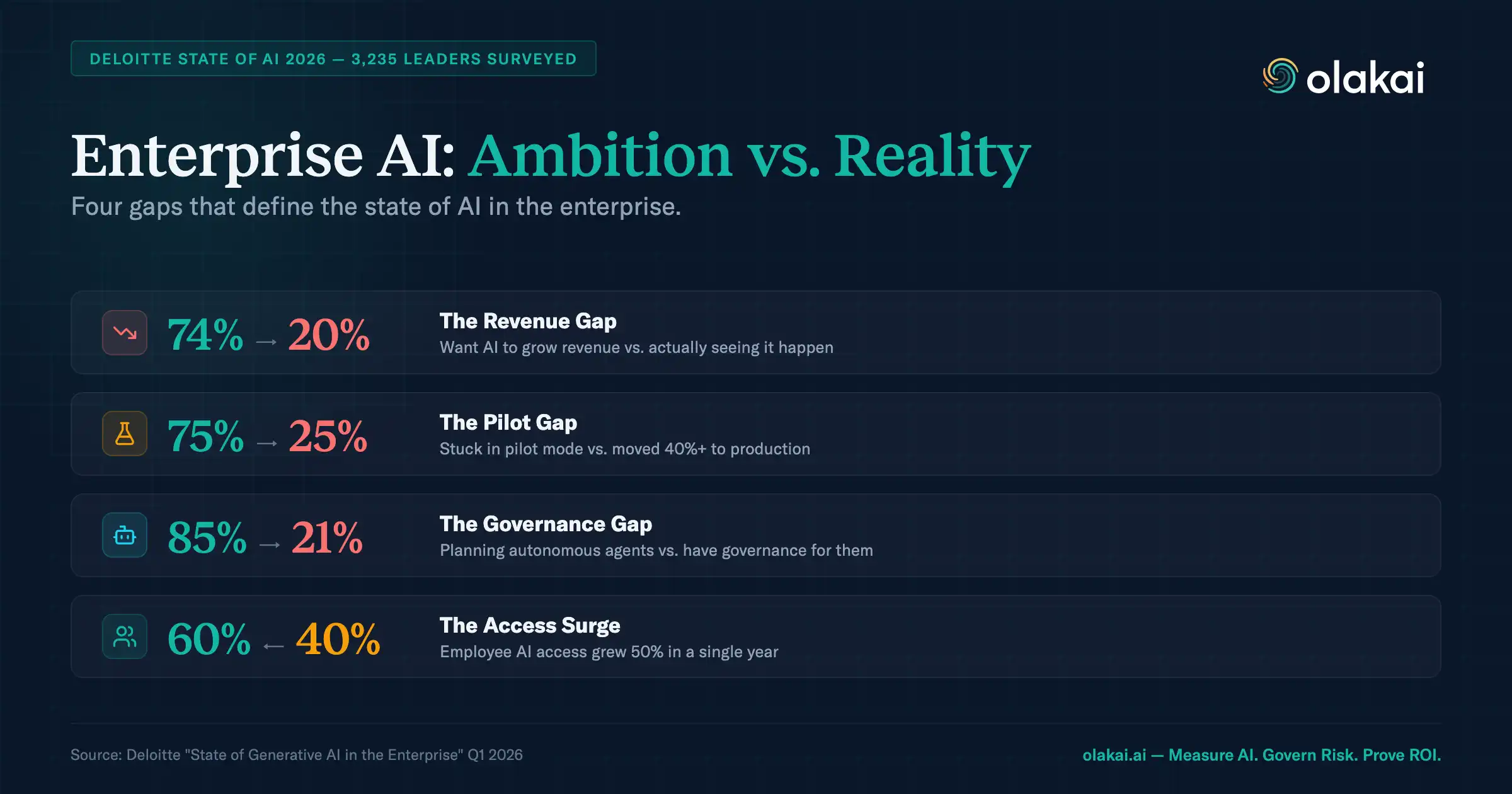
    This story repeats across enterprises worldwide. According to research from MIT, 95% of AI pilots fail to deliver measurable business value—most never scale beyond the experimental phase. In 2025, the average enterprise scrapped 46% of AI pilots before they ever reached production. Global investment in generative AI solutions more than tripled to roughly $37 billion in 2025, yet 74% of companies still struggle to scale their AI initiatives into real business impact.

    Why do some organizations break through while others remain trapped in what we call “pilot purgatory”? The answer isn’t technology—it’s how organizations approach the transition from experiment to production.

    The Pilot Trap

    Most enterprises approach AI the same way. They identify an interesting use case, assemble a team, run a pilot, declare success, and then stall. The pilot proved the technology works, but scaling requires investment, change management, and governance that organizations aren’t prepared to provide. The result is a graveyard of successful experiments that never delivered business value.

    The symptoms are unmistakable. Organizations have multiple proof-of-concepts but zero production deployments. Data science teams are enthusiastic while business stakeholders remain skeptical. There’s a “we did AI” checkbox without measurable outcomes to show for it. Security and compliance concerns block production deployment. No one owns the responsibility for scaling successful pilots into real operations.

    The ISG State of Enterprise AI Adoption Report 2025 quantifies this problem: only about one in four AI initiatives actually deliver their expected ROI, and fewer than 20% have been fully scaled across the enterprise. In a survey of 120,000+ enterprise respondents, only 8.6% of companies report having AI agents deployed in production, while 63.7% report no formalized AI initiative at all. The gap between AI adoption and AI value remains stubbornly wide.

    What Successful Organizations Do Differently

    1. Start with Business Problems, Not Technology

    Failed AI initiatives typically start with “We should use AI for something.” Successful ones start with “This business problem costs us $X million annually—can AI help?” The difference matters enormously.

    Business problems come with budgets and executive sponsors who have a stake in the outcome. Clear problems have measurable success criteria that everyone can agree on. Stakeholders are invested in solutions rather than experiments. When a pilot solves a quantified problem, the case for scaling writes itself.

    Before launching any AI initiative, quantify the business problem. If you can’t put a dollar figure on it, you probably don’t have the executive sponsorship needed to scale. The successful implementations follow what researchers call a counterintuitive split: 10% on algorithms, 20% on infrastructure, 70% on people and process. That last 70% requires business ownership, not just technical enthusiasm.

    2. Build Governance from Day One

    Pilots often skip governance because “we’ll figure it out later.” But when “later” arrives, the lack of logging, security controls, and compliance documentation blocks production deployment. Security teams rightfully refuse to approve systems they can’t audit. Compliance finds gaps that require redesign. What should have been a straightforward scale becomes a rebuild.

    Organizations that scale AI treat governance as a feature, not an afterthought. Security and compliance stakeholders are involved from the start. Logging and monitoring are built into the MVP, not bolted on later. Data handling practices are documented before production. Risk assessments happen during design, not after deployment.

    For a comprehensive framework on what governance should include, our CISO AI Governance Checklist provides the full requirements. The key insight: governance built early accelerates production; governance added late delays or blocks it entirely.

    3. Measure Outcomes, Not Activity

    “The chatbot handled 10,000 conversations” sounds impressive—but did it reduce support costs? Improve customer satisfaction? Drive revenue? Activity metrics are easy to collect but often misleading. Outcome metrics are harder to define but actually prove value.

    Activity metrics track what the AI does: chatbot conversations, AI completions, agent tasks, documents processed. Outcome metrics track what the business gains: cost savings, time saved, revenue impact, error reduction, customer satisfaction changes. The difference between “we processed 50,000 invoices” and “we reduced invoice processing costs by 60%” is the difference between a pilot that stalls and one that scales.

    Define outcome metrics before the pilot begins. Establish baselines so you can prove improvement. Our AI ROI measurement framework provides a structured approach to connecting AI activity to business outcomes.

    4. Plan for Change Management

    AI that changes workflows requires people to change behavior. Without change management, even great technology fails. Employees resist tools they don’t understand. Workarounds emerge that bypass the AI entirely. Training gaps lead to misuse and disappointment. The technology works but the adoption doesn’t.

    Successful organizations plan for adoption from the beginning. They involve end users in design and testing, building tools that fit how people actually work. They create training and documentation before launch, not after complaints pile up. They measure adoption rates and address resistance directly rather than hoping it resolves itself. They iterate based on user feedback, treating the human side of deployment as seriously as the technical side.

    Include change management in your pilot plan. Budget time and resources for training and adoption. A pilot that users love has a path to production; a pilot that users ignore doesn’t.

    5. Create a Path to Production

    Many pilots succeed in isolation but have no path to production. They’re built on different infrastructure than production systems. They lack integrations with enterprise tools. They don’t meet security and compliance requirements that production demands. No one owns ongoing maintenance once the pilot team moves on.

    Organizations that scale design pilots with production in mind from day one. They use production-like infrastructure from the start so there’s no migration surprise. They build integrations that will scale rather than proof-of-concept workarounds. They document operational requirements—monitoring, alerting, failover, maintenance. They assign ownership for post-pilot operation before the pilot begins.

    Before starting a pilot, define what production deployment looks like. Build the pilot to minimize the gap between demo and deployment.

    The Scaling Playbook

    When you’re ready to scale a successful pilot, the process typically unfolds in four phases.

    During the first two weeks, validate value rigorously. Review pilot metrics against the success criteria you defined at the start. Calculate ROI and payback period with real numbers, not projections. Document lessons learned and risks discovered during the pilot. Secure executive sponsorship for scaling—if you can’t get it now, your pilot hasn’t proven enough value.

    Weeks three through six are about preparing for production. Address security and compliance gaps identified during the pilot. Build production-grade infrastructure that can handle real load. Create monitoring and alerting that will catch problems before users do. Develop training materials that help users succeed with the new tools.

    Weeks seven through ten involve limited rollout. Deploy to a subset of users and monitor closely for issues. Gather feedback and iterate quickly. Validate that production metrics match pilot expectations. This phase catches problems at manageable scale before they become enterprise-wide crises.

    From week eleven onward, execute full deployment. Expand to all users with confidence built from the limited rollout. Complete training and communication across the organization. Establish ongoing monitoring that will support the system long-term. Report outcomes to stakeholders to demonstrate value and build support for future initiatives.

    Signs You’re Ready to Scale

    You’re ready to move from pilot to production when several conditions align. Metrics prove value with clear ROI and documented baselines—not projections, but measured results. Governance is in place with security and compliance sign-off on the production deployment. Infrastructure is ready with production-grade systems that can support scale. Ownership is clear with a team accountable for operation and improvement. Users are engaged, ideally asking for broader access rather than avoiding the pilot. Executive sponsorship is confirmed with leadership committed to the investment required.

    Signs You’re Not Ready

    Don’t scale if you can’t quantify the business value delivered—enthusiasm isn’t evidence. Don’t scale if security or compliance have outstanding concerns that haven’t been addressed. Don’t scale if users aren’t adopting the pilot solution—production won’t fix adoption problems. Don’t scale if no one owns ongoing operation—orphaned systems become liabilities. And don’t scale if you’re scaling to “prove AI works” rather than solve a business problem—that’s the path to expensive experimentation with no business impact.

    The Path Forward

    Moving from AI experimentation to business impact requires more than technology. It requires clear business problems with quantified value that justify investment. It requires governance that enables rather than blocks production deployment. It requires metrics that prove outcomes, not just activity. It requires change management that drives adoption. And it requires infrastructure that supports production scale.

    The enterprises that master this transition will compound their AI investments, building capability on capability. Those that don’t will keep running pilots—and keep wondering why AI isn’t delivering the transformation they were promised.

    The Future of Agentic use case library provides detailed examples of enterprise AI deployments that have successfully made this transition, with architecture patterns and governance frameworks you can adapt.

    Ready to scale AI with confidence? Talk to an expert to see how Olakai helps enterprises measure ROI, govern risk, and move from pilot to production.

  • How to Measure AI ROI: A Framework for Enterprise Leaders

    How to Measure AI ROI: A Framework for Enterprise Leaders

    “What’s the ROI on our AI investments?”

    It’s the question every board asks, every CFO needs to answer, and every AI leader dreads. Despite billions invested in AI, most enterprises can’t answer it with confidence. Pilots proliferate, costs accumulate, and proof of value remains elusive.

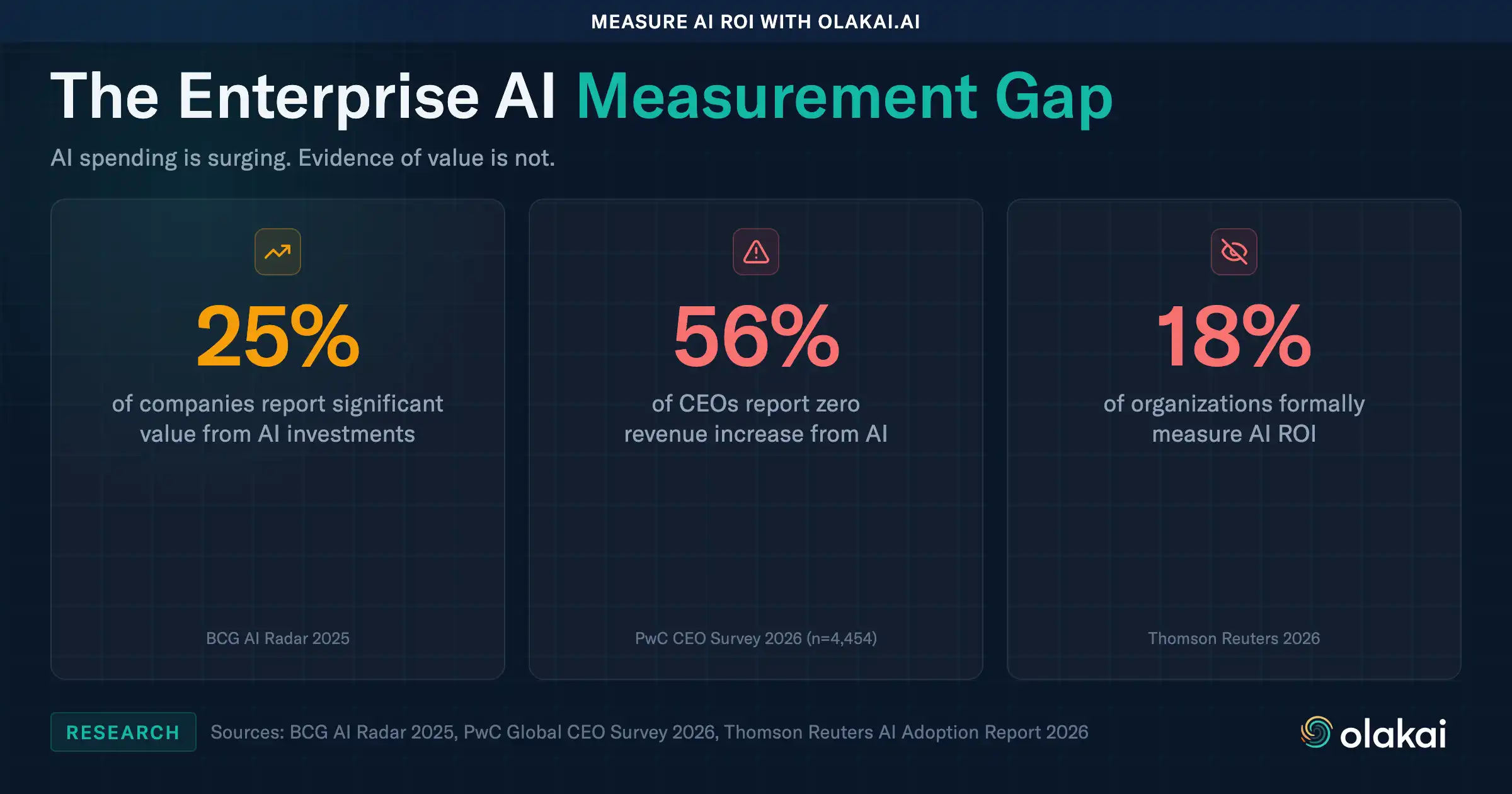
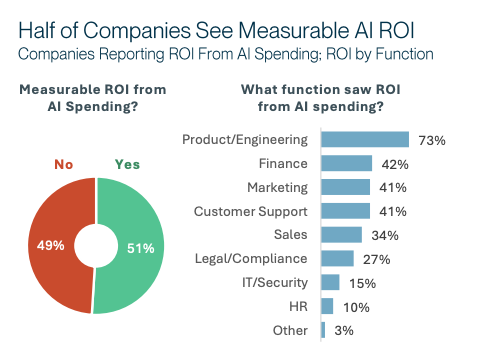
    The scale of this measurement gap is striking. According to McKinsey’s 2025 State of AI report, 88% of organizations report regular AI use in at least one business function. But only 39% report EBIT impact at the enterprise level. Organizations are spending on AI; they’re struggling to prove it’s working. S&P Global data shows that 42% of companies abandoned most of their AI projects in 2025—up from just 17% the year prior—often citing cost and unclear value as the primary reasons.

    This guide provides a practical framework for measuring AI ROI—one that works whether you’re evaluating a single chatbot or an enterprise-wide AI program.

    Why AI ROI Measurement is Hard

    Before diving into the framework, it’s worth understanding why AI ROI is harder to measure than other technology investments.

    Benefits are often indirect. When AI helps an employee work faster, the benefit shows up as productivity—not a direct cost reduction. Unless you’re tracking time saved and connecting it to business outcomes, the value remains invisible. The employee doesn’t disappear; they just do more. Proving the “more” matters requires discipline most organizations lack.

    Costs are distributed across model APIs, infrastructure, development time, training, change management, and ongoing maintenance. Without careful tracking, it’s easy to undercount the total investment. The API costs are visible; the engineering time spent debugging prompt failures often isn’t.

    Baselines are missing. How long did invoice processing take before AI? What was the error rate? Without pre-AI measurements, you can’t calculate improvement. Yet most organizations deploy AI first and ask measurement questions later—by which point the baseline is lost forever.

    Attribution is complex. When a sales team closes more deals, is it the AI-powered lead scoring, the new sales methodology, the improved economy, or the new sales leader? Isolating AI’s contribution requires experimental rigor that few commercial settings permit.

    The AI ROI Framework

    Effective AI ROI measurement requires four components working together: quantifying value created, capturing total cost of ownership, calculating ROI with appropriate rigor, and benchmarking against meaningful comparisons.

    The AI ROI Framework — $3.50 average return per $1 invested, four steps: value created, total cost, ROI calculation, benchmarking

    1. Value Created

    Quantify the benefits AI delivers across four categories.

    Time Saved: Calculate hours saved multiplied by fully-loaded labor cost. If an AI agent saves an accountant 5 hours per week on invoice processing, and that accountant costs $75/hour fully loaded, that’s $375/week or approximately $19,500/year in value. The formula is straightforward: hours saved per week times weeks per year times fully-loaded hourly cost. According to research, AI adoption is delivering 26-55% productivity gains for enterprises that measure carefully—but only if that saved time converts to productive work.

    Errors Avoided: Calculate the cost of errors prevented. If AI reduces invoice processing errors from 5% to 0.5%, and each error costs $150 to correct, and you process 1,000 invoices monthly, that’s $675/month or approximately $8,100/year in avoided rework. The formula: error rate reduction times monthly volume times cost per error times twelve months.

    Revenue Impact: For customer-facing AI, measure impact on conversion, upsell, or retention. If AI-powered lead qualification increases conversion from 3% to 4%, and average deal size is $50,000, and you process 100 leads monthly, that’s an additional $50,000/month or $600,000/year. This is where the biggest ROI potential lies—but also where attribution gets most difficult.

    Risk Reduction: For governance and compliance use cases, calculate the expected value of risk reduction. If AI reduces the probability of a $1M compliance violation from 5% to 1%, the expected value is $40,000 annually. Risk reduction is real value, even though it’s harder to celebrate than revenue gains.

    2. Total Cost of Ownership

    Capture all costs associated with the AI investment—not just the obvious ones.

    Direct costs include model API costs (per-token or per-call charges from AI providers), infrastructure (cloud compute, storage, networking), and software licenses (AI platforms, tools, orchestration software). These are the easy ones to track because they show up on invoices.

    Development costs include engineering time spent building, integrating, and testing; data preparation including cleaning, labeling, and pipeline development; and training and prompting work to fine-tune models and optimize outputs. These costs often get buried in general engineering budgets where they’re invisible to ROI calculations.

    Operational costs include maintenance (ongoing updates, monitoring, bug fixes), support (helpdesk and user support for AI tools), and change management (training, communication, adoption programs). Organizations consistently underestimate these ongoing costs.

    Hidden costs include governance overhead (compliance, audit, risk management), opportunity cost (what else could the team have built?), and technical debt (costs of workarounds and shortcuts that accumulate). These rarely appear in ROI models but determine whether AI investments compound or drain resources over time.

    3. ROI Calculation

    With value and cost quantified, calculate ROI using the formula: value created minus total costs, divided by total costs, times 100. For a more complete picture, also calculate payback period (months until cumulative value exceeds cumulative cost), net present value (present value of future benefits minus present value of costs), and internal rate of return (discount rate at which NPV equals zero).

    According to Gartner research, 45% of high AI maturity organizations keep initiatives in production for three years or more, compared to only 20% in low-maturity organizations. The difference isn’t luck—it’s rigorous measurement. IBM’s research found companies realize an average return of $3.50 for every $1 invested in AI, but that average masks wide variation between disciplined organizations and those hoping for magic.

    4. Benchmarking

    Context matters. Compare your metrics against pre-AI baseline (how did the process perform before AI?), industry benchmarks (how do similar organizations perform?), and alternative investments (what ROI could you get from other uses of capital?). Without benchmarks, even impressive-sounding numbers may represent underperformance.

    Key Metrics by Use Case

    Different AI use cases require different metrics. For customer support agents, track adoption rate (percentage of eligible users actively using the AI), task success rate (tasks completed without errors or escalation), cost per interaction (total cost divided by number of interactions), and user satisfaction (customer and employee ratings).

    For invoice processing, track data extraction accuracy (percentage of fields correctly extracted), touchless processing rate (invoices processed without human intervention), exception rate (invoices requiring human review), and cost per invoice (target: $2-6 versus $15-25 for manual processing).

    For sales research and lead qualification, track research completeness (required data points gathered), qualification accuracy (agreement with actual sales outcomes), time to completion (minutes from assignment to delivery), and intelligence freshness (average age of data sources).

    For governance and compliance, track policy compliance rate (interactions complying with policies), shadow AI detection rate (unauthorized usage identified), and audit pass rate (success rate on AI-related audits).

    Common Pitfalls

    Avoid these mistakes when measuring AI ROI.

    Counting activity, not outcomes: “The chatbot handled 10,000 conversations” sounds impressive—but did it actually resolve issues? Were customers satisfied? Did it reduce support costs? Activity metrics are easy to collect but often misleading. Focus on whether the activity produced the business outcome you wanted.

    Overestimating time saved: “The AI saves 30 minutes per task” only matters if that time converts to productive work. If employees fill saved time with low-value activities—or if the organization doesn’t capture the savings through higher output—the benefit is illusory. Organizations getting good results invest 70% of AI resources in people and processes, not just technology, ensuring that time savings translate to business outcomes.

    Ignoring maintenance costs: Pilot costs are easy to track; ongoing maintenance often gets lost in general IT budgets. Make sure you’re capturing the full lifecycle cost, including the engineering time spent fixing edge cases and handling failures.

    Missing the baseline: Without pre-AI measurements, you can’t prove improvement. Establish baselines before deploying AI, not after. This is the single most common and most fatal measurement mistake.

    Cherry-picking metrics: It’s tempting to highlight the metrics that look good and ignore the rest. Present a complete picture—including metrics that show room for improvement. Selective reporting destroys credibility when the full picture eventually emerges.

    Getting Started

    Ready to measure AI ROI? Begin by establishing baselines now—for any process you’re considering automating, measure current performance including time, cost, error rate, and volume before AI enters the picture.

    Define success metrics upfront. Before deploying AI, agree on what success looks like. What specific metrics will you track? Who owns them? How will you report? McKinsey found that CEO oversight of AI governance is the factor most correlated with higher self-reported bottom-line impact—especially at larger companies where executive attention ensures metrics connect to outcomes that matter.

    Instrument from day one. Build measurement into your AI deployment. Capture logs, track costs, and monitor outcomes from the start. Adding instrumentation after deployment is always harder than including it from the beginning.

    Review regularly. AI ROI isn’t a one-time calculation. Review monthly, adjust for learnings, and report to stakeholders quarterly. Gartner found that 63% of leaders from high-maturity organizations run financial analysis on risk factors, conduct ROI analysis, and concretely measure customer impact—that discipline separates them from the majority still struggling to prove value.

    Connect to business outcomes. Tie AI metrics to the numbers executives care about: revenue, margin, customer satisfaction, risk exposure. Technical metrics matter for optimization; business metrics matter for funding and support. The Future of Agentic guide to agent economics provides additional frameworks for connecting AI investment to business value.

    The Bottom Line

    Measuring AI ROI is harder than measuring other technology investments—but it’s not impossible. With clear frameworks, consistent measurement, and a focus on business outcomes rather than technical metrics, you can prove the value of AI investments and make informed decisions about where to invest next.

    BCG research shows only 4% of companies have achieved “cutting-edge” AI capabilities enterprise-wide, with an additional 22% starting to realize substantial gains. The 74% struggling to show tangible value despite widespread investment aren’t failing because AI doesn’t work—they’re failing because they can’t prove it works. Measurement is the differentiator.

    The enterprises that master AI ROI measurement will scale AI with confidence while others remain stuck in pilot purgatory.

    Need help measuring AI ROI across your organization? Talk to an expert to see how Olakai provides the visibility and analytics you need to prove AI value and govern AI risk.

  • 5 AI Use Cases Every Sales Team Should Know

    5 AI Use Cases Every Sales Team Should Know

    When a regional director at a Fortune 500 technology company analyzed where his sales team actually spent their time, the results were sobering. His top performers—the reps closing the biggest deals—were spending only 35% of their day actually selling. The rest went to research, data entry, follow-up emails, and preparing forecasts that were often wrong anyway.

    This isn’t unusual. Sales teams are under constant pressure to do more with less: more calls, more meetings, more deals—with the same headcount. According to research on AI in sales, 83% of sales teams using AI experienced growth in 2025, compared to 66% of teams without AI—a 17 percentage point performance gap. Teams that frequently use AI report a 76% increase in win rates, 78% shorter deal cycles, and a 70% increase in deal sizes.

    AI agents are changing the game by automating the tedious work that eats into selling time while improving the quality of every customer interaction. But not all AI use cases are created equal. Some deliver quick wins with minimal risk; others require significant investment but promise transformative results. Here are five AI use cases every sales leader should understand—from practical starting points to advanced implementations.

    Overview: Sales AI Use Cases at a Glance

    Use Case Typical ROI Complexity Time to Value
    Lead Qualification 6-10x Low 3-5 weeks
    Account Research 8-10x Low 2-3 weeks
    Deal Acceleration 10-15x Medium 3-5 weeks
    Sales Forecasting 12-15x Medium-High 4-6 weeks
    Competitive Intelligence 5-8x Low 2-4 weeks

    1. Lead Qualification: Score, Route, and Follow Up Automatically

    Marketing generates thousands of leads monthly, but sales teams waste precious time sifting through unqualified prospects instead of engaging with high-intent buyers. Response times stretch from hours to days, killing conversion rates. The vast majority of sales teams now use AI daily, with 52% using it specifically for data analysis including lead scoring, pipeline analysis, and forecasting.

    An agentic lead qualification workflow receives leads from forms, events, and campaigns, then scores them based on firmographic fit and engagement signals. It routes qualified leads to the appropriate sales representative by territory or expertise, then sends personalized follow-up emails within minutes rather than hours. Predictive lead scoring driven by AI enhances lead-to-customer conversion rates by as much as 28%—that’s not incremental improvement, it’s transformational.

    The impact compounds across the funnel. Organizations see a 30% increase in sales-qualified leads reaching reps, a 50% reduction in lead response time, and 6-10x ROI through sales productivity gains. For a deeper framework on measuring these gains, see our guide to measuring AI ROI in the enterprise.

    This is an ideal first AI use case for sales. The workflow is straightforward (score, route, follow up), integrations are standard (CRM, email, marketing automation), and the risk is low. You can start with simple scoring rules and add sophistication over time.

    2. Account Research and Buyer Intelligence: Enter Every Call Prepared

    Sales reps often enter calls unprepared, missing key stakeholders and failing to understand buyer context. Manual research takes hours and produces incomplete information, leading to weak first impressions and missed multi-threading opportunities. The reality is that selling time is precious, and every minute spent on research is a minute not spent building relationships.

    An account research agent changes this calculus entirely. It researches target accounts automatically, surfaces decision-maker profiles from LinkedIn, identifies all stakeholders involved in the buying process, maps organizational hierarchies, and analyzes buyer priorities based on news, financials, and company announcements. Reps receive comprehensive account briefs moments before calls—context that would take hours to compile manually, delivered in seconds.

    According to research on AI sales agents, sales representatives save 2-5 hours per week with AI, and teams report up to 44% more productivity. The impact on meeting quality is substantial: 30% reduction in research time, 20% higher meeting engagement scores, and 8-10x ROI through more effective conversations.

    Start with the most critical data points—company news, key executives, recent funding—and expand from there. Integration with LinkedIn Sales Navigator and news APIs is straightforward, and the use case delivers value from week one.

    3. Deal Acceleration and Bottleneck Detection: Revive Stalled Opportunities

    Deals often sit idle for weeks as reps forget follow-ups or lack clarity on next steps. Without visibility into engagement gaps, deals slip through cracks or extend sales cycles unnecessarily. By the time anyone notices, the opportunity may be lost to a faster competitor—or simple inertia.

    A deal acceleration agent continuously monitors velocity across the pipeline, identifying stalled deals that haven’t progressed in specific timeframes. It analyzes engagement history to find gaps, recommends specific next best actions based on deal context and stakeholder responses, and auto-generates personalized follow-up messages. The system learns from successful deals to improve recommendations over time.

    The numbers are compelling. According to research, 69% of sellers using AI shortened their sales cycles by an average of one week, while 68% said AI helped them close more deals overall. ZoomInfo documented a 30% increase in average deal sizes and a 25% faster sales cycle after adopting AI-driven pipeline management. The impact adds up: 25% faster sales cycles, 15% higher close rates on stalled deals, 40% reduction in lost opportunities, and 10-15x ROI through recovered revenue that would otherwise have slipped away.

    Getting started is straightforward. Define what “stalled” means for your business—7 days without activity? 14 days in the same stage?—then build rules to surface at-risk deals. Start with notifications before adding automated outreach.

    4. Sales Forecasting and Pipeline Inspection: Predict with Confidence

    Manual sales forecasting is time-consuming, frequently inaccurate (often off by 20% or more), and reactive to pipeline problems rather than anticipating them. Sales leaders struggle to identify which deals are truly at risk, leading to missed forecasts, revenue surprises, and difficult conversations with finance and the board.

    An AI forecasting agent continuously monitors the sales pipeline, analyzing deal progression and identifying risks like stalled activity, budget changes, and competitive threats. It predicts close probabilities using machine learning trained on your historical data, and flags deals requiring immediate attention. For deals forecasted to close within 30 days, leading AI systems achieve 90-95% accuracy—far better than gut instinct or spreadsheet models.

    Companies integrating AI into forecasting have seen accuracy improve by 40%, enabling better strategic decisions about hiring, capacity, and resource allocation. AI-driven CRM analytics result in a 20% increase in sales forecasting accuracy, improving operational decision-making across the organization. The impact is substantial: 30% increase in forecast accuracy, 40% reduction in forecast preparation time, 30% increase in average deal sizes through early intervention on at-risk opportunities, and 12-15x ROI through better resource allocation.

    This is a more advanced use case requiring clean CRM data and historical outcomes to train models. Start with rule-based risk flags, then layer in machine learning predictions as you accumulate data. The Future of Agentic use case library includes detailed sales forecasting architectures.

    5. Competitive Intelligence: Know Your Battleground

    Reps encounter competitors in nearly every deal but lack current intelligence on positioning, pricing, and weaknesses. (For how AI is transforming the other side of the revenue equation, see our guide to AI use cases for customer success teams.) Competitive information is scattered across wikis, Slack channels, and tribal knowledge—often outdated or incomplete by the time it reaches the frontline.

    A competitive intelligence agent continuously monitors competitor activity: website changes, press releases, product updates, and pricing changes. It synthesizes intelligence into battle cards that reps can access in the moment. It surfaces relevant competitive insights within deal context, and alerts reps when competitors are mentioned in accounts they’re working.

    The broader AI for sales and marketing market is forecasted to grow from $57.99 billion in 2025 to $240.58 billion by 2030, and competitive intelligence is one of the fastest-growing segments. Organizations see higher win rates against key competitors, faster ramp time for new reps who don’t need to absorb years of tribal knowledge, and 5-8x ROI through improved competitive positioning.

    Start by identifying your top 3-5 competitors and implementing basic monitoring (website changes, news mentions). Layer in win/loss analysis from closed deals to surface what’s actually working in competitive situations.

    Governance Considerations for Sales AI

    As you implement these use cases, governance matters more than you might expect.

    Data quality is foundational. Agents are only as good as the data they’re built on. Clean CRM data, accurate contact information, and complete deal records are prerequisites. Gartner (2025) finds that cross-functional alignment reduces AI implementation time by 25-30%, and much of that alignment involves ensuring data is reliable enough to power AI recommendations.

    Keep humans in the loop for high stakes. For deal acceleration and forecasting, consider maintaining human oversight for recommendations that could affect customer relationships or major resource decisions. AI should inform judgment, not replace it entirely.

    Measure outcomes, not just activity. Track whether AI-qualified leads actually convert, whether recommended actions actually accelerate deals, whether forecast accuracy actually improves. The goal is business results, not impressive-sounding metrics. For a framework on connecting AI activity to business outcomes, see our guide to AI ROI measurement.

    Start simple, then scale. Begin with one use case, prove value, build governance foundations, then expand. Trying to do everything at once is a recipe for failure.

    Getting Started

    If you’re ready to bring AI to your sales organization, start by auditing your current process. Where do reps spend time on non-selling activities? Where do deals stall? What data is missing or unreliable?

    Pick one use case—lead qualification or account research are ideal starting points with low complexity, high impact, and fast time to value. Define success metrics upfront, tying measurements to business outcomes (revenue, conversion, cycle time) rather than just activity. Build governance from day one by establishing logging, measurement, and oversight before deploying to production. For industry-specific guidance, see our technology and software industry page.

    The sales organizations that master AI will close more deals, faster, with fewer wasted hours. Salesforce reports that sales teams leveraging AI are 1.3 times more likely to experience revenue growth. That’s the gap between thriving and struggling in an increasingly competitive market.

    Want to see how leading sales organizations are implementing these use cases? Talk to an expert to learn how Olakai helps you measure ROI and govern AI agents across your sales stack.

  • What is Agentic AI? A Guide for Enterprise Leaders

    What is Agentic AI? A Guide for Enterprise Leaders

    If you’re an enterprise leader trying to make sense of AI, you’ve likely noticed a shift in the conversation. ChatGPT and copilots were impressive—but now there’s talk of agentic AI: systems that don’t just answer questions, but take action to achieve goals. What does this mean for your organization?

    The numbers suggest this isn’t hype. According to Gartner, 40% of enterprise applications will be integrated with task-specific AI agents by the end of 2026, up from less than 5% in 2025. That’s an 8x increase in a single year. McKinsey’s 2025 State of AI report found that 62% of organizations are already experimenting with AI agents, and 79% say they’ve adopted agents to some extent.

    This guide cuts through the hype to explain what makes AI “agentic,” how it differs from the chatbots and copilots you’re already using, and what enterprise leaders need to know as autonomous agents become a reality.

    The Evolution of Enterprise AI

    To understand agentic AI, it helps to see where we’ve been.

    Traditional AI (2020-2022) consisted of machine learning models that predict outcomes based on patterns. Think fraud detection scoring, demand forecasting, or customer churn prediction. These systems were powerful but passive—they required humans to interpret results and take action on the insights they provided.

    Chat AI (2023) brought large language models that respond to prompts with natural language. ChatGPT made AI accessible to everyone, enabling research assistance, content drafting, and customer service chatbots. But these systems had no ability to take action—they could only provide information and leave the execution to humans.

    Copilots (2024) represented AI assistants that augment human work with suggestions and completions. GitHub Copilot, Microsoft 365 Copilot, and Salesforce Einstein GPT define this generation. They’re context-aware and integrated into workflows, but humans remain in control of every decision. The AI suggests; the human decides and executes.

    Agentic AI (2025-2026) introduces autonomous systems that take action to achieve goals with minimal human intervention. These agents don’t wait for prompts—they plan multi-step workflows, use tools and APIs, and execute end-to-end processes. For a deeper exploration of how this evolution is unfolding, see our analysis of enterprise AI’s evolution from prediction to action.

    Six Core Characteristics of Agentic AI

    What makes an AI system truly “agentic”? According to Gartner, autonomous agents are combined systems that achieve defined goals without repeated human intervention, using a variety of AI techniques to make decisions and generate outputs. They have the potential to learn from their environment and improve over time. Look for these six characteristics.

    Autonomy means the system takes action without constant human input. It operates independently within defined boundaries and escalates only when necessary. Think of it like a trusted personal assistant who knows to book your recurring monthly flight without asking each time, but will check with you if prices exceed your usual budget. Gartner predicts that by 2029, agentic AI will autonomously resolve 80% of common customer service issues without human intervention.

    Planning enables the system to break down complex tasks into actionable steps. It creates execution plans and adjusts based on outcomes and changing conditions. Like a seasoned chef preparing Thanksgiving dinner—they know to start the turkey first, prep sides while it cooks, and adjust timing if guests arrive late. The planning capability is what transforms a responsive system into a proactive one.

    Tool Use allows the system to integrate with other systems via APIs, databases, and applications. It orchestrates multiple tools to complete end-to-end workflows. Think of a general contractor who doesn’t just plan your kitchen remodel—they actually pick up the phone to coordinate electricians, plumbers, and inspectors to get the job done. Agentic AI doesn’t just recommend calling the API; it calls it.

    Memory maintains context across interactions and sessions. The system remembers past decisions, user preferences, and workflow state. Like your family doctor who remembers your medication allergies from three years ago, your preferred pharmacy, and that you respond better to evening appointments. Memory transforms one-off interactions into ongoing relationships.

    Reasoning enables decisions based on goals, constraints, and context. The system evaluates trade-offs and selects optimal actions given the information available. Like a financial advisor who weighs your retirement goals against current cash needs and recommends whether to max out your 401(k) or pay down your mortgage. The reasoning is transparent and auditable.

    Learning allows the system to adapt from feedback, successes, and failures. It improves performance over time through experience and reinforcement. Like a barista who remembers you liked your latte extra hot last time, tries it that way again today, and asks for feedback to get your order perfect every visit. Learning agents get better the more they’re used.

    For a comprehensive exploration of these characteristics with interactive examples, the Future of Agentic guide to agent characteristics provides detailed analysis.

    Chat AI vs. Copilots vs. Agents: Key Differences

    Understanding the spectrum helps you set appropriate expectations.

    Dimension Chat AI Copilots Agentic AI
    Autonomy Level None—responds only when prompted Limited—suggests but doesn’t execute High—executes multi-step workflows
    Human Oversight 100% (every interaction) 80-90% (review before action) 10-30% (key decision points only)
    Task Complexity Single-turn Q&A Assisted completion Multi-step workflows
    Response Time Seconds Milliseconds to seconds Minutes to hours
    Cost per Interaction $0.001-0.01 $0.01-0.10 $0.10-1.00+
    Risk Level Low (information only) Medium (human reviews) High (requires governance)

    While generative AI focuses on creating content such as text, images, or code, agentic AI focuses on action. Adding task specialization capabilities evolves AI assistants into AI agents with the capacity to operate and perform complex, end-to-end tasks.

    Real-World Examples

    What does agentic AI look like in practice?

    Agentic Example: Invoice Processing. When an invoice exceeds $50K or has mismatched PO numbers, an agentic system automatically flags it, updates the status to “Review Required,” adds a comment explaining the anomaly, and sends a Slack message to the appropriate approver based on department and amount thresholds. No human initiated these steps—the agent made decisions and executed actions autonomously based on policy and context.

    Agentic Example: Travel Booking. An employee submits a trip request: “Book me a flight to San Francisco next Monday, staying until Thursday.” The agent searches flights, books the cheapest option under $500 per company policy, reserves a hotel near the office, creates an expense report pre-filled with trip details, updates the employee’s calendar, and sends a confirmation email with the complete itinerary—all without human intervention.

    Not Agentic: Code Completion. A developer uses an AI-powered code editor that predicts what they’ll type next. The AI suggests function completions, but the developer must explicitly accept each suggestion. This is a copilot pattern—sophisticated assistance, but no autonomous execution. The human remains in the loop for every action.

    Why This Matters for Enterprise Leaders

    The shift to agentic AI has significant implications that go beyond technology decisions.

    Higher stakes. When agents take action autonomously, mistakes have real consequences. A chatbot that gives wrong information is annoying; an agent that executes wrong actions can cost money, damage relationships, or create compliance issues. Deloitte’s 2025 study found that while 30% of organizations are exploring agentic options and 38% are piloting solutions, only 14% have solutions ready to deploy and just 11% are actively using agents in production. The gap reflects how seriously enterprises are taking the governance requirements.

    New governance requirements. You need visibility into what agents are doing, controls to prevent unauthorized actions, and the ability to audit decisions after the fact. Traditional IT governance wasn’t designed for autonomous systems. Gartner predicts that guardian agents—specialized agents focused on governance and oversight—will capture 10-15% of the agentic AI market by 2030. For a comprehensive framework, see our AI governance checklist for CISOs.

    Different ROI model. Agents cost more per interaction but can deliver dramatically higher value by completing end-to-end workflows. The economics shift from “cost per query” to “value per outcome.” In a best-case scenario, Gartner projects agentic AI could generate nearly 30% of enterprise application software revenue by 2035—surpassing $450 billion. For a framework on measuring this value, see our AI ROI measurement guide.

    Workforce implications. Agents won’t replace humans wholesale, but they will change what humans do. Many roles will shift from execution to oversight and exception handling. By 2028, Gartner predicts 33% of enterprise software applications will include agentic AI, enabling 15% of day-to-day work decisions to be made autonomously. Organizations need to prepare their workforce for this shift.

    The Multi-Agent Future

    Just as monolithic applications gave way to distributed service architectures, single all-purpose agents are being replaced by orchestrated teams of specialized agents. Gartner reported a staggering 1,445% surge in multi-agent system inquiries from Q1 2024 to Q2 2025. By 2028, Gartner predicts 70% of AI applications will use multi-agent systems.

    This evolution means enterprise AI will increasingly involve ecosystems of specialized agents working together—finance agents, HR agents, security agents, customer service agents—coordinating to complete complex workflows that span organizational boundaries.

    Getting Started with Agentic AI

    If you’re considering agentic AI for your enterprise, start with low-risk, high-volume use cases. Lead qualification, invoice processing, and IT ticket routing are common starting points where autonomous action delivers clear value with manageable risk. 50% of enterprises using generative AI are expected to deploy autonomous AI agents by 2027, doubling from 25% in 2025.

    Build governance from day one. Don’t wait until you have a dozen agents to think about visibility, controls, and measurement. Establishing governance foundations early prevents painful retrofitting later. Our AI risk heatmap framework helps you match governance intensity to risk level.

    Measure what matters. Track not just agent activity but business outcomes: time saved, error rates, cost per transaction, and ROI. Without measurement, you can’t prove value or identify problems before they become crises.

    Plan for scale. Pilot projects often succeed; scaling is where most enterprises struggle. Consider how your infrastructure, governance, and change management will handle 10x the agents before you need to find out.

    The Bottom Line

    Agentic AI represents a fundamental shift from AI that informs to AI that acts. For enterprise leaders, this means new opportunities for automation and efficiency—but also new requirements for governance, measurement, and oversight.

    The enterprises that thrive will be those who embrace agentic AI while building the guardrails to use it responsibly. That means investing not just in the agents themselves, but in the infrastructure to measure their impact, govern their behavior, and ensure they’re delivering real business value.

    Ready to implement agentic AI with confidence? Talk to an expert to see how Olakai helps enterprises measure ROI, govern risk, and scale AI agents responsibly.