
Use case: AI ROI
Prove what your AI program is worth. In dollars, not demos.
Only 14% of CFOs say AI is delivering significant ROI today, and most CIOs cannot point to measurable value a year after rollout. The problem is rarely the AI. It is that nobody is measuring it. Olakai measures every copilot, AI coding tool, and autonomous agent against business outcomes, vendor-neutral by design, so you can prove the return to the board and decide what to scale, fix, or retire.
Interactive example of return per AI motion from the same measured data: autonomous agents against their run cost, assistive applications against their seat cost, and coding, where the value is measured but the cost cannot be isolated until API keys are attributed. Illustrative data from the Olakai demonstration environment, not customer data.
Every vendor reports adoption. Nobody reports return.
Gartner‘s 2026 survey of more than 2,000 CIOs found that 13% report significant or transformational value from AI, and only 17% have criteria for retiring AI that is not paying off. RGP‘s 2026 CFO research puts the share of finance chiefs seeing significant AI ROI at 14%. Every tool you bought came with a dashboard that counts prompts, seats, and suggestions. None of them tells you what the work was worth.
Olakai is the measurement layer above every vendor: value created, cost incurred, and the return, for the whole AI program in one view. It is the system of record the finance, security, and engineering conversations all draw from.
13%
of CIOs report significant or transformational value from AI (Gartner, 2026 CIO survey)
14%
of CFOs say AI is delivering significant ROI today (RGP, 2026 CFO research)
17%
have criteria for retiring AI that is not paying off (Gartner, 2026)
What you get
What you get with Olakai
Measure
One ROI number across every AI tool
Chatbots, copilots, AI coding tools, and autonomous agents, from every vendor, measured on the same basis. Time saved converted to dollars and to AI Equivalent Engineers. Cost reconciled to real bills where the provider exposes them. See how Olakai measures ROI.
Attribute
Value by team, tool, and persona
Who is getting value, where it concentrates, and which licenses sit idle. The adoption cohorts in Olakai Assistive separate power users from seats nobody touched, so the next renewal is a decision instead of a renewal.
Decide
What to scale, fix, or retire
Pilot purgatory ends when a pilot has a number. Olakai gives every AI investment a value-versus-cost position and a trend, custom KPIs tie it to the outcome you care about, and Kai explains the math when the board asks.
Olakai Agentic: return per agent
Every agent’s return on its run cost. At the value of an hour you choose.
An agent’s value is the hours it gives back, and the hours are only worth what you say they are. Olakai measures each agent’s runs, the time they replaced, and what those runs cost, then reports return per agent and per group. The value-of-an-hour slider is the assumption made visible: move it and every return recomputes, which is the conversation finance wants to have before it trusts the number. Agent governance supplies the runs; Olakai Agentic supplies the cost.
Interactive example of return on run cost per agent. Drag the value-of-an-hour slider and every return recomputes; the group pills filter to business, workflow, or standalone agents; the tiles total return per group. Illustrative data from the Olakai demonstration environment, not customer data.
Return per agent
Value returned divided by run cost, for every agent, with the business, workflow, and standalone groups filterable.
One explicit assumption
The value of an hour is a slider, not a buried constant, so the board can see the number at $40 and at $90.
Group tiles
Return per group on the same screen, so a workflow’s orchestrator and its workers are judged together.
Olakai Assistive: seat economics
Seat return and idle cost, from the same two assumptions.
Adoption is not value, but value never shows up without it. Olakai Assistive maps actual usage of ChatGPT, Claude, Microsoft Copilot, and 1,100+ AI tools to the people and seats behind it, then computes seat return against seat cost, the cost of seats nobody used, and how many people fall under a light-use threshold you set. Two sliders, the value of an hour and the threshold, drive every figure, so the renewal conversation starts with the assumptions on the table.
Interactive example of the seat economics calculator. The value-of-an-hour slider sets what a saved hour is worth; the light-use slider sets how many licensed interactions count as light use. Together they drive seat return, idle seat cost, the light-user count, the per-app active-versus-configured seat table, and the histogram of interactions per person with the threshold marked. Illustrative data from the Olakai demonstration environment, not customer data.
Seat return
Value created in licensed applications against the configured seat cost, per app and in total.
Idle seat cost
Seats paid for with no active user this period, as a monthly figure you can act on at renewal.
Light users
People under the interaction threshold, with the histogram showing where the threshold cuts.
Kai: board-ready answers
Ask the board question. Get the board answer, with the reasoning.
Kai is the conversational layer across Olakai Agentic and Olakai Assistive. Ask it what the AI program returned last quarter, which tools to cut, or whether a pilot is on track to justify its budget, and it answers in plain English with the chain of reasoning and the numbers behind it. The 60-second version of a board deck.
- “What was our AI ROI last quarter, by department?”
- “Which AI tools are generating value, and which should we not renew?”
- “Is the customer-support agent pilot on track to pay for itself?”
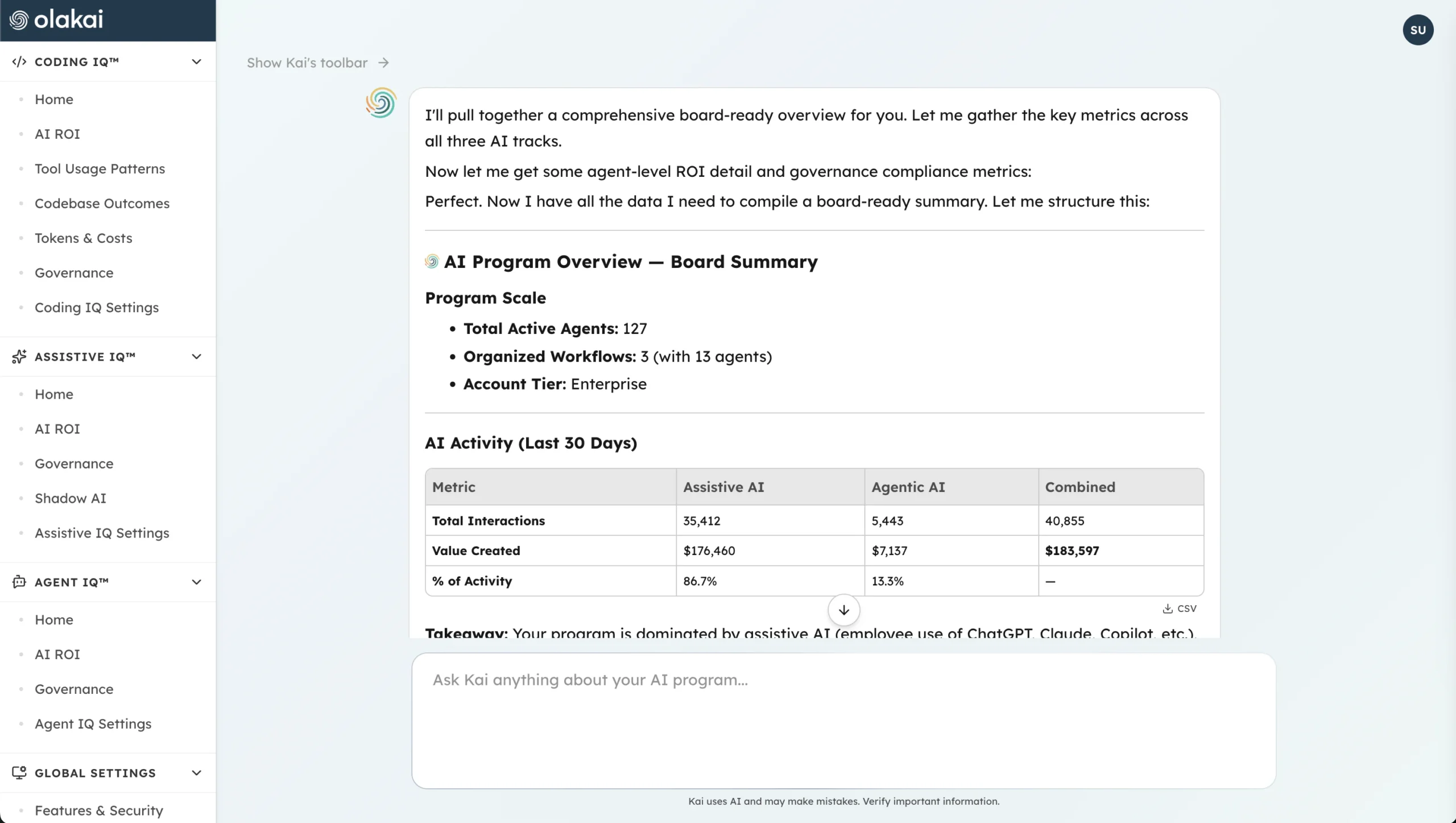
Every number in Olakai is clickable down to the interactions it came from. That is what makes it auditable, and what makes it survive the CFO’s second question.
Related use cases
One platform. ROI, spend, governance, and engineering impact from the same data.
“What did we spend on AI last quarter, what did it return, and what should we do differently next quarter?”
The same measurements that produce the ROI number drive spend control, governance, and engineering impact. Across Olakai Agentic and Olakai Assistive, deployed as SaaS or inside your own walls, with integrations for every AI data source you already have.
Use case
FinOps for AI
Allocation by team and project, run-rate forecasts, and alerts before the overrun. Cost per PR, not cost per token.
Use case
AI Governance
Every tool and agent discovered, including shadow AI. Policy and DLP enforced at the point of use, audit trail kept.
Use case
AI Engineering Productivity
Cycle time, review time, and cost per PR for AI-assisted work, measured on your own repos. Nothing to install.