Category: Industry Analysis

Market trends, acquisitions, and competitive landscape

  • The Cache Tax: Where DeepSeek’s Price Increase Is Concentrated

    The Cache Tax: Where DeepSeek’s Price Increase Is Concentrated

    From Enterprise AI Weekly, recorded 14 August 2026. On Tuesday I said compute gets more expensive from here and that the falling price per token was the wrong number to watch. I got a couple of messages telling me I was being dramatic, which is fair, and I probably was a little. Then three companies repriced in the same week.

    DeepSeek raised prices for the first time

    I want to be fair to DeepSeek here, because they are a large part of the reason any of us have cheap inference at all. They started the price war, and they are the company everybody cites when they tell you AI is getting cheaper. On Wednesday they announced their first ever price increase: peak and off-peak pricing, live from Sunday, with Chinese business hours costing double the rest of the day. Against the flat rate that preceded it, the peak output price is up more than four times. The wording was that this would allocate resources more reasonably, which is a polite way of saying they are short of compute and have started rationing it with price.

    The cache tax

    There is a second layer to that announcement I have not seen covered anywhere, and honestly I only found it because I went looking at the cache line specifically. This is a little geeky, so bear with me. The headline model prices went up three to four times. The cached input price went up about twelve.

    Cached input is what agents run on. Long system prompts, the same context re-read every turn, retrieval, tool loops, which is precisely the workload everyone is scaling right now, me included. So the increase is concentrated in the one line item that agentic workloads consume most of, and if you built an agent budget on a cheap cache hit, it changed on Sunday. That is the part worth carrying out of this week, and it is the reason I would go back through any 2027 business case that assumes cost per token keeps falling.

    And it is not only them

    Google shipped Gemini 3.7 Flash on Thursday at $0.75 per million in and $3.75 out, which is a good price. It is also an introductory price that doubles on 1 January, and to their credit they said so in the launch post, so you can plan around a date. Grok 4.6 shipped at $2 in and $6 out, also good, until you cross 200,000 tokens of context, at which point the whole request reprices at double. Not the overflow, the entire request. That is the one that would catch me out, because nobody sets a context length on purpose. It just grows.

    What that costs in practice

    Take one realistic agent task at 10 million tokens in and 1 million out. The cheapest model on the market runs you about $1.70. The most expensive runs about $150. That is 89 times, for the same job. I ran it twice because I did not believe it the first time. And the cheapest number on that chart expired that weekend, which is worth remembering the next time you read a post explaining to people who do not buy compute that compute is getting cheaper.

    An 89x spread on an identical task is a routing decision before it is a procurement decision, and it is the same argument I made about matching the model to the task, only with a wider gap and a deadline attached. It is also why a falling rate card and a rising bill keep coexisting: the menu got cheaper at one end while the workload moved to the other.

    The quote I keep coming back to

    OpenAI’s enterprise lead told TechCrunch that six months ago every customer conversation was about what the model can do and whether it is good enough. Then he said this:

    Our conversations are never about that now. Now the conversations are about we are spending so much. What visibility do you have? What auditability do you have? What token controls do you have?

    OpenAI’s enterprise lead, to TechCrunch

    That is the company selling you the tokens, describing what its own customers now ask for. They sit on the other side of the invoice from you, and that is what they hear all day. I do not know about you, but I found it more convincing than anything I could have written this week. Customers stopped asking whether it works and started asking what it costs, and in the space of five days three vendors made it cost more.

    Visibility, auditability, and token controls is a fair description of what a measurement layer has to do, and it is notable that the list came from a vendor rather than from me. Those three words are also, roughly, the order in which enterprises acquire the capability: you see the spend, then you can explain it, then you can bound it. Most of the organisations I speak to are somewhere in the first stage and budgeting as though they were in the third.

    So the check this week is narrow enough to run on Monday. Do you know what share of your token spend is cached input, and would you notice if its price moved under you? Do you know which of your agents sit above a 200,000 token context on a normal day, given that the threshold reprices the whole request rather than the excess? And is anything in your stack watching the vendors’ own pricing pages, given that one of this week’s three increases was published with a date on it months in advance?

    None of that requires a project. It requires a record of what you are already spending, broken down far enough to answer a question somebody else set, which is the same reason an agent portfolio needs splitting by agent before anyone can say which parts of it earned their keep.

    If you think I have this wrong, tell me, I welcome that all day long. And if you would rather see your own number than argue about mine, that is the work.


  • Uber Blew Through a Year of AI Budget in Four Months. The Guardrail It Built Next Already Existed.

    Uber Blew Through a Year of AI Budget in Four Months. The Guardrail It Built Next Already Existed.

    Before Uber capped anything, it did the opposite. The company encouraged employees to use AI coding tools “as much as possible” and put usage on internal leaderboards — a competitive, public ranking of who was generating the most AI activity, with no ceiling attached. Four months later, Uber’s CTO told the company it had blown through its entire annual AI budget. Not a quarter’s worth. Not a soft warning at 80%. The whole year, gone in a third of it, discovered only after the money was already spent.

    The fix Uber built next is real infrastructure, not a memo. According to TechCrunch’s reporting, Uber now caps AI spending at $1,500 per employee, per month, per agentic coding tool — a separate limit for each of Claude Code and Cursor, so maxing out one doesn’t touch the budget for the other. Employees can track their own usage against the cap through an internal dashboard, and the limit can be exceeded with permission when the work genuinely calls for it. That’s a legitimate governance mechanism, built under real pressure, by a company that clearly has engineers capable of shipping it fast. It’s also the second half of a story worth sitting with: the guardrail arrived after the crash, not before it.

    A flat cap catches the symptom, not the trajectory

    A per-employee, per-tool monthly ceiling is a real control, and it’s a meaningfully better position than the leaderboard-driven free-for-all that came before it. But it’s also a blunt instrument compared to what a purpose-built AI spend governance system actually does. A flat cap tells an employee “no” at $1,500 with no earlier signal along the way. It doesn’t distinguish between a team burning through budget in the first ten days of the month versus one pacing evenly across thirty. It has no program-level ceiling sitting above the per-tool one, and no way to see a provider-wide spend trend across every developer at once — just individual caps, checked individually, after the spend has already happened.

    Compare that to what a real budget mechanism looks like when it’s built to catch the problem before month-end rather than cap it after the fact. Olakai’s own AI Spend Governance runs a daily run-rate forecast against every budget — program-wide, per-provider, per-developer — and fires two different kinds of alerts: one when actual spend crosses a threshold (50%, 80%, 100% of the limit), and a second, more useful one, when the trajectory alone is on pace to blow through the budget by month-end, even while spend is technically still under the line today. That second alert is the exact warning Uber didn’t have in month three, when the company was still four to six weeks from finding out the hard way.

    The other half of the problem: nobody could say what the spend bought

    Spend control is only half of what went wrong at Uber, and arguably the easier half to fix. The harder admission came from COO Andrew Macdonald, who said on a podcast that “it’s very hard to draw a line” between the company’s AI usage and the new consumer features it had shipped. That’s a striking thing for a public company’s COO to say on the record — not “AI isn’t working,” but “we genuinely can’t tell.” A company that spent a full year’s AI budget in four months, driven by a leaderboard that rewarded activity over outcome, and then couldn’t connect that activity to a specific shipped result, wasn’t missing a budget cap. It was missing a way to measure value at all.

    That’s the pattern that should worry a CFO more than the overspend itself. A budget overrun is a one-time, fixable embarrassment. A COO unable to say whether a year of AI spend produced anything measurable is a standing problem that a hard cap doesn’t touch — Uber can enforce $1,500 per employee per tool forever and still not know if that $1,500 is buying real developer output or just more prompts on a leaderboard. Spend control and value measurement are usually treated as two separate initiatives, owned by two different teams, on two different timelines. They’re actually the same problem: you can’t govern spend you can’t see clearly, and you can’t prove ROI on spend you’re not governing.

    What the next version of this story should look like

    Uber isn’t unusual for having gone through this — it’s unusual for having said so publicly. Most companies encouraging “use AI as much as possible” this year, with no program-wide budget ceiling and no forecast catching the trajectory early, are somewhere on the same four-month timeline Uber already lived through; they just haven’t hit the wall yet, or haven’t been reported on when they did. The version of this story worth aiming for isn’t “we built a cap after the crisis.” It’s a unified view of AI coding spend and AI coding value from day one — budgets that alert before the month closes, not after, and a productivity signal sitting right next to the cost one, so nobody’s COO has to say “it’s very hard to draw a line” on a podcast eighteen months in.

    If your organization is somewhere on that same trajectory — multiple AI coding tools, growing spend, and no clear answer yet to “what did this actually buy us” — the better time to build the guardrail is before the invoice, not after. Talk to an Expert about what proactive AI spend governance looks like against your own provider data.

  • Even Google Can’t Ship Its Best AI

    Even Google Can’t Ship Its Best AI

    TSMC bet another $100 billion this week. Google can’t ship its best model. And the evaluations that actually decide enterprise AI purchases just went private. Here is what the week is telling anyone managing an AI budget.

    What a week to read the room. A few AI stories underneath the market’s rough run tell you exactly where this is heading. The fast version first, then the one thing worth teaching.

    The boom is very real

    Earlier this month, IBM had its worst single-day stock drop since 1987 after warning that AI-infrastructure spending was diverting client budgets away from its own software and services lines — the AI bill eating into every other line of the budget, a pattern we track closely on Olakai’s analytics and custom KPI pages. That story kept going, and two new ones landed on top of it.

    First, TSMC, the company that actually makes the chips, had a monster quarter: profit up 77%, and it committed another $100 billion to factories in Arizona on top of what it had already pledged, taking its total US commitment to around $265 billion. Chairman C.C. Wei’s line: “AI-related demand continues to be extremely robust.” Nobody puts a quarter-trillion dollars into fabs unless they are very sure the demand is coming.

    But here is the part any AI budget owner should notice. TSMC also flagged that the memory shortage is now squeezing parts of the market that have nothing to do with AI. The same force that hit IBM. Chips up, memory up, and eventually the cost of everything running on top of them, up. The AI buildout has a downstream tax, and it is coming for procurement lines that have never touched an AI vendor.

    The story worth sitting on: Google

    Google delayed its flagship model again. Gemini 3.5 Pro slipped, the stock dropped, and Alphabet shed serious market value this week. Forget the model horse race for a second and look at why. The reported reasons were token efficiency problems and long-horizon task performance.

    Sit with that. One of the most capable AI labs on the planet is holding back its best model, in part, because it uses too many tokens. Even Google is fighting the efficiency battle, which is the exact thing we have been teaching for months in pieces like how model routing turns token efficiency into a budget lever. Token efficiency is becoming the frontier metric. Not just how smart a model is, but how much it burns to be smart.

    The lesson buried in the delay

    There is a second lesson in the Google story worth pulling out. Flagship launches now wait on something, and it is not a leaderboard. It is private buyer evaluations. Enterprises do not sign contracts on a public benchmark score, which is fascinating on its own — they run the model against their own data, in their own harness, and that harness never gets published.

    What that means for any AI budget owner: a leaderboard win that does not clear procurement is a press release. The score that matters is the one run against a company’s own workload. We made this same point about coding models in the Cursor CFO Council breakdown, where cost per request lies and cost per accepted line tells the truth. Same principle, bigger stage. The public number is marketing. A company’s own number is the truth, and the only way to have that number is to measure it — to get the visibility and the control over tokenomics that a vendor’s press release will never hand over.

    If proof that efficiency is where the game is now is needed, look back at the Cursor data broken down that same week: once caching is counted, output tokens were 0.6% of total usage, and without caching the bill would have run roughly ten times higher. Google is fighting the same fight at the model level that every enterprise is fighting at the usage level. Everybody, all the way up to Google, is learning that spending wisely beats spending big.

    What is coming next

    One more item, because it is the shape of what is next. Nvidia launched Cosmos 3 Edge this week, a model for robots and physical AI, and Jensen Huang is calling physical AI the next frontier: factories, warehouses, healthcare robots.

    Here is why that is worth flagging now, not later. Every one of those is a brand-new category of AI consumption, tokens, compute, inference, running in the physical world, that nobody has a budget line for yet. A year ago, most finance teams were not thinking about tokens as a quarterly CFO line item. Now they are, per the CFO-facing shift covered in what CFOs need from AI ROI reporting. Physical AI is next. If tokenomics feels like a headache now, wait until the warehouse forklift has an inference bill.

    The read

    The boom is loud. TSMC just bet another hundred billion on it. But proof got quiet. Even Google cannot show its next model is efficient enough to ship, and the evaluations that actually decide purchases have gone private, inside each buyer’s own harness.

    Loud spending, quiet proof. The winners from here will be the enterprises that can measure their own AI, on their own workload, across every vendor in one place, and show what it returned — while everyone else is still reading someone else’s leaderboard. That gap between public marketing numbers and a company’s own verified return is precisely the space Olakai’s vendor-neutral measurement layer is built to close, whether the tool in question is a chatbot, a coding agent, or the next physical-AI deployment nobody has budgeted for yet.

    One question for the week: is your organization still trusting the leaderboard, or does it run its own evals?

    Talk to an Expert →

  • The AI Bill Is Eating Everything Else

    The AI Bill Is Eating Everything Else

    From the AI ROI Series, recorded 14 July 2026. IBM lost about $55 billion in market value in a single session, the stock fell more than 20%, and it was the company’s worst day since 1987. Preliminary second-quarter revenue came in at $17.2 billion against a consensus near $17.86 billion.

    The reason came straight from CEO Arvind Krishna. In the final weeks of June, clients redirected their capital expenditure toward servers, storage, and memory, racing to lock in supply-constrained infrastructure before prices climbed. In his words, IBM “did not anticipate the magnitude of the capex reprioritization.” And then, rather more bluntly, “this quarter we faltered.”

    Almost everyone covered this as a company having a bad quarter, which it plainly was. Infrastructure fell 7%, large software deals that were supposed to close did not, and consulting was roughly flat. I look at it from my seat, which is spent inside enterprise AI budgets, and from there the interesting part is where the money went rather than which line it came out of.

    The tell is what happened to everyone else

    Accenture, Cognizant, ServiceNow, Adobe, and Workday all sold off on somebody else’s earnings, which is the market pricing a pattern rather than a company. Enterprise AI spending is still climbing, and the thing worth understanding is that it is now climbing at the expense of the budget lines next to it. Every dollar going into compute, memory, and tokens is a dollar that did not go into software licenses, consulting engagements, and the rest of what an enterprise buys.

    Which means every line item in your budget now has to justify itself against the AI line item, and that includes the AI line item itself. When AI is the thing crowding out everything else, AI had better be able to show what it returned. So let us look at where that money actually goes, because I promised those numbers and, honestly, they surprised me.

    Where the token money actually goes

    WhatShareWhy it matters
    Input tokens, reading your codebase~90% of token usageYou pay mostly to read, not to write
    Input tokens as a share of cost~70%The cost lives on the input side
    Output tokens, once caching is counted0.6% of usageWriting the code is a rounding error
    Cost without caching~10x higherCaching is the biggest hidden lever in the bill
    Source: Cursor aggregated usage data, via The Pragmatic Engineer. Figures as at July 2026.

    That table upends how most people picture their coding bill. The money goes on having the model read your codebase and your documentation, over and over, on every turn. Output is very nearly a rounding error at 0.6% of usage once cache reads are counted, and Cursor’s own data says that without smart caching the cost would be roughly ten times higher. Caching sits somewhere between a tuning detail and the single largest variable in the invoice, and most organisations I talk to have never looked at it.

    The correction I owe you

    Here is a number that complicates something I have been saying for months, so let me be straight about it rather than quietly move on.

    ModelCost per agent requestCost per accepted line
    Opus 4.7~$1.57roughly equal to GPT-5.5
    GPT-5.5~$0.81roughly equal to Opus
    Composer 2.5~$0.18cheapest per request
    Source: Cursor aggregated usage data, via The Pragmatic Engineer. Figures as at July 2026.

    Opus costs about twice as much per agent request as GPT-5.5, and on that number alone it looks like an easy cut. Measure cost per line of code that actually survives review, though, and the two land in roughly the same place, because more of the expensive model’s output gets accepted. So the simple version of the routing argument, which is to send everything to the cheaper model, turns out to be too simple. Routing is still right, and it is still the highest-leverage lever available, but the unit you route on has to be cost per accepted output. Optimise the wrong unit and you will cut the bill while quietly destroying the value underneath it, which is the same trap as measuring acceptance rate on its own.

    The governance number in the same dataset

    One more figure, and it is the one that should make a CTO put down their coffee. In the span of a single month, the share of developers letting AI agents commit code with no manual review went from about 10% to around 40%. Four in ten developers are no longer personally checking the output. So you are paying for tokens, on input you are not measuring, producing code that increasingly nobody reads, inside a stack where you cannot see what any of it returned. The cost problem and the governance problem are arriving in the same quarter, which is inconvenient, because most organisations have separate teams and separate timelines for the two.

    What the AI natives are doing about it

    Perplexity is quietly building its own internal coding tool, codenamed Teammate, to run software projects end to end. Two things about that are worth your attention. The first is the economics: if you are an AI company paying a model vendor for tokens, you are funding a competitor, so you build. The second is that Teammate is deliberately model-agnostic. They are designing routing in from day one, because they understand that locking yourself to a single model is a cost trap and a capability trap at once. The companies closest to the tokens are the ones being most disciplined about them, and that is worth sitting up for.

    Their CTO reportedly told engineers they should be able to “stop looking at code” by the end of the year. Put that next to the 40% who already are not, and the direction is not especially subtle.

    The uncomfortable question for consulting

    Now the part that will be uncomfortable for a lot of people reading this. If AI agents do work that used to be billable hours, what is an hour worth? IBM’s consulting line was flat while clients poured money into compute, and Accenture and Cognizant sold off on IBM’s numbers, so the advisory world is standing directly in the crossfire of the capex shift.

    I do not think consulting is finished, and the change contains a genuine opportunity, because consultancies are exactly who enterprises turn to and ask to prove the AI is working. That is the highest-value question in the market right now, and it is not one you can answer by the hour: a quarterly slide deck is a photograph, and the meter runs every second. Proving AI value has to be instrumented, continuous, and measured at the token level, tied to what actually shipped, which is a product problem rather than an engagement problem. The firms that productise that measurement will win an enormous amount of work, and the ones attempting it manually will be compressed by the technology they are advising on.

    What to check this quarter

    This is directional, as always, and you should check my math against your own invoices rather than take mine. But three things follow, and they are checks rather than recommendations. Can you see what share of your coding spend is input rather than output, and do you know whether caching is switched on across every tool you pay for? Do you route on cost per accepted output, or on cost per request, which is the number your vendor console happens to show you? And can you say what proportion of AI-written code in your repositories was reviewed by a person, which is a question about your own engineering data rather than about any vendor’s dashboard.

    Most organisations cannot answer the first, guess at the second, and have never asked the third. That gap is the reason a measured view of AI ROI stopped being a reporting exercise this year, and it is why the record of what your AI did, kept across every tool and every token, is the thing I would build before the next budget cycle rather than after it. The capex reckoning is already deciding which line items survive.

    One question worth taking into your next budget review, and you can answer it from what you already have: if AI ate into your budget this year, what did it give back, and can you show it?

    I’m Paul, co-founder of Olakai. Measuring what AI actually costs and what it actually returns, across every tool and every token, is the work I spend my days on. Your AI is an investment, so let’s measure it like one.

  • Companies Are Cutting Jobs to Pay for AI. Can They Prove It’s Working?

    Companies Are Cutting Jobs to Pay for AI. Can They Prove It’s Working?

    The jobs apocalypse arrived, and it is being funded by payroll. If a company is trading people for an AI bet, the bar to prove that bet is working just became the highest it has ever been.

    On Monday, Microsoft cut about 4,800 jobs, roughly 2.1% of its workforce, with its Xbox division heading toward 3,200 cuts, a fifth of that organization, on top of more than 15,000 the year before. Across the tech sector, more than 123,000 jobs have been cut in 2026 so far, up 66% from the prior year, and for three months running, outplacement firms have named AI as the leading driver.

    Now hold that next to the other number. Microsoft is projecting around $190 billion in capital expenditure this year, more than $100 billion of it on AI and cloud, two-thirds of that on AI chips. Across Big Tech, AI outlays are set to top $700 billion in 2026. This is the same pattern we flagged in April when Meta paired a $53 billion capex increase with 14,000 job cuts and the market barely blinked, a story we broke down in Meta’s AI capex bet versus the market’s muted reaction. Microsoft’s version of the trade is bigger, and it is not an isolated data point. It is the pattern becoming the norm.

    Why this is scarier than replacement

    If AI were simply doing the work better, the math would be clean. It is not clean. It is a bet, an enormous one, and the market has started asking whether it pays. Microsoft’s stock fell 23% in the first half of 2026, wiping out roughly $1.2 trillion in value, as investors openly questioned whether an AI outlay of that scale will return in proportion to its size. The largest, most sophisticated software company on earth is being punished for spending it cannot yet prove.

    These jobs are not being replaced by AI that got too good. They are being traded to fund the bet that it eventually will. An analyst quoted by D.A. Davidson put the quiet part out loud: Microsoft has been managing down its workforce in order to pay for its AI investments. That is the story of this moment in one sentence.

    And the timing could not be more brutal. At the exact moment the pressure to show returns is highest, roughly one in five leaders admit the AI reports reaching them are rosier than reality: bad news softened, failures kept quiet. That gap between the story leadership hears and the truth on the ground is where the next round of cuts gets justified on numbers that were never real. It is exactly the blind spot we described in the AI visibility audit — you cannot govern what you cannot see, and a rosy dashboard is worse than no dashboard at all.

    The accountability bar went up, not down

    For anyone holding an AI budget, the implication is direct. If a company is trading headcount for an AI bet, the bar to prove that AI is actually delivering is not lower now. It is the highest it has ever been. That is owed to the people whose roles paid for it, and to the ones still there, watching.

    Proving it is a discipline, not a slogan, and none of the five pieces are exotic:

    • Tie every AI dollar to an outcome, not activity. “We deployed it” is not a result. “It shipped this, saved this, earned this” is.
    • Measure value per dollar, per team, per workflow. Know what is actually delivering and what is theater, by name.
    • See it across every vendor in one place. A bet spread over four tools nobody can total is a bet nobody can evaluate.
    • Stress-test the trade. If this AI does not deliver what the business case promised, what got given up to fund it, and what is the plan.
    • Report the truth, not the rosy version. The optimistic dashboard is the thing that eventually mugs a leadership team, and it takes people down with it.

    Why this matters most in the CFO’s office

    For a CFO signing off on the next AI budget line, “we think it’s working” stopped being an acceptable answer the moment a real person’s job became the funding source. The CFO now needs the same rigor applied to AI spend that gets applied to any other capital allocation decision: outcome per dollar, by workflow, reconciled against what was promised in the original business case. That is the exact gap we mapped in AI metrics that matter to CFOs, and it is a bigger gap than most finance teams realize until the layoffs start.

    The giants are learning the hard way that scale without proof gets punished. If Microsoft can lose more than a trillion dollars of market value on an AI bet its own investors cannot verify, a company betting its payroll on the same faith, at a fraction of Microsoft’s balance sheet, is playing with fire.

    The move

    None of this is an argument against AI investment. It is an argument for measuring it, because the stakes stopped being just budget. When the funding for a company’s AI ambitions comes out of people’s jobs, “we think it’s working” is not good enough. Measurement is the difference between a strategy a leadership team can defend and a gamble it will eventually answer for — which is exactly why Olakai exists as the vendor-neutral layer that ties AI spend to proven outcomes, across every tool, before the next round of cuts gets greenlit on a story nobody checked.

    One question worth sitting with: if your company cut a single role to fund AI this year, can you prove the AI returned more than that role did?

    Talk to an Expert →

  • AI’s $725B Capex Reckoning: Prove ROI or Get Cut

    AI’s $725B Capex Reckoning: Prove ROI or Get Cut

    One company spent $500 million on AI in a single month. Not across a year, not spread over a sprawling transformation program, but in one month, because nobody had set a usage limit on employee licenses. That detail, reported by Axios at the end of May, is the kind of figure that used to be a rounding error in a hyperscaler’s budget and is now the thing that ends careers.

    Axios called the broader phenomenon “AI sticker shock,” and it is moving through corporate America quickly. Microsoft reportedly pared back AI coding licenses partly over cost. Uber’s operating chief said AI expenses were becoming harder to justify. The build-out that boards celebrated as visionary eighteen months ago is now generating invoices that finance teams cannot tie to outcomes, and the market has finally started asking the only question that matters: what did all of this actually produce?

    The scale of the bet

    The numbers behind the spending are staggering, even by big-tech standards. The four largest hyperscalers are on track for roughly $725 billion in combined capital expenditure in 2026, up about 77% from the prior year, the largest concentrated infrastructure build in the history of the industry. Meta alone raised its 2026 capex guidance to between $125 billion and $145 billion on its first-quarter earnings call, adding tens of billions in new commitments in a single revision.

    Someone has to pay for that, and increasingly it is the workforce. Tech-sector layoffs passed 142,000 in the first five months of 2026, up roughly a third year over year, with companies openly framing payroll cuts as a way to fund AI infrastructure. The story enterprises told themselves was simple and seductive: spend now on AI, cut headcount, and watch the returns roll in. The first half of that story is unfolding on schedule. The second half is where the reckoning begins.

    Gartner’s verdict: layoffs don’t equal returns

    In May, Gartner published a finding that should have stopped the spreadsheet logic cold. Surveying 350 executives at billion-dollar companies, Gartner found that 80% of organizations deploying AI had reduced headcount, yet there was no correlation between those cuts and higher returns. The companies slashing the most jobs were posting nearly identical financial results to the companies cutting the least. As Gartner’s Helen Poitevin put it, workforce reductions may create budget room, but they do not create return.

    The organizations actually pulling ahead, Gartner found, were the ones using AI to amplify their people rather than replace them. That distinction matters more than it first appears, because amplification is something you have to be able to see and measure. You cannot prove that AI made a team more productive unless you know what that team was doing before, what it is doing now, and what the difference is worth. The losers in this cycle are not the companies that spent too much. They are the companies that spent without instrumenting anything, and now cannot tell whether the spending worked. This is exactly the signal a vendor-neutral measurement layer was built to capture: the link between AI activity and business outcome, across every tool, in numbers a board will accept.

    The accountability gap nobody instrumented for

    The measurement gap is not a fringe problem affecting a handful of laggards. It is the median state of the enterprise. A recent RGP survey of 200 finance chiefs found that only 14% have seen clear, measurable impact from their AI investments to date. NVIDIA’s own survey of more than 3,200 leaders found that 30% still cannot quantify AI ROI at all, even as the vast majority report rising budgets. McKinsey’s 2026 State of AI work landed in the same place, with more than 80% of respondents saying gen AI has produced no tangible effect on enterprise-level earnings.

    Read those three findings together and an uncomfortable picture emerges. The problem is not necessarily that AI fails to work. The problem is that almost nobody can say with rigor whether it is working, which means almost nobody can defend a budget when the question finally comes. And the question is coming. This is the same dynamic we mapped in the enterprise AI revenue gap: a widening distance between the organizations that built measurement into their AI programs and the ones that treated proof as something to figure out later. “Later” has arrived, and it is sitting in the CFO’s chair holding an invoice.

    What the winners actually measure

    The companies that will survive the capex reckoning are not the ones with the biggest GPU clusters. They are the ones that can walk into a budget review with evidence. That evidence has a consistent shape: visibility into what AI is genuinely being used for across the organization, business metrics tied to each use case rather than vanity counts of prompts and tokens, and a clear line from spend to outcome that finance can audit. These are precisely the metrics that matter to financial leadership, and they are the difference between a renewal and a cut.

    This is the work Olakai exists to do. As a vendor-neutral system of record for the entire AI stack, it gives a CFO or a head of finance the board-ready answer that “we think it’s helping” can never provide: which tools are delivering value, which licenses are sitting idle, where spend is running ahead of return, and what the next dollar of AI budget is actually buying. The same visibility that proves value also controls cost, because the $500 million surprise in the Axios story was not really a pricing problem. It was a visibility problem. Nobody was watching the meter.

    Before your next budget review

    The capex wave is not slowing down. With three quarters of a trillion dollars flowing into AI infrastructure this year and agentic systems multiplying the number of decisions made without a human in the loop, the volume of spending that needs justification is only growing. The market has shifted from rewarding ambition to demanding proof, and that shift is permanent. Organizations still stuck moving from pilot to production without a measurement foundation are the ones whose budgets get cut first when the board goes looking for savings.

    The fix is not complicated, but it is urgent. Instrument before you scale. Establish baselines before the next deployment. Treat measurement as a foundational layer of your AI architecture the way you treat security, not as a report you assemble in a panic the week before budget season. The companies that do this will go to their boards with numbers. The ones that do not will go with narratives, and narratives are the first thing cut when the money gets tight.

    Will you have an answer when the board asks what your AI is worth? Talk to an expert to see how Olakai gives you unified visibility, business-aligned KPIs, and audit-ready ROI evidence across every AI tool in your enterprise.

  • Anthropic’s Mythos Crisis: What a $900B Raise Tells Enterprise AI Buyers

    Anthropic’s Mythos Crisis: What a $900B Raise Tells Enterprise AI Buyers

    The most safety-conscious frontier AI lab on earth just told the market it cannot economically serve 120 customers on a single model. Then it set out to raise the largest private funding round in history to fix the math, and the White House looked at the numbers and said no. If you are an enterprise leader being pressured to chase the next frontier capability, this is the data point that should land on your desk this week.

    The story so far

    On April 7, Anthropic announced Claude Mythos, a frontier model so capable at finding and exploiting software vulnerabilities that the company chose not to release it publicly. Instead, it stood up Project Glasswing, a controlled-access program of about 50 vetted partners. The list reads like a Fortune 50 cybersecurity wishlist: Apple, Microsoft, Google, AWS, Nvidia, JPMorgan Chase. Within days of the announcement, Bloomberg reported that unauthorized users had already accessed Mythos through a third-party vendor environment, leveraging publicly available techniques and information from the earlier Mercor breach. They reportedly also had access to other unreleased Anthropic models. Week one, fifty partners, breached.

    What changed this week

    Then came two stories that, together, reframe the entire conversation. First, The Wall Street Journal reported, with Bloomberg confirmation, that Anthropic proposed expanding Mythos access to roughly 70 additional companies, bringing the total to about 120. The White House told Anthropic, privately, that they oppose the move.

    The first reason is the obvious one: security. The system was compromised in week one with 50 partners, and adding 70 more increases the attack surface in ways the administration is not comfortable with. The second reason has not had nearly enough oxygen in the coverage. The administration also told Anthropic, in plain English, that the company does not have enough computing power to serve 120 customers without degrading the U.S. government’s own access to the model.

    Read that sentence twice, because it is the entire story.

    The compute math

    Now follow the money on the same news cycle. Bloomberg reported the same week that Anthropic is in early talks for a funding round that would value the company at over $900 billion, more than double its current $350 billion mark and enough to leapfrog OpenAI‘s $850 billion valuation and make Anthropic the most valuable AI startup in the world. What is the capital for? Per reports tied to the WSJ coverage, part of the raise is specifically aimed at funding the compute capacity required to scale Mythos.

    So here is the math, the way it actually reads. You have the most safety-conscious frontier lab on earth, what the lab itself describes as the most powerful model it has ever built, and a customer list of 50 hand-picked partners, every one of them a Fortune 50 or critical-infrastructure player. And you cannot serve them, plus 70 more, without one of two things happening: either the U.S. government’s access gets degraded, or you raise potentially the largest private funding round in history to buy enough compute to make the math work. The administration looked at that math and said no, and that is not a security-only objection. It is a market signal.

    What this means for your enterprise AI roadmap

    If you are a CIO, CISO, CHRO, or CFO anywhere near AI strategy right now, this story should land on your desk with one question attached. If Anthropic, with Google’s $40 billion commitment and Amazon’s $25 billion commitment behind it, cannot economically serve 120 customers on one model, what makes you think you should be in line to chase the next frontier capability layer right now?

    There is a story about compute scarcity that the AI vendor narrative has been quietly papering over for two years. The pitch decks talk about agentic this and frontier that and capability the other, while the compute reality is that even the leaders of the field cannot meet demand at the scale they have already promised, let alone the scale they are selling you for tomorrow. When the seller of the most powerful model on earth says, even at a $900 billion valuation, that it still cannot serve more than a few dozen customers without rationing, the buyer-side translation is direct: you are not behind, you are not missing out, you are being sold AI futures the vendor cannot deliver compute for.

    Foundation first, again

    The Mythos story is not anti-innovation, and it is not even anti-frontier. The capability is real, the breakthroughs are real, and the cybersecurity implications, both defensive and offensive, will reshape the next decade. The pace of stacking is the question, because every enterprise leader I talk to is being pressured, from above by boards and from below by ambitious teams, to be on the next thing. The Mythos story is a hard data point for pushing back, because even the people building the next thing cannot economically deliver it at the scale they are promising. The market is rationing this capability whether you want to participate or not.

    The right move, the move I see actually working when I look at every guest who has come on the main show, is the unsexy one. Build a measurement layer that tells you what your current AI is actually doing — that is the SEE step from our enterprise AI ROI playbook: full visibility before any scaling conversation. Build a governance posture that includes your third-party vendor chain, because that is exactly where Mythos itself was breached, and the same logic that flags unauthorized shadow AI inside your walls applies to vendor environments outside them — Olakai’s governance layer exists for that reason. Build a strategy that names what AI is for in your business, not what AI is in the market, because the MEASURE step tells you what to track when the board asks “is any of this paying off.” Prove value in 30 to 60 days with a structured pilot before any scaling commitment, so the unit economics are real numbers and not slide-deck promises. Then, when the next frontier capability becomes economically deliverable at the scale you actually need, you will be ready to stack it on a foundation that holds — and the measurement layer you built will tell you which capabilities are actually worth stacking.

    If you are running ahead of that, the question is no longer whether you are taking on too much risk; the question is whether your vendor can even serve you. This week’s news suggests, increasingly, that the answer is no.

    Coming next on Enterprise AI Unlocked

    I sat down last week with Jason Smith, AI Lead EMEA at Publicis Groupe, and Rob Saltrese, Co-Founder and COO of Lyra Labs, for a full Roundtable on the Mythos breach and what it tells every enterprise about foundation-first AI strategy. The White House news arrived after we hit stop on the recording, and we could not have planned a sharper data point if we had tried. The episode is now live on Enterprise AI Unlocked, and the full conversation goes deeper than this article on vendor-chain risk, board-level AI literacy, and what foundation-first looks like in practice.

    In the meantime, the math is on the table. It is not pretty, and it is telling you something important about where enterprise AI actually is, versus where the headlines say it should be.

    Want help building the measurement and governance foundation before you stack the next frontier capability? Talk to an Expert about how Olakai measures AI ROI and governs risk across your stack.

  • Meta’s $53B AI Capex Bet vs. 14,000 Layoffs: When the Market Stops Cheering

    Meta’s $53B AI Capex Bet vs. 14,000 Layoffs: When the Market Stops Cheering

    I closed the layoff trilogy last week with Disney. The plan for the next installment was to step back from headline reactions and get back to measurement frameworks that actually move enterprise decisions, because that is where Show Me The Math belongs. Then Meta dropped a memo on Thursday afternoon, and the math demanded one more episode.

    The announcement

    Meta will lay off approximately 8,000 employees on May 20, 2026, and close another 6,000 open roles, for a total of 14,000 careers affected by a single Thursday afternoon memo from Chief People Officer Janelle Gale. The memo does not mention AI once and explains the decision as an effort to run the company more efficiently and to offset other investments Meta is making.

    The other investments are not subtle.

    The capex picture

    In its January 2026 earnings report, Meta guided 2026 capital expenditures to a range of $115 billion to $135 billion. In 2025, the actual figure was $72.2 billion. Taking the midpoint of the 2026 guidance at $125 billion, the year-over-year increase is approximately $53 billion, with the spending going toward AI infrastructure, data centers, custom chips, and the company’s superintelligence research lab, which has been writing widely-reported nine-figure compensation packages for top researchers. For scale, Meta also disclosed total 2026 expense guidance of $162 billion to $169 billion, which means the capex line alone is now nearly the size of the entire operating expense base.

    The savings picture

    Meta has not publicly disclosed the average fully-loaded cost of an employee, so we have to work with estimates. Using a generous figure of $400,000 per head for a workforce concentrated in the Bay Area and dominated by engineers, the 8,000 layoffs translate to approximately $3.2 billion in annual payroll savings, and including the 6,000 closed open roles at the same blended rate brings the total avoided cost to roughly $5.5 billion per year. That figure represents about 10 to 11 percent of the year-over-year capex increase.

    In other words, even if every dollar saved from headcount reductions and unfilled roles were redirected to capex, it would not cover one-tenth of the new AI spend. The remainder has to come from somewhere, and in Meta’s case that somewhere is the advertising business, which generated $59.89 billion in revenue in Q4 2025 alone, up 24 percent year over year. So when the memo says efficiency, what it actually means is that the AI bill is bigger than the savings, someone still has to pay the difference, and the advertising business is paying it. The buffer in that equation is human beings.

    The market reaction is the real story

    This is the part I did not expect, and it is the part that motivated me to write at all. Meta shares were down approximately 2 percent in afternoon trading on Thursday, broadly tracking the market, and by Friday the stock had recovered most of the move. Effectively flat.

    Two or three years ago, a layoff memo of this scale paired with an efficiency narrative would likely have driven a multi-billion-dollar bump in market capitalization by the closing bell, and the 2022 Year of Efficiency framing added meaningful value to Meta’s stock at the time. It worked then. Today, the market shrugged.

    That muted response is arguably the most important signal in the entire story. I noticed the same thing with Disney earlier in the week. Investors have now watched the same playbook executed by Block in February (40 percent), Snap earlier this month (16 percent), Oracle in waves through last quarter, Amazon‘s 16,000 cuts in January, and on the same Thursday afternoon as Meta, Microsoft offered voluntary buyouts to roughly 8,750 US employees. The layoff-funds-AI memo is no longer news, it is a quarterly ritual, and when the market stops rewarding the action, the action stops being a strategy. It becomes a tax.

    This is the signal Olakai was built for. When the market stops accepting “we built it” and starts demanding “show me what it returned,” the gap between AI investment and measurable AI outcome becomes the most important number in your finance stack. The companies that close that gap before the next earnings call will not need a layoff memo to balance the AI capex line. The companies that do not close it will keep funding AI by subtracting people, and the market has now told them, in the most polite way possible, that the trick has stopped working.

    What this means for your AI ROI math

    Show Me The Math is a financial discipline at its core, and the discipline only works if it includes the full picture. For enterprise leaders watching this play out at the trillion-dollar scale, the buyer-side translation is direct: the largest, most well-capitalized AI spenders on earth cannot make their own AI capex math work without dipping into headcount and ad revenue, which means the assumption that AI investment self-funds through measurable productivity gains is being stress-tested in public, and the results are not yet conclusive.

    That is exactly the gap Olakai exists to close. We are the vendor-neutral Enterprise AI Intelligence Platform — the system of record that sits across every AI agent, copilot, and embedded tool in your stack, telling you what each one costs, what it returns, and where the unit economics actually break even. The thesis at trillion-dollar scale is the same as the thesis at enterprise scale: AI does not pay for itself by default, it pays for itself when you can measure it. Without that measurement layer, every CIO and CFO is running the same script Meta just ran in public, except with smaller numbers and less margin to absorb the miss.

    The four-step playbook keeps applying. See what your AI is actually doing across the stack, including the shadow AI you do not yet know is running. Measure the metrics that matter to a CFO — cost per task, completion rate, revenue impact, cycle-time reduction — not the activity metrics that look good on an internal dashboard. Decide within 30 to 60 days whether a pilot is generating the unit economics it promised, because every quarter you spend funding an unverified deployment is a quarter you cannot redirect to one that works. Act on what the data tells you, including killing pilots that are not delivering. That is the entire AI ROI playbook, and it scales from a single agent in a single department to the $125 billion capex line at Meta.

    The human factor

    When 14,000 careers at one company are called off in a single afternoon, the line items on the income statement do not capture what is actually moving. There are mortgages, school enrollments, visa statuses on different and more urgent timelines than the headlines suggest, and partners with their own careers in the same compressed labor market. That is a lot of real lives compressed into a 27-day countdown to May 20.

    The severance package is comparatively generous and worth saying so honestly: 16 weeks of base pay, two additional weeks per year of service, and 18 months of healthcare coverage for US employees. That cushion matters and is better than most. But severance is a parachute, not a destination, and severance is not a strategy. The cost of living is at multi-year highs, the tech hiring market has been compressed for two years, and the carry cost of being between roles in 2026 is materially higher than it was during the 2022 wave. The people receiving an email on May 20 are entering a labor market where the same pattern is being repeated by the very companies they would naturally apply to next.

    This is the part the math does not capture, and it is the part that matters most.

    What to do with this

    If you are a CFO, the Meta memo is your future-state preview. AI capex is going to eat budget you did not know was edible, and the answer is not to wait for Q3 surprises but to audit your AI spend against measurable outcomes now, ideally in the same quarter you read this. Olakai’s CFO use case walks through the specific framing — what to measure, what to ignore, and what a board-ready AI ROI scorecard actually looks like.

    If you are a sales or operations leader, the question is not whether AI replaces your team. The question is whether the AI you are already paying for is actually moving unit economics, or just adding another seat license to your stack. Map every AI tool to a measurable outcome before the next renewal cycle, because the measurement gap is what makes the layoff-funds-AI playbook so easy to default to. Olakai’s job is to surface that mapping automatically, so the renewal conversation starts with data rather than vibes.

    If you are an individual contributor watching this, the response is not panic, it is leverage. Innovate. Use AI to make your own work better. Become the person on the team who shows up with measurable output the rest of the team cannot match. The era in which headcount equaled value is closing, and the era in which measurable, accountable AI value defines organizational worth is opening. Both eras are tough, and the second one is at least one we can prepare for.

    The next episode and the bigger picture

    I will stress-test the Meta capex bet directly in a future installment, once there is more public information to work with. Q1 2026 earnings drop on April 29, and that call should give us something concrete to model: at what level of AI-driven revenue growth or operational savings does the $53 billion year-over-year increase actually break even, and what does Meta need to show to justify the cost the workforce is being asked to absorb? The short preview is that the spreadsheet does not yet justify the memo, and whether it will is the question Meta has to answer to investors next week, and to the 14,000 people whose lives have already been answered for them.

    The bigger picture is the one Olakai keeps pushing on every guest who comes on the podcast and every CFO we talk to: AI investment without an intelligence layer underneath it is a bet on faith, and faith is the most expensive form of capex on the books. Foundation first, measurement before scaling, governance that extends to your vendor chain, and an honest scorecard that survives a board review. Build that, and the next AI capex decision is grounded in data your CFO can defend. Skip it, and the only lever left is the one Meta just pulled.

    If you want help building that measurement and governance foundation before your own capex math forces a memo of its own, talk to an Expert. And if you want the longer-form conversations behind the analysis, the Enterprise AI Unlocked podcast goes deeper than the weekly Show Me The Math notes.

  • NVIDIA Surveyed 3,200 Leaders. 30% Still Can’t Measure AI ROI.

    NVIDIA Surveyed 3,200 Leaders. 30% Still Can’t Measure AI ROI.

    NVIDIA’s 2026 State of AI report reads like a victory lap. Eighty-eight percent of enterprise leaders say AI increased revenue. Eighty-seven percent report cost reductions. Eighty-six percent are growing their AI budgets this year. If you stopped there — and most of the coverage did — you’d conclude that enterprise AI has crossed every finish line that matters.

    But buried in page after page of bullish data from 3,200 enterprise leaders is a finding that should give every CFO pause: 30% of those same leaders admit they still can’t quantify the ROI of their AI investments. Nearly one in three organizations spending more on AI this year cannot say, with any rigor, whether last year’s spending worked.

    Source: All data in this analysis comes from NVIDIA’s 2026 State of AI Report, a survey of 3,200+ enterprise leaders across six industries conducted August–December 2025. Charts reproduced from the original report.

    The Headline Numbers vs. the Fine Print

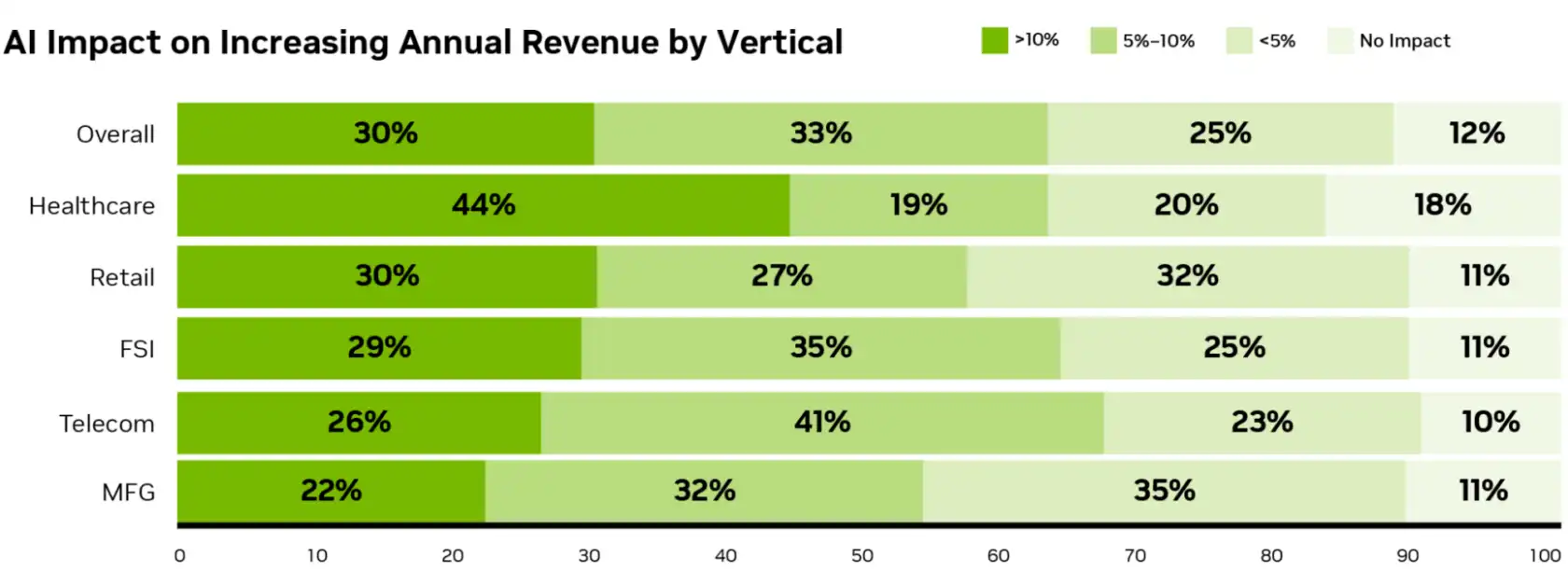
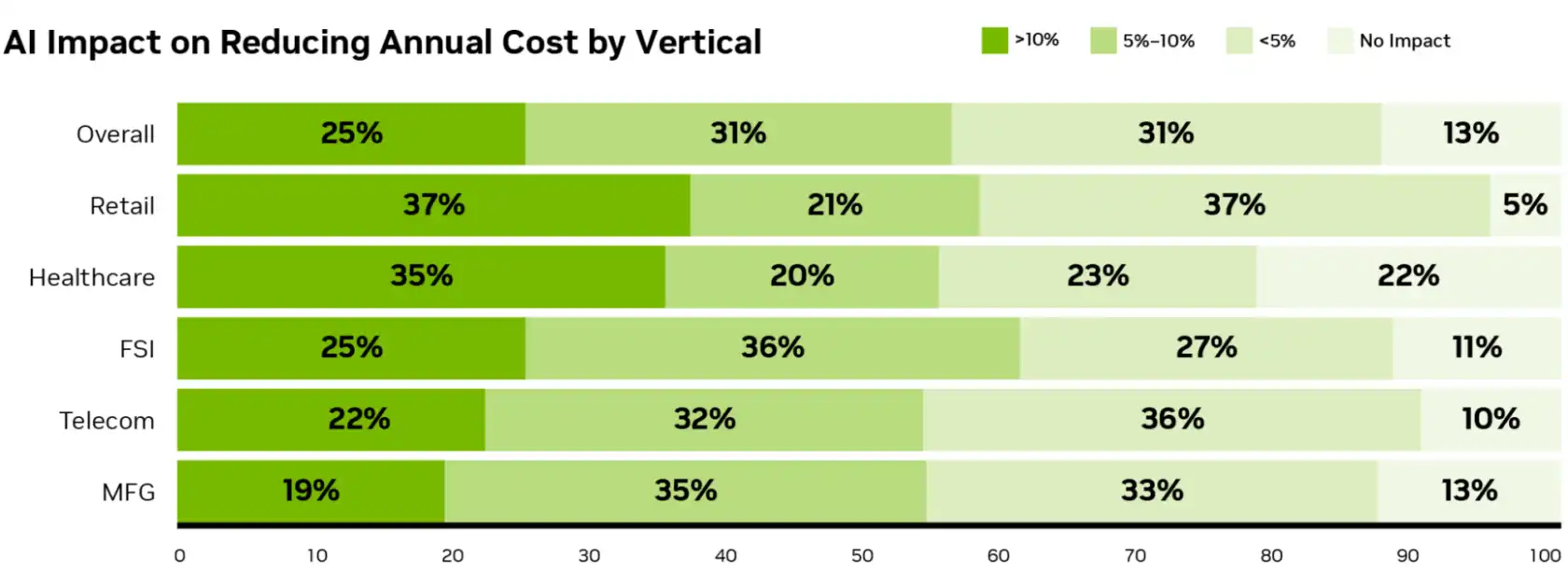
    The optimistic numbers are real, and they’re striking. Among the 3,200+ respondents surveyed between August and December 2025, 30% reported revenue increases exceeding 10%, with another 33% seeing gains between 5% and 10%. Cost reductions were nearly as widespread — 87% reported savings, and a quarter achieved cuts greater than 10%. In retail and consumer packaged goods, that figure climbed to 37%. These aren’t pilot results. They’re self-reported impacts from organizations with active AI deployments across financial services, healthcare, manufacturing, telecommunications, and retail.

    NVIDIA State of AI 2026: AI impact on increasing annual revenue by industry vertical — 88% report revenue growth
    88% of organizations report AI-driven revenue increases. Healthcare leads with 44% seeing gains over 10%. Source: NVIDIA State of AI 2026.
    NVIDIA State of AI 2026: AI impact on reducing annual costs by industry vertical — 87% report cost decreases
    87% report cost reductions from AI, with retail leading at 37% achieving cuts exceeding 10%. Source: NVIDIA State of AI 2026.

    The trouble is how those numbers were generated. Self-reported revenue impact and measured revenue impact are different things. When NVIDIA’s own survey shows that 48% of respondents struggle with data sufficiency, 38% lack the AI expertise they need, and 30% can’t quantify ROI at all, you have to ask: how confident are the other 70% in their numbers? The report doesn’t say. And that gap between perception and measurement is where billions of dollars in AI spending disappear every year.

    This isn’t a reason to dismiss the progress. Organizations like PepsiCo, which achieved a 20% throughput increase and 10-15% reduction in capital expenditure through AI-powered digital twins, demonstrate that AI can deliver measurable returns. Clinomic’s medical ICU assistant reduced documentation errors by 68% and clinical workload by 33%. These are concrete, instrumented outcomes. The question is why so many organizations can’t produce similar evidence.

    The Measurement Problem Gets More Expensive Every Quarter

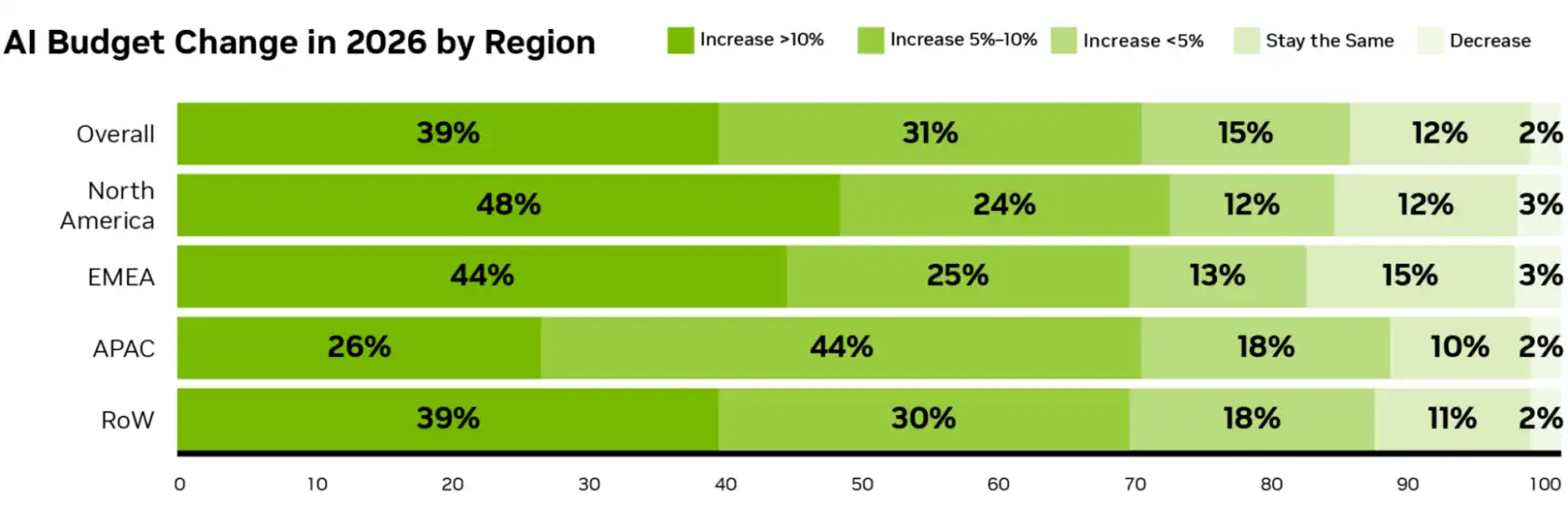
    Budget season makes the stakes concrete. Eighty-six percent of organizations are increasing AI budgets in 2026, with 40% planning increases of 10% or more. North American enterprises are even more aggressive — 48% are pushing budgets up by double digits. These aren’t exploratory budgets. They’re operational commitments that will demand operational proof.

    NVIDIA State of AI 2026: AI budget changes in 2026 by region — 86% increasing budgets, 48% of North America by 10%+
    86% of organizations are increasing AI budgets in 2026. Nearly half of North American enterprises plan increases of 10% or more. Source: NVIDIA State of AI 2026.

    The organizations that instrumented early have a structural advantage. Lowe’s built AI digital twins for more than 1,750 stores and can point to the cost of generating 3D product models — under $1 each — as a clear efficiency metric. Nasdaq constructed a proprietary AI platform and can trace its impact across both internal operations and external products. These companies didn’t stumble into measurement. They designed for it from the start, choosing specific outcomes to track before deploying the technology.

    The 30% without measurement infrastructure face a different budget conversation entirely. When the CFO asks what last quarter’s AI spend produced, “we believe it’s helping” isn’t an answer that protects next quarter’s allocation. As AI budgets grow, the metrics that matter to financial leadership become non-negotiable — and organizations without baselines can’t even begin that conversation.

    Agentic AI Makes the Gap Worse

    Perhaps the most forward-looking finding in the report: 44% of organizations are already deploying or actively assessing AI agents, with telecommunications (48%) and retail (47%) leading adoption. These aren’t chatbots answering customer questions. Agentic AI systems operate autonomously — making decisions, executing multi-step workflows, and interacting with other systems without human approval at every stage.

    That autonomy creates a measurement blind spot that assistive AI never did. When a human uses ChatGPT to draft an email, the value chain is short and visible. When an AI agent autonomously triages customer issues, escalates edge cases, updates CRM records, and triggers follow-up workflows, the value chain branches and compounds in ways that are nearly impossible to track without purpose-built instrumentation. If 30% of organizations can’t measure ROI on their existing AI tools, they’re not going to suddenly develop that capability for systems that are orders of magnitude more complex. Every autonomous decision an agent makes without measurement infrastructure is both an ROI blind spot and a risk exposure.

    What the Winners Did Differently

    A pattern emerges when you study the case studies NVIDIA highlights. PepsiCo didn’t deploy digital twins and hope for the best — they defined throughput improvement and capital expenditure reduction as target metrics before writing a line of code. Clinomic didn’t build a medical assistant and then try to figure out if it worked — they instrumented documentation error rates and clinician workload from day one. Lowe’s didn’t scale to 1,750 stores on intuition — they tracked cost-per-model as a unit economic that justified each expansion.

    The 30% who can’t quantify ROI didn’t fail at AI. They failed at instrumentation. They deployed capable technology without building the measurement layer that turns activity into evidence. And now, with budgets growing and boards asking harder questions, that gap is becoming a strategic liability. McKinsey’s latest research echoes this finding — organizations that establish clear performance metrics before scaling AI are significantly more likely to capture value across multiple business functions.

    The framework that separates measurement leaders from the rest follows a consistent pattern: first, establish visibility into what AI is actually doing across the organization; then, define the business metrics that matter for each use case; next, run structured evaluations against those baselines; and finally, use the evidence to make scale-or-sunset decisions. This See-Measure-Decide-Act cycle is what transforms AI investment from a faith-based initiative into a data-driven program.

    What to Do Before Your Next Budget Review

    The NVIDIA report makes one thing clear: the AI investment wave is not slowing down. With 86% of organizations increasing budgets and 44% moving into agentic AI, the volume of spending that needs justification is only growing. The organizations that thrive in this environment won’t be the ones with the most sophisticated models or the largest GPU clusters. They’ll be the ones that can answer, with precision, what their AI investments produced.

    If you’re in the 30% today, the path forward isn’t complicated — but it is urgent. Instrument before you scale. Establish baselines before your next deployment. Build measurement into your AI architecture the same way you’d build security into your cloud infrastructure: not as an afterthought, but as a foundational layer. The CFO will ask for proof. The board will ask for proof. Make sure you have it.

    Ready to close the measurement gap? Talk to an expert to see how Olakai gives you unified visibility, business-aligned KPIs, and ROI evidence across every AI tool in your enterprise.

  • What JP Morgan’s Agentic AI Rollout to 250,000 Employees Tells Us

    What JP Morgan’s Agentic AI Rollout to 250,000 Employees Tells Us

    JP Morgan Chase just gave 250,000 employees access to AI — and then announced it was moving to agentic AI, where those systems won’t just answer questions but execute complex multistep tasks autonomously. The bank’s vision: “Every employee will have their own personalized AI assistant; every process is powered by AI agents.”

    It’s the largest enterprise AI deployment publicly disclosed. And it raises a question every enterprise will face as AI scales: can governance keep pace with adoption?

    The Numbers Behind the Rollout

    The scale is worth pausing on. JP Morgan’s LLM Suite — an internal AI platform built on models from OpenAI and Anthropic — is available to the bank’s entire workforce except branch and call center staff. Of the 250,000 employees with access, 150,000 use it weekly. Half of those use it daily. The platform is updated every eight weeks with new enterprise data, creating a continuously evolving tool that gets more capable and more embedded in daily work with each cycle.

    Behind the platform sit 2,000 AI and machine learning specialists — 900 data scientists, 600 machine learning engineers, and 200 AI researchers — managing 600-plus production use cases. That’s a specialist-to-user ratio of roughly 1:125. Even with one of the largest enterprise AI teams in the world, JP Morgan has far more AI usage than any team can manually oversee.

    And that’s before agentic AI enters the picture.

    From Assistive to Agentic: A Governance Leap

    There’s a fundamental difference between assistive AI and agentic AI from a governance perspective. Assistive AI — the copilots, chatbots, and summarization tools that make up most enterprise AI today — operates in a request-response pattern. An employee asks a question, the AI responds, the employee decides what to do with the response. The human is in the loop for every decision.

    Agentic AI operates differently. An AI agent receives a goal, decomposes it into subtasks, executes those subtasks autonomously (potentially across multiple systems), and delivers a result. The human may not be in the loop for intermediate decisions. The agent might query a database, analyze the results, draft a recommendation, and send it to a stakeholder — all without human review of each step.

    JP Morgan described itself as “early in the next phase” of deploying agentic AI in late 2025. The use cases in banking are obvious: automated fraud investigation that pulls transaction records, cross-references patterns, and generates suspicious activity reports. Loan underwriting that collects applicant data, runs credit analysis, and produces risk assessments. Compliance monitoring that scans communications, identifies potential violations, and initiates review workflows.

    Each of these use cases involves an AI system making decisions — or heavily influencing decisions — about sensitive data, regulated activities, and consequential outcomes. Governing these systems requires fundamentally different controls than governing a chatbot that summarizes meeting notes.

    The Governance Challenge at 250,000 Users

    Scale compounds every governance challenge. Consider the numbers: 150,000 weekly active AI users generating millions of interactions. Each interaction potentially involves customer data, financial records, proprietary strategies, or regulated communications. The average organization already experiences 223 data policy violations involving generative AI per month. At JP Morgan’s scale, that number could be orders of magnitude higher.

    Then there’s the shadow AI problem. Research shows that 9% of employees now switch between personal and enterprise AI accounts — up from 4% in the previous period. At 250,000 employees, 9% represents 22,500 potential data leakage vectors. These are employees whose company-approved tools don’t meet their needs for convenience or functionality, driving them to seek alternatives that lack enterprise security and privacy controls.

    And the challenge deepens as AI moves from assistive to agentic. With assistive AI, governance can focus on what employees share with AI tools — input monitoring. With agentic AI, governance must also cover what AI systems do autonomously — output monitoring, decision accountability, and cascading action controls. An agentic AI system that autonomously initiates a trade, approves a credit application, or files a regulatory report introduces governance requirements that most enterprises haven’t even begun to design.

    How JP Morgan Is Approaching Governance

    JP Morgan’s governance structure provides a template — though it’s one built with resources few organizations can match.

    Platform centralization. Rather than allowing AI tool sprawl, JP Morgan channeled adoption through a single platform (LLM Suite). This centralization creates a single point of governance: access controls, data policies, usage monitoring, and audit trails all flow through one system. The alternative — employees using dozens of independent AI tools — makes governance exponentially harder because each tool has different data handling practices, different security models, and different audit capabilities.

    Model governance. The LLM Suite uses models from multiple vendors (OpenAI and Anthropic), updated every eight weeks. This multi-model strategy diversifies vendor risk while the regular update cycle ensures the platform stays current. But it also means continuous governance validation — every update cycle requires re-evaluation of model behavior, security posture, and compliance alignment.

    Use case-level oversight. Each of JP Morgan’s 600-plus production use cases is individually tracked and governed. This granularity matters because the governance requirements for a document summarization tool are fundamentally different from the governance requirements for a fraud detection agent. Use case-level governance allows risk-proportional controls — more oversight for high-stakes, high-sensitivity applications and lighter controls for low-risk productivity tools. Our AI risk heatmap approach follows the same principle.

    Dedicated governance functions. JP Morgan maintains a Model Risk Governance function that assesses each AI use case and a Firmwide Chief Data Officer responsible for data governance, quality, and access control. These aren’t part-time responsibilities added to existing roles. They’re dedicated functions with the organizational authority to block or modify AI deployments that don’t meet governance standards.

    The Workforce Reality

    Jamie Dimon has been unusually candid about AI’s impact on employment. In February 2026, he acknowledged that AI is already displacing workers at JP Morgan, stating the bank has “huge redeployment plans” to move affected employees to other roles. He’d previously called AI “possibly as transformational as the printing press, steam engine, computing, and the Internet.”

    JP Morgan isn’t alone. Bank of America, Citigroup, and Wells Fargo all projected lower headcounts for 2026, with AI-driven efficiency gains cited as a key factor. The financial services industry, with its high proportion of knowledge work and data-intensive processes, is one of the sectors most exposed to AI-driven workforce changes.

    This workforce dimension adds another governance requirement that most frameworks ignore: the responsibility to plan for displacement before it happens. JP Morgan’s approach — retrain and redeploy — is more thoughtful than many enterprises, but it still requires knowing which roles AI will affect, on what timeline, and at what scale. That knowledge comes from the same measurement infrastructure that proves AI ROI: if you can’t measure what AI is doing, you can’t project what it will change.

    What This Means for Other Enterprises

    Most organizations won’t deploy AI to 250,000 users overnight. But every organization scaling AI faces the same governance challenges JP Morgan faces — just at a different magnitude. The principles translate:

    Centralize AI access before you lose control. Once employees adopt dozens of independent AI tools, governing the ecosystem becomes nearly impossible. A platform strategy — even a modest one — creates the governance foundation that fragmented tool adoption destroys.

    Design agentic governance before deploying agentic AI. The gap between assistive AI governance (monitoring inputs) and agentic AI governance (monitoring autonomous decisions) is substantial. Organizations that deploy agentic AI with assistive-era governance will face accountability gaps when agents make consequential decisions without human oversight.

    Treat shadow AI as inevitable, not preventable. At any scale, some employees will use unauthorized AI tools. The governance response should be detection and redirection (identifying unauthorized tools and channeling users to approved alternatives), not just prohibition. Prohibition fails at scale because it creates friction that drives adoption underground.

    Start workforce planning now. If AI is going to change roles at your organization — and it will — the time to plan for redeployment is before displacement occurs, not after. That planning requires visibility into where AI is being used and how it’s changing work patterns — data that only comes from measurement infrastructure.

    JP Morgan’s rollout is a preview of what every enterprise AI program will eventually face: the governance challenge of AI operating at scale, across an entire workforce, with increasing autonomy. The question isn’t whether your organization will get there. It’s whether your governance infrastructure will be ready when it does.

    For a deeper look at the frameworks and readiness assessments for agentic AI deployment, Future of Agentic’s governance hub provides comprehensive resources. And our CISO governance checklist offers a practical starting point for security leaders.

    Scaling AI and need governance that scales with it? Talk to an expert to see how Olakai provides unified AI governance across assistive and agentic AI — before risk scales with adoption.