
Technology & Software
Run AI like the product line it’s becoming.
Tech companies are the biggest AI spenders and the biggest AI builders. Engineering teams burning token budgets, product teams shipping AI features, support orgs deploying customer-facing agents — all of it needs the same governance layer.
You’re not just using AI. You’re shipping it.
Your engineering teams are spending heavily on Cursor, GitHub Copilot, and Claude to ship faster. Most can’t tell you the ROI per developer or forecast next month’s token bill. The spend is real and growing — the visibility isn’t.
Your product team is shipping AI-powered features to customers. Your support org is running agents that handle thousands of conversations a day. Your CISO is asking which of those have a proper audit trail. Most AI governance vendors treat you like an enterprise buyer of AI tools. You’re also a builder — and that distinction matters.
By the Numbers
Engineering teams at high-growth tech companies report AI coding tool adoption across 60–80% of developers — but fewer than 1 in 5 can demonstrate the productivity ROI in a board meeting.
The companies that govern AI spend and output from the same platform are the ones that keep deploying. The rest stall at the budget review.
SaaS or on-prem — your architecture, your choice.
Most technology companies deploy Olakai as SaaS — up and running in hours, no infrastructure to manage. If your security policy, enterprise customer contracts, or data residency requirements call for something different, Olakai also runs inside your own AWS, Azure, or GCP tenancy, or fully on-premises. Same platform, same capabilities. The architecture fits your requirements, not the other way around.
- SaaS deployment: fastest time to value, no infrastructure overhead
- Private cloud or on-premises: available when SOC 2, data residency, or enterprise customer security requires it
- Source code, prompts, and agent logs stay in your chosen environment — never processed outside it
- Same governance capabilities and audit trails regardless of deployment model
Two lenses, one platform
Olakai is one platform, one data model, one set of controls. Olakai Agentic and Olakai Assistive are the two lenses you use to look at it — they share data, share context, and share Kai. What you see in one lens is immediately visible in the other.
Olakai Agentic
Measure AI coding tool ROI and govern every agent you ship, in one lens. Token spend by provider, team, and developer. Run-rate forecasting before the invoice arrives. Full execution audit trails and policy enforcement before a bad decision reaches a user. The observability layer your engineering and product teams need, from code to production.
Olakai Assistive
Track every AI tool your non-engineering teams are using — sales, marketing, support, operations. License utilization, shadow AI detection, time saved per workflow. The visibility your IT and security teams need before a compliance question lands on their desk.
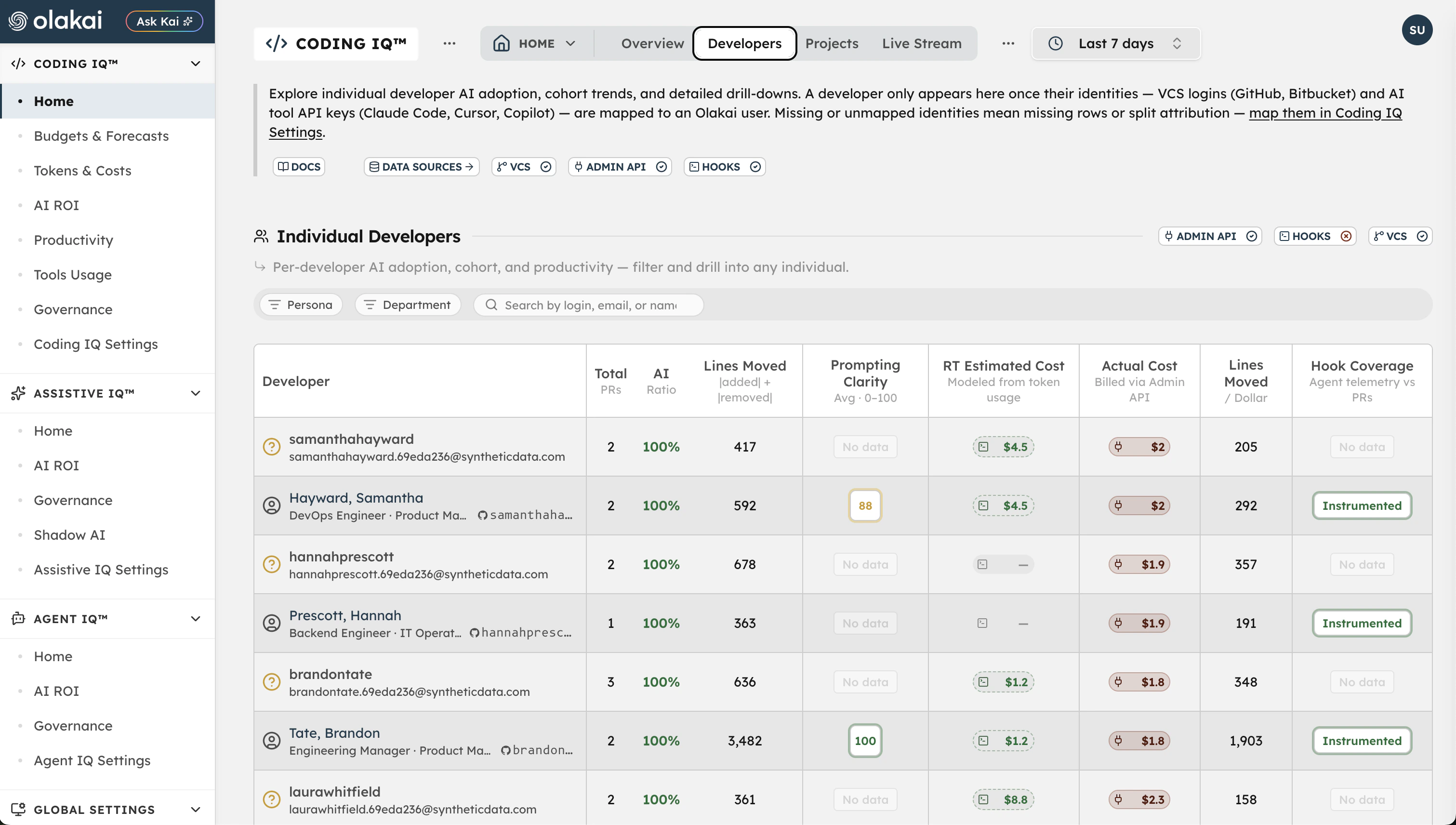
Olakai Agentic — Developer adoption
Find who’s getting value. Reclaim what isn’t.
Olakai Agentic segments every developer into one of four adoption cohorts — Power, Casual, New, or Idle — and shows you which tools they use, how often, and what their cycle time looks like against peers. Estimated and reconciled actual cost attributed per developer, side by side. The view that tells you exactly who to enable, who to train, and where to reclaim licenses before the next renewal.
- Power (>70% AI-assisted PRs), Casual (20–70%), New (first AI PR in 14 days), Idle (<20%) — segmented automatically
- Per-developer cost: estimated vs. reconciled actual, side by side
- Idle license identification before renewal — reclaim before the next contract cycle
Olakai Agentic — Production agent governance
Know what every agent you shipped is doing in production.
Olakai Agentic gives your engineering and product teams full visibility into every autonomous agent running in your environment — customer-facing chatbots, internal automation, AI features in your product. Every execution logged: inputs received, tools called, decisions made, outcomes produced. Policy enforcement at the workflow level means issues are caught before they reach users.
- Every agent execution logged end-to-end — inputs, tools, decisions, outcomes, latency
- Policy violations caught at the workflow level before user impact
- Audit-ready logs for enterprise customer security reviews and SOC 2 compliance
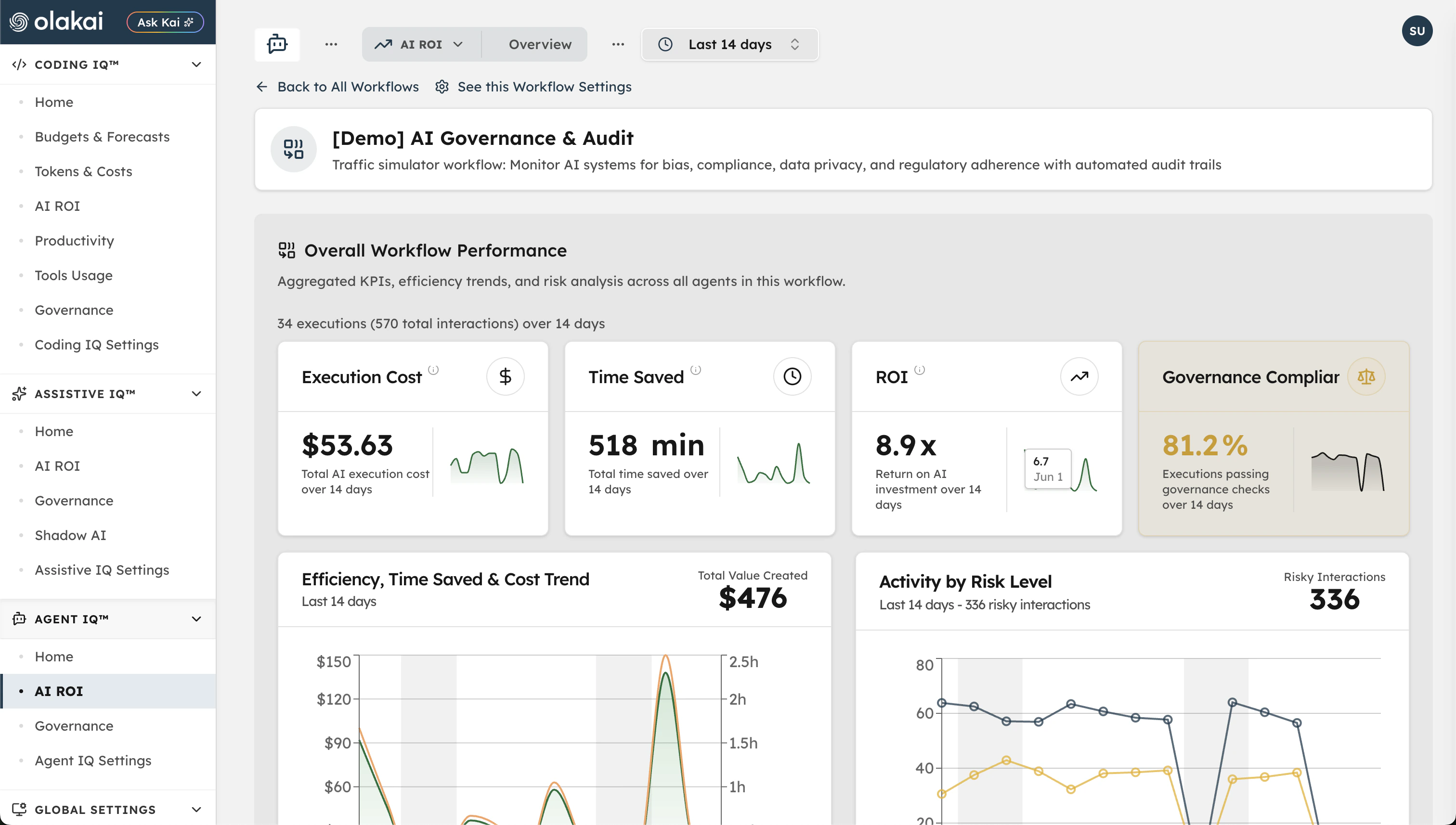
The KPIs that matter in technology & software
Every pillar gives you a different lens on AI performance. Here are the metrics Olakai actually measures — across every vendor, every team, across every vendor and team.
Olakai Agentic
Token spend by provider, team, and developer
Normalized across Cursor, Copilot, Anthropic, OpenAI in one view
Run-rate month-end forecast
Trajectory alerts at 50%, 80%, and 100% of budget — before the overrun, not after
Agent executions with complete audit trail per run
Every input received, tool called, decision made, and outcome produced
Policy violations caught before user impact
Enforcement at the workflow level — before the bad decision reaches a user
Olakai Assistive
Shadow AI tools in use across sales, marketing, support, and operations
By tool, team, and risk classification — a prioritized list, not just a count
License utilization
Active vs. idle seats across every approved tool, by team and by individual
Time saved per team member per week
Hours recovered from AI-assisted workflows, by role and department
Prompt policy compliance rate
Percentage of AI interactions that meet your data handling and usage policies
Why Measurement Changes Everything
From AI Spend Opacity to Engineering ROI
Token bills grow. Headcount stays flat. But “we spent $2M on AI coding tools” isn’t a ROI story. Olakai connects spend to output — PR velocity, cycle time, code quality — by team, by provider, by developer.
From Shipped Agents to Governed AI Products
Shipping an AI feature without an audit trail isn’t a tech debt problem — it’s a customer trust problem. Olakai gives every agent execution a complete log, so your enterprise customers can ask “what did your AI do?” and get an answer.
From Shadow AI Tolerance to Measured Adoption
“We know people use ChatGPT” is not a governance posture. Olakai shows you every tool in use across every team, quantifies the exposure, and gives you the data to decide what to sanction, what to govern, and what to turn off.
Ask your AI program a question. Get a reasoned answer.
Kai synthesizes every Olakai data source — spend, adoption, agent logs, governance status — and answers in plain English. With the reasoning shown and the data behind every number.
“Which AI coding tools are producing the fastest PRs, and what’s our cost per merged line of code?”
“Which agents running in our product environment have had policy violations in the last 30 days?”
“What’s our total AI spend this month across engineering, product, and support teams?”
Talk to an Expert.
See how Olakai gives your engineering and product teams one governed view across every AI coding tool, agent, and copilot you run — tailored to your stack, no pitch.