

A year ago, the knock on AI in finance was simple: it can’t do math. And honestly, the critics had a point. A University of Waterloo study found that GPT-4o got basic multiplication wrong more than 70% of the time. The internet’s favorite example was even simpler than that: ask ChatGPT how many R’s are in “strawberry” and it would confidently tell you two. For CFOs and finance leaders watching from the sidelines, the message was clear. If this thing can’t count letters, it’s not touching our books.
That was twelve months ago. The tools caught up faster than almost anyone predicted. Reasoning models, code execution, structured outputs, and vertical-specific AI applications have closed the gap between “can’t do math” and “cuts your financial close by a week.” And now we have the data to prove it.
Finance Is the Second-Biggest AI ROI Story Nobody’s Talking About
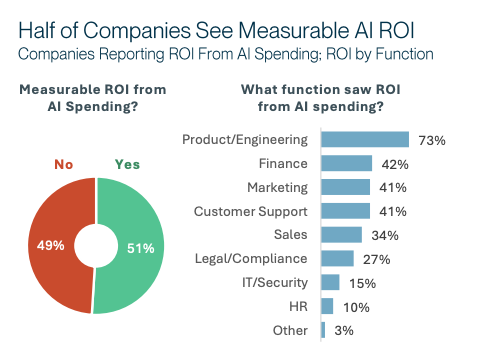
Silicon Valley Bank just published their 2026 State of the VC-Backed CFO report, surveying 230 finance leaders at high-performing venture-backed companies. The headline finding on AI: 51% of companies that budgeted for AI tools last year report measurable ROI from that spending. But the more interesting number is the breakdown by function.
Product and Engineering leads at 73%, which surprises no one. The AI coding assistant market has been the loudest story in enterprise software for two years. But right behind it, at 42%, is Finance. Ahead of Marketing (41%), Customer Support (41%), Sales (34%), and Legal (27%). Finance teams are quietly generating more measurable AI returns than almost every other function in the company, and the conversation hasn’t caught up yet.
Most of the media coverage, the conference panels, and the vendor marketing around AI ROI have centered on engineering productivity. That makes sense — that’s where the tooling matured first. But the SVB data tells a different story. The CFO’s office is becoming one of the most productive proving grounds for AI in the enterprise, and the returns are showing up in places that directly affect the bottom line.
Where AI Is Delivering Real Returns in Finance
So where exactly is the 42% coming from? The gains are concentrated in a handful of core finance operations that share a common trait: they’re repetitive, data-heavy, and historically consumed enormous amounts of skilled human time.
The monthly close. A joint study from MIT Sloan and Stanford GSB, published in August 2025, analyzed hundreds of thousands of transactions across 79 companies and found that AI cuts the monthly financial close by 7.5 days on average. For anyone who’s lived through the close process, that number speaks for itself. A week back is a week of analysis, planning, and decision-making that finance teams didn’t have before.
FP&A and forecasting. Financial planning and analysis teams are running forecast cycles 30-40% faster with AI-assisted modeling. The FP&A function has historically been one of the most strategic roles in finance but also one of the most time-constrained. When your team spends less time building the model and more time interpreting what it says, the quality of the output changes. According to a 2025 FP&A Trends survey, 53% of organizations still don’t use AI in any FP&A process, which means the early movers have a significant head start.
Accounts payable and cost analytics. McKinsey found that 44% of CFOs now use generative AI across five or more finance use cases, up from just 7% the year before. AP processing, cost analytics, variance analysis, and fraud detection are among the most common deployments. These aren’t moonshot applications. They’re the blocking and tackling of corporate finance, automated at scale for the first time.
The SVB report adds another layer to this: companies that reported ROI from AI in customer service applications showed the highest median revenue per employee at $327K, followed by Marketing at $311K and Finance at $259K. Finance may not top that particular metric, but the breadth of its AI adoption across multiple sub-functions — close, FP&A, AP, audit, compliance — makes it one of the most versatile AI verticals inside any company.
The Spending Is Accelerating. The Measurement Isn’t.
The SVB report reveals just how aggressively companies are investing in AI. Median spending on AI platforms and tools jumped from $2K in 2024 to $20K in 2025 — a 10x increase in a single year. CFOs expect that to double again to $50K in 2026. And 65% of the companies surveyed plan to spend more on AI this year than they spent on accounting software last year. That’s a striking data point. AI budgets are approaching parity with one of the most established categories in enterprise finance software.
But here’s the tension: while spending is doubling, only about half of companies can actually demonstrate that the investment is working. The other 49% are spending without a clear picture of return. This is a familiar pattern in enterprise technology adoption. The budget moves faster than the infrastructure to measure what it’s actually producing.
Deloitte’s Q4 2025 CFO Signals survey reinforces this gap. Among 200 North American CFOs at companies with $1B+ in revenue, 87% said AI would be “extremely or very important” to finance operations in 2026. Technology transformation displaced enterprise risk management as CFOs’ top priority for the first time. Yet only 21% of active AI users in finance said it had delivered clear, measurable value. The ambition is there. The measurement infrastructure, for most companies, is not.
This is the core problem we’re building Olakai to solve. Not running the AI, but giving finance leaders — and every other function — visibility into whether their AI investments are actually delivering returns. When you can measure AI ROI across tools, teams, and use cases from a single platform, the conversation with the board changes from “we think AI is working” to “here’s exactly what it’s producing.”
Why This Matters for CFOs and Board Members Right Now
The SVB data carries an implication that goes beyond operational efficiency. Companies that have demonstrated ROI from AI implementation are half as likely to have raised a bridge round or extension round in the last 12 months compared to those that haven’t. AI isn’t just saving time in the back office — it’s becoming a signal of operational discipline that investors are watching for.
Meanwhile, 91% of the VC-backed companies surveyed now encourage employees to use AI at work, up from 68% last year. One in three companies is already hiring fewer junior-level employees because of AI. The workforce implications are real and accelerating, and they’re landing squarely on the CFO’s desk — headcount planning, budget reallocation, productivity benchmarking, all of it.
For CFOs and board members who haven’t yet engaged deeply with AI in their own function, the SVB report should be a catalyst. The question is no longer whether AI can handle finance work. The “strawberry” era is over. The question is whether your organization can measure the value it’s already generating — and whether you can build the framework to prove ROI before your next board meeting.
Getting Started: Three Steps for Finance Leaders
If the SVB data resonates and you’re thinking about where to start, the playbook is more straightforward than it appears. First, audit what your team is already using. Gartner’s 2025 data shows that 59% of finance functions have already adopted some form of AI, but in many cases leadership doesn’t have full visibility into what tools are deployed, who’s using them, and what they’re accomplishing. Start with a visibility audit — you can’t measure what you can’t see.
Second, pick one high-volume process and measure it. The monthly close is the most obvious candidate based on the data, but AP processing and FP&A forecasting are equally strong starting points. Define a baseline, deploy an AI tool, and track the delta. The companies seeing 42% ROI in the SVB survey didn’t transform their entire finance stack overnight. They ran structured pilots, measured the results, and scaled what worked.
Third, build the measurement layer before you scale. The 49% of companies that can’t demonstrate AI ROI aren’t necessarily failing at AI — they’re failing at measurement. Put the infrastructure in place to track what your AI tools are doing across finance before you double the budget. That’s how you turn the SVB report’s 42% from a benchmark into a floor.
The CFO has always been the person in the room who measures everything — revenue, burn, margins, headcount efficiency. Now that same discipline needs to be applied to AI itself. The finance leaders who figure out how to measure their own AI investments are going to be the ones driving the next conversation with their boards.
Talk to an Expert about how Olakai gives finance leaders visibility into AI ROI across every tool and team.