

Your employees are using AI tools you don’t know about. Right now. They’re pasting customer data into ChatGPT to draft emails. They’re uploading financial documents to AI summarizers. They’re using unapproved coding assistants that send your source code to third-party servers.
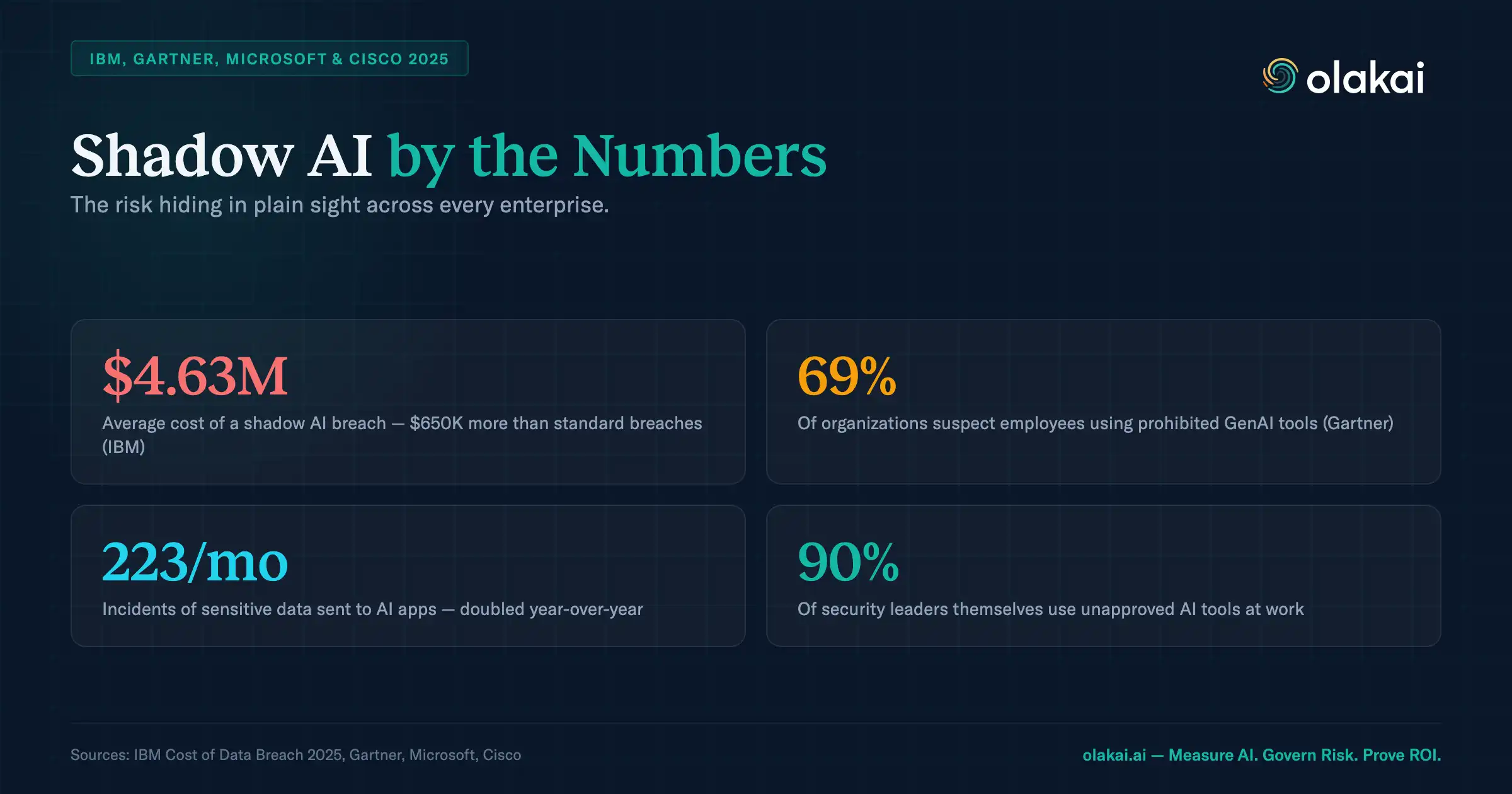
And the numbers are staggering. According to a Gartner survey of cybersecurity leaders conducted in 2025, 69% of organizations suspect or have evidence that employees are using prohibited public GenAI tools. Microsoft’s research found that 71% of UK employees admitted to using unapproved AI tools at work—with 51% doing so at least once a week. This isn’t occasional experimentation; it’s a systematic shadow operation running parallel to your official technology stack.
This is shadow AI—the enterprise AI equivalent of shadow IT—and it represents one of the most significant and underestimated risks facing organizations today.
What is Shadow AI?
Shadow AI refers to AI tools and services that exist outside your organization’s visibility and governance. They’re not approved by IT, security, or compliance teams. They’re not visible in your technology inventory. They’re not governed by your data protection policies. And they’re not monitored for security, compliance, or cost implications.
Just as shadow IT emerged when employees started using Dropbox, Slack, and other cloud tools without IT approval, shadow AI is spreading as employees discover that AI makes their jobs easier—regardless of whether it’s sanctioned. According to the 2025 State of Shadow AI Report, the average enterprise hosts 1,200 unauthorized applications, and 86% of organizations are blind to AI data flows. Nearly half (47%) of people using generative AI platforms do so through personal accounts that companies aren’t overseeing.
Why Shadow AI is Different from Shadow IT
Shadow AI carries risks that go beyond traditional shadow IT in fundamental ways.
Data goes out, not just in. When an employee uses unauthorized Dropbox, they might store company files externally—a risk, but a bounded one. When they use unauthorized AI, they actively send sensitive data to third-party models. That customer complaint they pasted into ChatGPT? It might be used to train the model, potentially surfacing in responses to competitors. According to Cisco’s 2025 study, 46% of organizations reported internal data leaks through generative AI—data that flowed out through employee prompts rather than traditional exfiltration.
Prompts reveal more than files. The questions employees ask AI reveal context that raw data doesn’t. “Summarize this contract and identify terms unfavorable to us” tells the AI (and its operator) not just the contract contents, but your negotiating strategy and concerns. The prompt itself is intelligence.
Answers drive decisions. When AI provides analysis or recommendations, employees act on them. An unauthorized AI tool giving bad financial advice, incorrect legal interpretation, or flawed technical guidance can lead to costly mistakes with no audit trail. And there’s no recourse when things go wrong.
The attack surface is enormous. Prompt injection, jailbreaking, and other AI-specific attacks create new vectors. An employee who pastes customer data into a compromised AI tool might unknowingly expose that data to attackers who’ve manipulated the model.
The Scope of the Problem
If you think shadow AI isn’t happening in your organization, the statistics suggest otherwise. Gartner predicts that by 2030, more than 40% of enterprises will experience security or compliance incidents linked to unauthorized shadow AI. That’s not a distant future risk—it’s the trajectory we’re already on.
The financial impact is real and immediate. According to IBM’s 2025 Cost of Data Breach Report, shadow AI incidents now account for 20% of all breaches and carry a cost premium: $4.63 million versus $3.96 million for standard breaches. AI-associated cases caused organizations more than $650,000 extra per breach. The gap between AI adoption and AI governance is where shadow AI thrives—and where the costs accumulate.
Perhaps most concerning: 83% of organizations operate without basic controls to prevent data exposure to AI tools. The average company experiences 223 incidents per month of users sending sensitive data to AI applications—double the rate from a year ago. And 27% of organizations report that over 30% of their AI-processed data contains private information, including customer records, financial data, and trade secrets.
Common Shadow AI Scenarios
These aren’t hypothetical risks. They’re happening in organizations like yours, every day.
The helpful marketer uses an AI writing tool to draft blog posts. She pastes competitor analysis, product roadmaps, and customer testimonials as context. The tool’s terms of service allow training on user inputs. Your competitive intelligence is now potentially in someone else’s model—or in their training data, waiting to surface in responses to your competitors.
The efficient developer uses an unapproved coding assistant to speed up development. He pastes internal API documentation and proprietary algorithms for context. The code generated might include those patterns in ways that constitute IP leakage, and the original code may be used for model training.
The overwhelmed HR manager uses an AI tool to help screen resumes and draft interview questions. She pastes candidate information, salary data, and performance review excerpts. She’s now exposed PII to an unapproved processor, potentially violating GDPR and internal policies—with no documentation of consent or processing basis.
The pressured analyst uses an AI tool to summarize earnings calls and model scenarios. He pastes material non-public information into prompts. If that information surfaces elsewhere—or even if someone later discovers it was processed through an unauthorized channel—it could trigger SEC scrutiny.
Why Traditional Controls Don’t Work
The approaches that worked for shadow IT often fail for shadow AI.
Blocking doesn’t scale. You can’t block every AI tool—new ones appear daily. Employees use personal devices. VPNs and proxies circumvent network controls. Small businesses face the highest risk, with 27% of employees in companies with 11-50 workers using unsanctioned tools. These organizations average 269 shadow AI tools per 1,000 employees while lacking the security resources to monitor them.
Policies aren’t enough. Acceptable use policies help, but they rely on employees reading, understanding, and following them. When AI makes someone dramatically more productive, policy compliance becomes an afterthought. According to research, 90% of security leaders themselves report using unapproved AI tools at work—with 69% of CISOs incorporating them into daily workflows. If the people writing the policies aren’t following them, you have a systemic problem.
Training has limits. Security awareness training can highlight risks, but it can’t prevent every incident. Employees under deadline pressure make expedient choices.
A Better Approach: Discovery, Governance, and Alternatives
Effective shadow AI management requires a multi-pronged approach that acknowledges human nature while protecting organizational interests.
Discovery: See what’s happening. You can’t govern what you can’t see. Modern shadow AI discovery involves monitoring network traffic for AI tool usage patterns, analyzing browser extensions and desktop applications, surveying employees about tools they’re using, and reviewing expense reports and credit card statements for AI subscriptions. The goal isn’t surveillance—it’s visibility. You need to know what’s being used so you can make informed governance decisions.
Risk assessment: Prioritize what matters. Not all shadow AI carries equal risk. Assess each discovered tool against data sensitivity (what data types are being processed?), regulatory exposure (does usage implicate GDPR, CCPA, HIPAA, or SOX?), vendor risk (what are the tool’s data handling practices?), and business impact (how critical is this tool to the workflow?). For a framework on matching governance to risk levels, see our AI risk heatmap approach.
Provide sanctioned alternatives. Heavy-handed blocking drives shadow AI underground. Instead, provide approved alternatives that meet employee needs: deploy enterprise AI tools with proper data protection, negotiate data processing agreements with AI vendors, configure guardrails like PII detection and content filtering, and communicate what’s available and how to access it. When approved tools are easy to use and meet employee needs, shadow AI becomes less attractive.
Continuous monitoring. Shadow AI isn’t a one-time problem to solve—it’s an ongoing challenge to manage. Establish regular discovery scans to identify new tools, usage monitoring for sanctioned tools, incident response procedures for policy violations, and feedback loops to understand why employees seek alternatives. According to Delinea’s 2025 report, 44% of organizations with AI usage struggle with business units deploying AI solutions without involving IT and security teams. That gap needs ongoing attention.
The Role of Governance
Ultimately, shadow AI is a symptom of governance gaps. Organizations that struggle with shadow AI often lack visibility (no central inventory of AI tools and usage), policy (no clear guidelines on acceptable AI use), process (no fast-track approval for low-risk AI tools), alternatives (no sanctioned tools that meet employee needs), and culture (no psychological safety to ask “Can I use this?”).
Building AI governance isn’t about creating barriers—it’s about creating clarity. Employees want to do the right thing. They just need to know what the right thing is. Our CISO governance checklist provides a comprehensive framework for building these foundations.
Getting Started
If you’re concerned about shadow AI in your organization—and if you’re paying attention to the statistics, you should be—start with a discovery exercise. Survey employees, analyze network traffic, review expense reports. Understand your current exposure before trying to solve it.
Assess risks by prioritizing discovered tools by data sensitivity and regulatory exposure. Focus governance efforts on highest-risk usage first—you can’t solve everything at once.
Provide alternatives by deploying sanctioned AI tools that meet legitimate employee needs. Make approved tools easier to use than shadow alternatives. If the official path is harder than the unofficial one, you’ll keep losing.
Build governance foundations through policies, processes, and monitoring. But start lightweight—you can add sophistication over time. Gartner also predicts that by 2030, 50% of enterprises will face delayed AI upgrades and rising maintenance costs due to unmanaged GenAI technical debt. Building governance now prevents that debt from accumulating.
Communicate clearly. Tell employees what’s approved, what’s not, and why. Create a safe channel to ask questions. The Future of Agentic use case library can help illustrate what good AI governance looks like in practice.
The Bottom Line
Shadow AI is already in your organization. The question isn’t whether it exists, but how you’ll respond. A heavy-handed approach drives usage underground. A permissive approach exposes you to risk. The right approach—discovery, governance, and alternatives—lets you get the benefits of AI while managing the downsides.
Want to understand your shadow AI exposure? Schedule a demo to see how Olakai helps enterprises discover, assess, and govern AI usage across the organization.