
Three out of four organizations say shadow AI is a problem. One in three doesn’t know whether they’ve already been breached because of it.
Those numbers come from the HiddenLayer 2026 AI Threat Landscape Report, released this month, which surveyed 250 IT and security leaders. The headline finding: 76% of organizations now cite shadow AI as a definite or probable problem. That’s up from 61% last year — a 15-point jump that represents one of the largest shifts in the dataset. And 31% of organizations don’t know whether they experienced an AI security breach in the past 12 months. Not “haven’t been breached.” Don’t know.
Shadow AI isn’t stabilizing. It’s accelerating.
What Changed in Twelve Months
The 15-point jump from 61% to 76% didn’t happen because security teams got worse at their jobs. It happened because AI tools proliferated faster than governance could follow.
In 2025, the AI coding tool market exploded. Cursor crossed $2 billion in annualized revenue. Claude Code hit $2.5 billion. GitHub Copilot remained embedded across enterprise engineering teams. Beyond development, ChatGPT, Gemini, Claude, and dozens of specialized AI tools became standard productivity enhancers for marketing teams, sales organizations, customer success groups, and finance departments. Each one represents a potential vector for unauthorized data flow.
The math is simple. More AI tools available means more tools employees will adopt without waiting for IT to evaluate, approve, and provision them. According to the 2025 State of Shadow AI Report, the average enterprise hosts 1,200 unauthorized applications. Nearly half of employees using generative AI platforms do so through personal accounts that companies can’t see or govern.
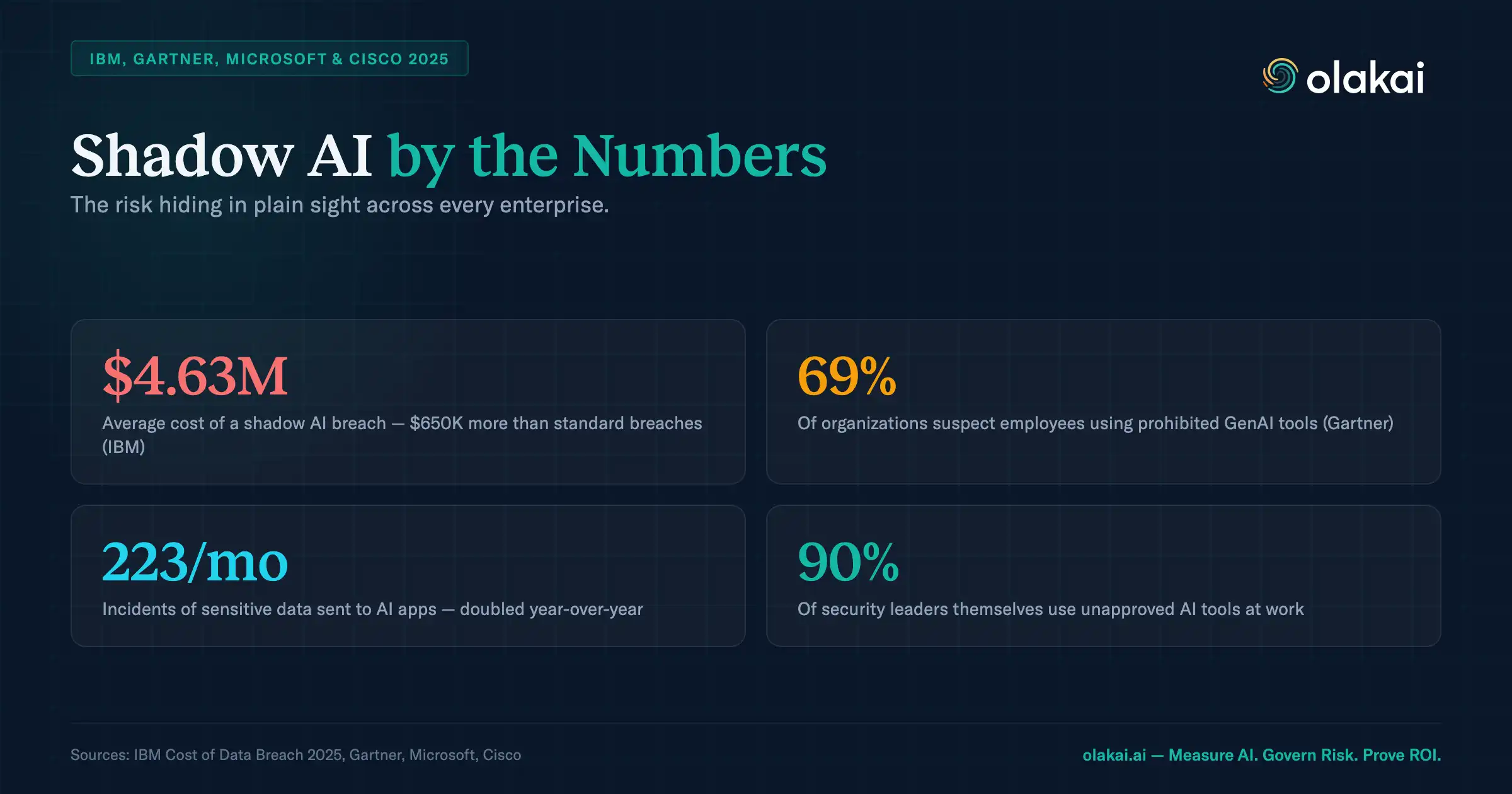
And the data exposure isn’t hypothetical. IBM’s 2025 Cost of a Data Breach Report found that one in five organizations reported a breach due to shadow AI, with those breaches costing $4.63 million on average — $670,000 more than standard breaches. Only 37% of organizations have policies to manage AI or detect shadow AI usage. The other 63% are flying blind.
Why Banning Doesn’t Work — and What Does
Every CISO who has tried to block AI tool access has learned the same lesson that IT leaders learned with Dropbox and Slack a decade ago: prohibition doesn’t eliminate usage. It eliminates visibility.
Employees route around restrictions because AI tools make them measurably more productive. The sales rep who uses AI to draft responses closes more deals. The developer who uses an AI coding assistant ships features faster. The analyst who uses AI for research produces better work in less time. Telling them to stop isn’t a governance strategy — it’s a talent retention risk.
The data backs this up. According to the 2026 CISO AI Risk Report from Saviynt, which surveyed 235 CISOs at large enterprises, 75% have already discovered unsanctioned AI tools running in production environments — and another 16% aren’t sure. Shadow AI ranked as CISOs’ number one risk concern, ahead of traditional threats like phishing and ransomware. Yet only 37% of organizations have policies to manage AI usage or detect shadow AI, according to IBM.
The answer isn’t better firewalls. It’s better alternatives. When organizations provide governed AI tools that meet the same needs employees are solving with shadow tools, unauthorized usage becomes unnecessary — not just prohibited. The problem isn’t employees wanting to use AI. The problem is organizations not giving them a governed way to do it.
The Costs You Can’t See
The financial cost of shadow AI breaches is quantifiable — $4.63 million per incident, according to IBM. But the costs that accumulate before a breach are harder to measure and potentially larger.
Data leakage at scale. When employees paste company data into ungoverned AI tools, that data flows to third-party servers that may retain it for model training. Customer records, financial projections, product roadmaps, and source code are all flowing through systems your security team can’t monitor. The Reco Shadow AI Report found that 86% of organizations are blind to AI data flows, and the average company experiences 223 incidents per month of users sending sensitive data to AI applications — double the rate from a year ago.
Compliance exposure that compounds. The EU AI Act’s provisions for high-risk AI systems take effect on August 2, 2026. Organizations using AI in hiring, credit decisions, healthcare, or safety-critical systems will need to demonstrate compliance with transparency, human oversight, and risk management requirements. If those AI systems include tools that were never formally evaluated or approved — shadow AI, in other words — demonstrating compliance becomes impossible. You can’t document controls for tools you don’t know about.
Licensing and IP liability. When AI tools generate outputs based on copyrighted training data, the liability for using those outputs falls on your organization. If a developer uses an ungoverned coding assistant that was trained on GPL-licensed code, and that code pattern ends up in your proprietary software, the legal exposure belongs to you — not the AI vendor and not the developer who used it.
Audit trail gaps. When regulators, auditors, or legal teams ask how AI is being used in your organization, you need a comprehensive answer. Shadow AI makes that impossible. IBM found that 97% of organizations that reported AI breaches lacked proper AI access controls. The breach isn’t the only problem — it’s the inability to explain what happened and why.
The Governance Playbook That Works
Effective shadow AI governance follows a sequence: Detect, Assess, Redirect, Monitor. Not “block everything” — but “see everything, govern what matters.”
Detect. You can’t govern what you can’t see. The first step is comprehensive discovery of AI tool usage across your organization — not just the tools IT provisioned, but the ones employees adopted on their own. This means monitoring network traffic patterns, analyzing browser extensions and desktop applications, reviewing SaaS procurement and expense reports, and surveying teams about their actual workflows. The goal is a complete inventory, not a witch hunt.
Assess. Not all shadow AI carries equal risk. An employee using ChatGPT to brainstorm blog post ideas is not the same as a developer pasting proprietary algorithms into an ungoverned coding assistant. Prioritize by data sensitivity, regulatory exposure, and business criticality. Our AI risk heatmap framework provides a structured methodology for matching governance intensity to actual risk levels.
Redirect. For high-value use cases discovered in the shadow, provision approved alternatives that meet the same need with appropriate controls. Enterprise versions of popular AI tools typically include data handling agreements, SSO integration, audit logging, and content filtering that their consumer counterparts lack. When approved tools are easy to access and meet employee needs, the incentive to use unauthorized alternatives disappears.
Monitor. Shadow AI isn’t a one-time problem to solve — it’s an ongoing condition to manage. New AI tools launch weekly. Employee needs evolve. Governance policies need continuous enforcement. Build continuous monitoring into your AI governance framework, with alerts for new unauthorized tools, data flow anomalies, and policy violations.
The Market Is Signaling
The venture capital and analyst community has noticed what enterprise security teams are experiencing firsthand. The AI governance market reached $492 million in 2026 and is heading toward $1 billion by 2030, according to Gartner estimates. That growth reflects a simple reality: organizations are realizing they can’t scale AI adoption without governance infrastructure to match.
A 2025 Gartner survey of 360 organizations found that enterprises using dedicated AI governance platforms are 3.4 times more likely to achieve high governance effectiveness than those relying on manual processes. Manual approaches — spreadsheet inventories, annual surveys, policy documents that nobody reads — worked when AI usage was limited to a few approved tools. They break down completely when every department in the organization is adopting AI tools at its own pace.
The organizations that figure out shadow AI governance first won’t just avoid breaches. They’ll move faster than their competitors because they’ll be able to say yes to AI adoption with confidence rather than defaulting to no out of fear. They’ll know which tools are delivering value, which ones create risk, and where to invest next. Visibility isn’t just a security capability — it’s a strategic advantage.
The 76% Is a Leading Indicator
When three-quarters of organizations acknowledge a problem and a third don’t know whether they’ve already been breached, we’re past the awareness phase. The question is no longer whether shadow AI is a risk. It’s whether your organization will address it before a breach forces your hand.
The path forward isn’t restriction. It’s visibility. See what’s happening. Assess the risk. Redirect usage to governed channels. Monitor continuously. The organizations that do this will turn shadow AI from a hidden liability into a governed advantage. The organizations that don’t will keep finding out the hard way — through breach reports, compliance failures, and audit findings that could have been prevented.
How much AI is running in your organization that you don’t know about? See how Olakai’s shadow AI detection gives you complete visibility across every AI tool your employees use. Schedule a demo to find out.