


“What’s the ROI on our AI investments?”
It’s the question every board asks, every CFO needs to answer, and every AI leader dreads. Despite billions invested in AI, most enterprises can’t answer it with confidence. Pilots proliferate, costs accumulate, and proof of value remains elusive.
The scale of this measurement gap is striking. According to McKinsey’s 2025 State of AI report, 88% of organizations report regular AI use in at least one business function. But only 39% report EBIT impact at the enterprise level. Organizations are spending on AI; they’re struggling to prove it’s working. S&P Global data shows that 42% of companies abandoned most of their AI projects in 2025—up from just 17% the year prior—often citing cost and unclear value as the primary reasons.
This guide provides a practical framework for measuring AI ROI—one that works whether you’re evaluating a single chatbot or an enterprise-wide AI program.
Why AI ROI Measurement is Hard
Before diving into the framework, it’s worth understanding why AI ROI is harder to measure than other technology investments.
Benefits are often indirect. When AI helps an employee work faster, the benefit shows up as productivity—not a direct cost reduction. Unless you’re tracking time saved and connecting it to business outcomes, the value remains invisible. The employee doesn’t disappear; they just do more. Proving the “more” matters requires discipline most organizations lack.
Costs are distributed across model APIs, infrastructure, development time, training, change management, and ongoing maintenance. Without careful tracking, it’s easy to undercount the total investment. The API costs are visible; the engineering time spent debugging prompt failures often isn’t.
Baselines are missing. How long did invoice processing take before AI? What was the error rate? Without pre-AI measurements, you can’t calculate improvement. Yet most organizations deploy AI first and ask measurement questions later—by which point the baseline is lost forever.
Attribution is complex. When a sales team closes more deals, is it the AI-powered lead scoring, the new sales methodology, the improved economy, or the new sales leader? Isolating AI’s contribution requires experimental rigor that few commercial settings permit.
The AI ROI Framework
Effective AI ROI measurement requires four components working together: quantifying value created, capturing total cost of ownership, calculating ROI with appropriate rigor, and benchmarking against meaningful comparisons.
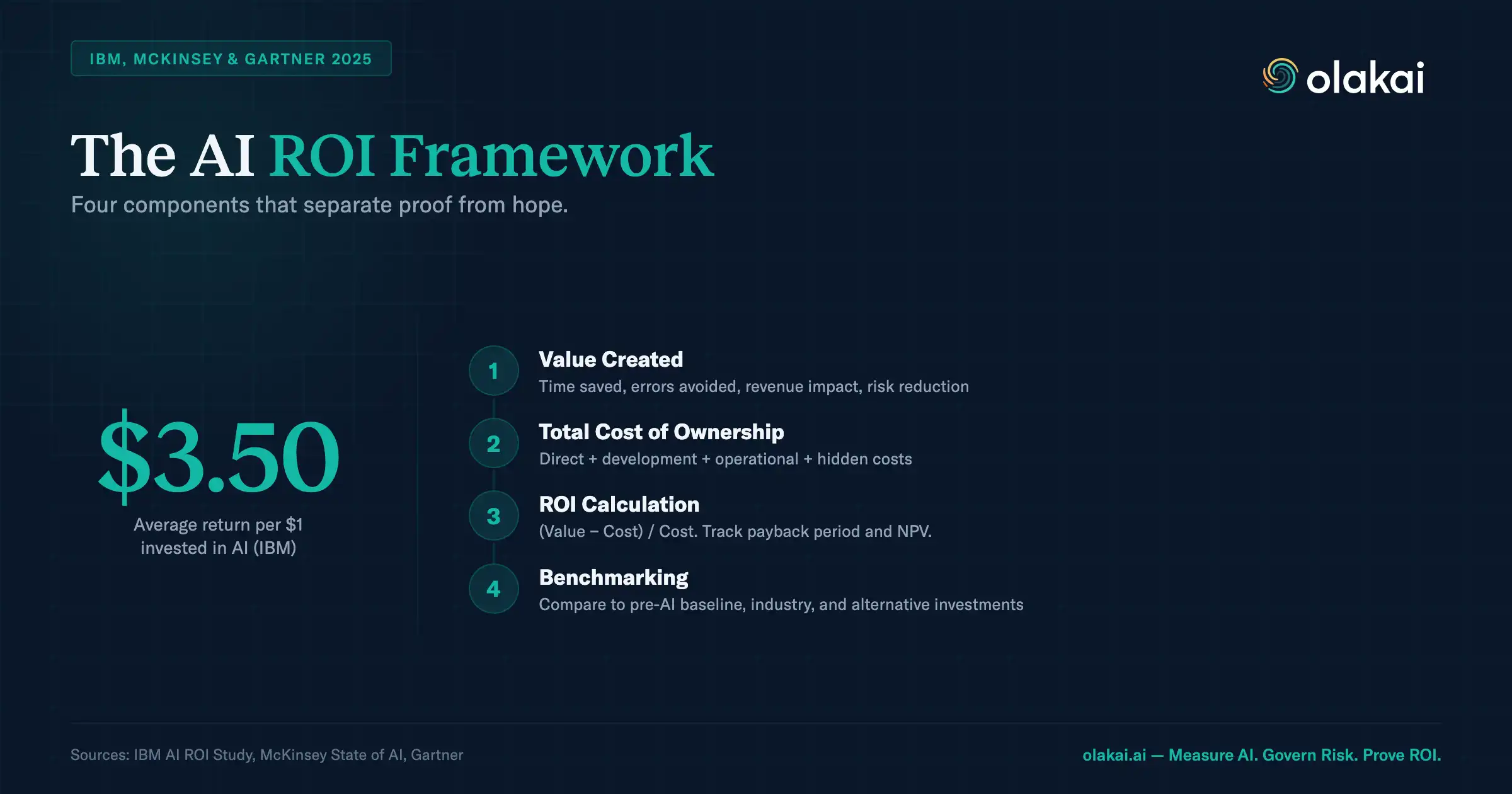
1. Value Created
Quantify the benefits AI delivers across four categories.
Time Saved: Calculate hours saved multiplied by fully-loaded labor cost. If an AI agent saves an accountant 5 hours per week on invoice processing, and that accountant costs $75/hour fully loaded, that’s $375/week or approximately $19,500/year in value. The formula is straightforward: hours saved per week times weeks per year times fully-loaded hourly cost. According to research, AI adoption is delivering 26-55% productivity gains for enterprises that measure carefully—but only if that saved time converts to productive work.
Errors Avoided: Calculate the cost of errors prevented. If AI reduces invoice processing errors from 5% to 0.5%, and each error costs $150 to correct, and you process 1,000 invoices monthly, that’s $675/month or approximately $8,100/year in avoided rework. The formula: error rate reduction times monthly volume times cost per error times twelve months.
Revenue Impact: For customer-facing AI, measure impact on conversion, upsell, or retention. If AI-powered lead qualification increases conversion from 3% to 4%, and average deal size is $50,000, and you process 100 leads monthly, that’s an additional $50,000/month or $600,000/year. This is where the biggest ROI potential lies—but also where attribution gets most difficult.
Risk Reduction: For governance and compliance use cases, calculate the expected value of risk reduction. If AI reduces the probability of a $1M compliance violation from 5% to 1%, the expected value is $40,000 annually. Risk reduction is real value, even though it’s harder to celebrate than revenue gains.
2. Total Cost of Ownership
Capture all costs associated with the AI investment—not just the obvious ones.
Direct costs include model API costs (per-token or per-call charges from AI providers), infrastructure (cloud compute, storage, networking), and software licenses (AI platforms, tools, orchestration software). These are the easy ones to track because they show up on invoices.
Development costs include engineering time spent building, integrating, and testing; data preparation including cleaning, labeling, and pipeline development; and training and prompting work to fine-tune models and optimize outputs. These costs often get buried in general engineering budgets where they’re invisible to ROI calculations.
Operational costs include maintenance (ongoing updates, monitoring, bug fixes), support (helpdesk and user support for AI tools), and change management (training, communication, adoption programs). Organizations consistently underestimate these ongoing costs.
Hidden costs include governance overhead (compliance, audit, risk management), opportunity cost (what else could the team have built?), and technical debt (costs of workarounds and shortcuts that accumulate). These rarely appear in ROI models but determine whether AI investments compound or drain resources over time.
3. ROI Calculation
With value and cost quantified, calculate ROI using the formula: value created minus total costs, divided by total costs, times 100. For a more complete picture, also calculate payback period (months until cumulative value exceeds cumulative cost), net present value (present value of future benefits minus present value of costs), and internal rate of return (discount rate at which NPV equals zero).
According to Gartner research, 45% of high AI maturity organizations keep initiatives in production for three years or more, compared to only 20% in low-maturity organizations. The difference isn’t luck—it’s rigorous measurement. IBM’s research found companies realize an average return of $3.50 for every $1 invested in AI, but that average masks wide variation between disciplined organizations and those hoping for magic.
4. Benchmarking
Context matters. Compare your metrics against pre-AI baseline (how did the process perform before AI?), industry benchmarks (how do similar organizations perform?), and alternative investments (what ROI could you get from other uses of capital?). Without benchmarks, even impressive-sounding numbers may represent underperformance.
Key Metrics by Use Case
Different AI use cases require different metrics. For customer support agents, track adoption rate (percentage of eligible users actively using the AI), task success rate (tasks completed without errors or escalation), cost per interaction (total cost divided by number of interactions), and user satisfaction (customer and employee ratings).
For invoice processing, track data extraction accuracy (percentage of fields correctly extracted), touchless processing rate (invoices processed without human intervention), exception rate (invoices requiring human review), and cost per invoice (target: $2-6 versus $15-25 for manual processing).
For sales research and lead qualification, track research completeness (required data points gathered), qualification accuracy (agreement with actual sales outcomes), time to completion (minutes from assignment to delivery), and intelligence freshness (average age of data sources).
For governance and compliance, track policy compliance rate (interactions complying with policies), shadow AI detection rate (unauthorized usage identified), and audit pass rate (success rate on AI-related audits).
Common Pitfalls
Avoid these mistakes when measuring AI ROI.
Counting activity, not outcomes: “The chatbot handled 10,000 conversations” sounds impressive—but did it actually resolve issues? Were customers satisfied? Did it reduce support costs? Activity metrics are easy to collect but often misleading. Focus on whether the activity produced the business outcome you wanted.
Overestimating time saved: “The AI saves 30 minutes per task” only matters if that time converts to productive work. If employees fill saved time with low-value activities—or if the organization doesn’t capture the savings through higher output—the benefit is illusory. Organizations getting good results invest 70% of AI resources in people and processes, not just technology, ensuring that time savings translate to business outcomes.
Ignoring maintenance costs: Pilot costs are easy to track; ongoing maintenance often gets lost in general IT budgets. Make sure you’re capturing the full lifecycle cost, including the engineering time spent fixing edge cases and handling failures.
Missing the baseline: Without pre-AI measurements, you can’t prove improvement. Establish baselines before deploying AI, not after. This is the single most common and most fatal measurement mistake.
Cherry-picking metrics: It’s tempting to highlight the metrics that look good and ignore the rest. Present a complete picture—including metrics that show room for improvement. Selective reporting destroys credibility when the full picture eventually emerges.
Getting Started
Ready to measure AI ROI? Begin by establishing baselines now—for any process you’re considering automating, measure current performance including time, cost, error rate, and volume before AI enters the picture.
Define success metrics upfront. Before deploying AI, agree on what success looks like. What specific metrics will you track? Who owns them? How will you report? McKinsey found that CEO oversight of AI governance is the factor most correlated with higher self-reported bottom-line impact—especially at larger companies where executive attention ensures metrics connect to outcomes that matter.
Instrument from day one. Build measurement into your AI deployment. Capture logs, track costs, and monitor outcomes from the start. Adding instrumentation after deployment is always harder than including it from the beginning.
Review regularly. AI ROI isn’t a one-time calculation. Review monthly, adjust for learnings, and report to stakeholders quarterly. Gartner found that 63% of leaders from high-maturity organizations run financial analysis on risk factors, conduct ROI analysis, and concretely measure customer impact—that discipline separates them from the majority still struggling to prove value.
Connect to business outcomes. Tie AI metrics to the numbers executives care about: revenue, margin, customer satisfaction, risk exposure. Technical metrics matter for optimization; business metrics matter for funding and support. The Future of Agentic guide to agent economics provides additional frameworks for connecting AI investment to business value.
The Bottom Line
Measuring AI ROI is harder than measuring other technology investments—but it’s not impossible. With clear frameworks, consistent measurement, and a focus on business outcomes rather than technical metrics, you can prove the value of AI investments and make informed decisions about where to invest next.
BCG research shows only 4% of companies have achieved “cutting-edge” AI capabilities enterprise-wide, with an additional 22% starting to realize substantial gains. The 74% struggling to show tangible value despite widespread investment aren’t failing because AI doesn’t work—they’re failing because they can’t prove it works. Measurement is the differentiator.
The enterprises that master AI ROI measurement will scale AI with confidence while others remain stuck in pilot purgatory.
Need help measuring AI ROI across your organization? Talk to an expert to see how Olakai provides the visibility and analytics you need to prove AI value and govern AI risk.