The Platform | The Products » Olakai Agentic · Olakai Assistive
One platform. Every AI interaction measured, governed, and costed.
Olakai captures what your copilots, AI coding tools, and autonomous agents actually do, normalizes it into one model, and turns it into the four answers every AI program owes the business: what it returned, what it cost, whether it stayed inside policy, and whether it made engineering faster. Vendor-neutral, deployed as SaaS or inside your own walls.
How it works
AI interactions from any source, turned into operational intelligence.
Olakai captures agent runs, prompts, pull requests, and workflow events from every AI source you run, normalizes them into a common model, stores them securely, and applies its Insights Engine to quantify usage, cost, quality, and outcomes. Those insights power the analysis and the controls: what to scale, what to cut, and which guardrails to enforce. Every number traces back to the interactions it came from, which is what makes it auditable. See how the data gets in.
Two products run on that one foundation. Olakai Agentic proves the ROI of every AI coding tool and governs every autonomous agent, across every team and provider. Olakai Assistive proves adoption, value, and policy across copilots, chat assistants, and AI-enabled SaaS. One platform, one model, one set of controls, and Kai to ask it questions in plain English.
Olakai Agentic
Every coding tool and every autonomous agent. Costed, measured, governed.
Usage-based pricing made AI coding tools the fastest-growing line in the engineering budget, and autonomous agents the hardest spend to see: a workflow that calls a model forty times a run has no seat and no invoice line. Olakai Agentic attributes every run and every token to a developer, a project, and an agent, forecasts the month before the invoice, measures the pull-request cycle time AI actually changed, and keeps the agents inside policy. AI coding tools and agent governance on one record.
Interactive example of the agent inventory: three multi-agent workflows drawn as orchestrator-to-worker trees, then the standalone and business agents. Circle area is value created; the outer ring is the share of runs at or above the risk threshold. Open the workflow table for the figures. Illustrative data from the Olakai demonstration environment, not customer data.
Agent topology, with value and risk
Orchestrators and their workers drawn as they run; circle area is value, the outer ring is the share of runs above the risk threshold.
Budgets and forecasts
Six overlapping budget lenses, a daily run-rate forecast with a confidence level, and alerts before the breach.
Cycle time, cost per PR, cohorts
AI-assisted against the rest on your own repos, Claude Code, Cursor, Copilot, Codex, and Gemini on one scorecard.
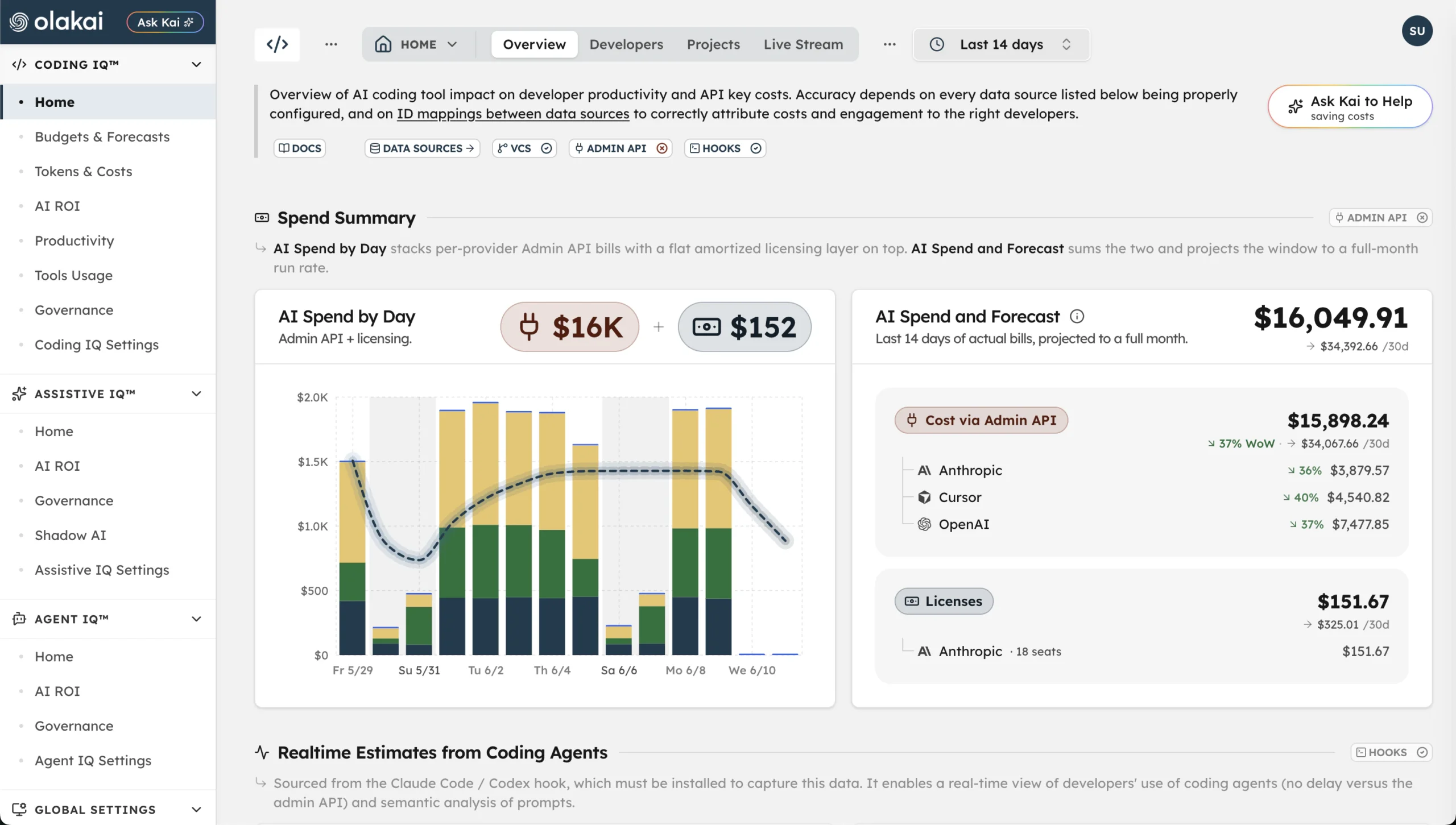
Olakai Agentic: AI coding tools
Are the coding tools making engineering faster, and what does each one cost?
The AI Impact Dashboard splits every merged pull request into AI-assisted and not, compares coding, review, and total cycle time between the two, and puts each developer in an adoption cohort. Beside it, spend by provider and model, budgets with alerts, and cost per PR per tool. Detection is passive, from GitHub and GitLab data; there is nothing to install on a developer’s machine.
- AI-assisted PR share, cycle time delta, and review time by team
- Spend by provider, model, developer, and project, reconciled to real bills where exposed
- Power, casual, new, and idle cohorts, with the idle-seat cost attached
Olakai Assistive
Every copilot, chat assistant, and AI-enabled app your people use. Including the ones nobody approved.
Olakai Assistive maps actual usage of ChatGPT, Claude, Microsoft Copilot, Gemini, and 1,100+ AI applications to the people, teams, and seats behind it. It converts the time saved into dollars, finds the idle seats and the oversubscribed apps, enforces acceptable-use policy and DLP at the point of use, and ranks each risk against the value at stake, so the answer to an unapproved tool can be yes, within limits. Olakai Assistive and shadow AI discovery on one record.
Interactive example of the unapproved-applications map. Each bubble is one AI application nobody approved, placed by people using it and interactions, on logarithmic axes, sized by volume; the pills filter by category; the table beneath records the recommended call for each group. Illustrative data from the Olakai demonstration environment, not customer data.
Discover everything
Unapproved applications plotted by people and interactions, sized by volume, with a licence, review, restrict, or standardize call for each.
Value and seat economics
Hours and dollars saved per person by team; seat return, idle seat cost, and light users from two sliders.
Policy and evidence
Plain-language policies evaluated on every interaction, DLP for prompts and uploads, and the audit trail kept.
Key features
The capabilities both products share.
Measure ROI
Prove AI value with outcome-driven analytics: time saved, dollars, AI Equivalent Engineers.
Govern Risk
Policy enforcement at the point of use, DLP for prompts and uploads, audit trails.
Agent IQ
Measure and govern every autonomous agent, from Agentforce and Copilot Studio to LangChain and CrewAI.
Custom KPIs
Dashboards and metrics for the outcomes your business actually counts.
Monitor AI
360° visibility across autonomous agents, coding tools, and AI-enabled applications.
Shadow AI
Detect and govern the AI tools nobody approved, across 1,100+ applications.
Integrations
VCS, coding tools, copilots, agents, model providers, and automation platforms.
Kai
Ask your AI program anything. Get a reasoned answer, and act on it, in seconds.
Core technology
From an interaction to a dollar figure, in four steps.
Olakai’s Insights Engine turns AI activity into business intelligence through a four-step pipeline. It augments every interaction with context: agent function, user role, department. Its models classify each one by task and subtask. It calculates the time saved against the traditional benchmark for that task. And it applies your organization’s wage configuration to translate hours into a defensible dollar figure, for every AI investment, at every level of the org.
One platform, every data source
Olakai connects to your AI stack however it is built: direct API and SDK integration, vendor admin APIs (Anthropic, OpenAI, Cursor, Google, GitHub Copilot), version control (GitHub, GitLab), automation platforms (Zapier, n8n), coding-agent hooks, and the browser extension. Every signal lands in the same model, so usage, cost, quality, and governance are one view rather than six.
Use cases